How the Ninth Came Together
A poem he had wanted to set for thirty years, a symphony that breaks its own rules in the final movement, and a premiere its composer could not hear — the making of the Ninth is the making of an idea Beethoven carried most of his life.
By the time Beethoven wrote the Ninth Symphony he had been deaf for years and had been carrying its central idea for decades. The finished work — the first symphony by a major composer to end in human voices — was less a sudden invention than the arrival of something he had been circling since his twenties.
The idea began with a poem. Friedrich Schiller's An die Freude — "Ode to Joy" — appeared in 1785, and Beethoven, still living in his native Bonn in the early 1790s, is reported to have wanted to set it to music almost as soon as he read it. He was in his early twenties. The setting that finally reached the concert hall came more than thirty years later. Few masterpieces have a longer fuse.
In the decades between, the poem surfaces and submerges in his sketchbooks like a melody he could not put down. There are trial "joy" tunes, experiments in how to carry Schiller's German, fragments that would end up belonging to entirely different pieces. In 1808 he wrote the Choral Fantasy, a strange hybrid for piano, orchestra and chorus whose closing theme is unmistakably a first draft of the Ode to Joy melody — a public rehearsal, sixteen years early, of the tune the world now knows. Beethoven did not compose the Ninth in a burst of inspiration. He assembled it, slowly, out of a lifelong preoccupation.
A commission, and a decision no one had made
The occasion came from abroad. The Philharmonic Society of London had offered Beethoven a commission for a new symphony, and that offer gave the long-gestating material a destination and a deadline. The bulk of the composition falls between 1822 and 1824, running in parallel with the enormous Missa Solemnis — two of the largest works of his life taking shape on the same desk at once.
The decision that made the Ninth unprecedented was structural. For three movements it is a symphony in the tradition Beethoven had already stretched further than anyone: a stormy opening in D minor, a hurtling scherzo, a slow movement of great tenderness. Then, in the finale, voices enter — a bass soloist, then the other soloists, then a full chorus — singing Schiller's words. No composer of stature had ended a symphony this way. Instruments had always been enough.
O Freunde, nicht diese Töne! — O friends, not these sounds!
He worried the problem for months. The sketches show him hunting for how to introduce the voices, how to justify so violent a break in the form. His solution was audacious: the finale opens by quoting and rejecting the themes of the three previous movements, in an instrumental recitative, before a human voice finally interrupts — with words Beethoven wrote himself, not Schiller's — to announce that a new kind of sound is needed. Only then does the Ode to Joy begin. The seam between symphony and song is not hidden; it is made the subject of the music.
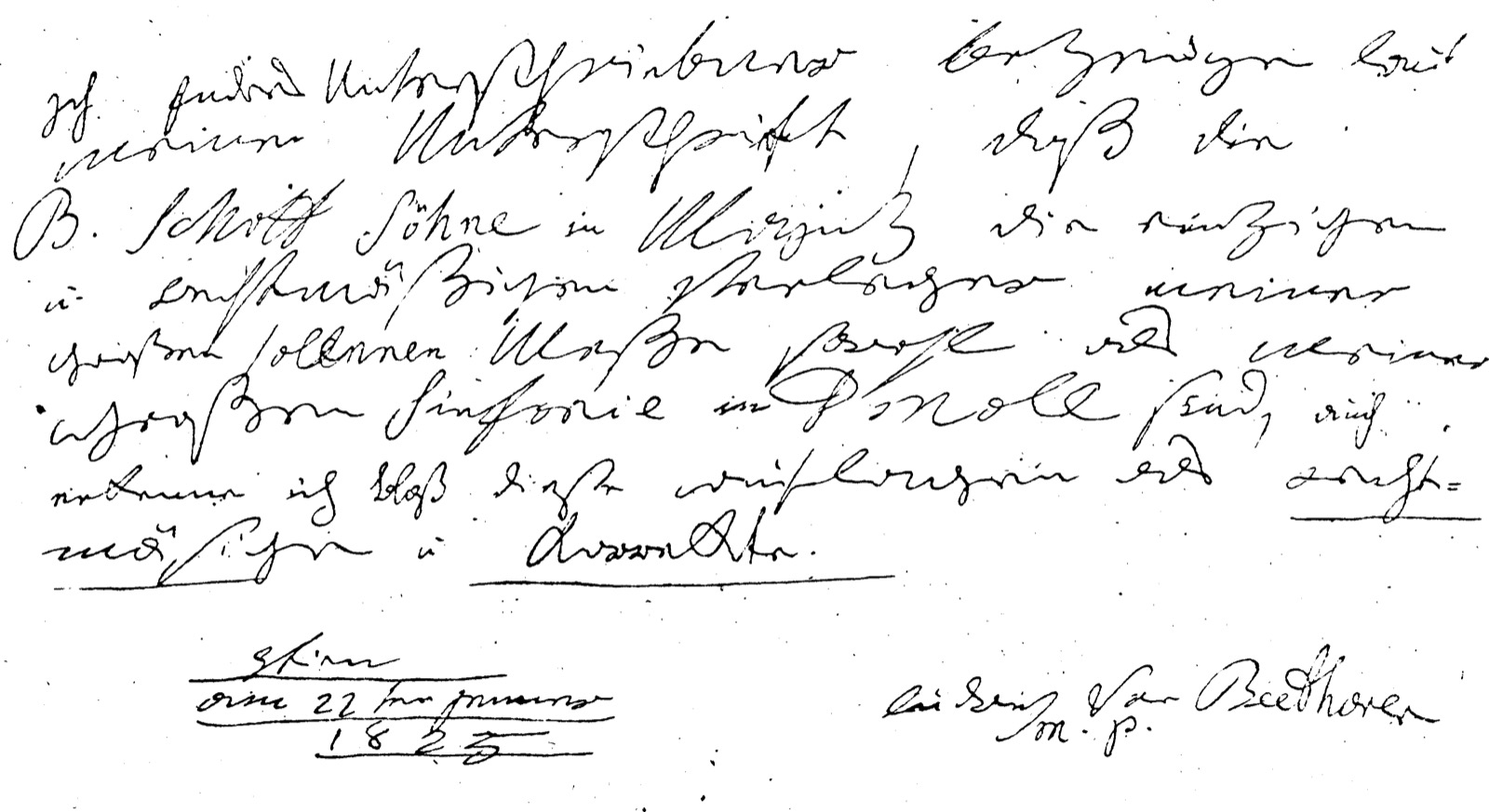
Beethoven's hand, 1824. He composed the Ninth almost entirely by inner hearing — the sound of the choral finale existed for him only in his head.
Composed in silence
The circumstance that hangs over the whole enterprise is that Beethoven could not hear it. His deafness had begun around 1798 and deepened relentlessly for two decades; by the 1820s it was effectively total, and he conducted his daily life through conversation books, written notes passed back and forth with visitors. The Ninth — with its four vocal soloists, its chorus, its vast orchestral climaxes — was written by a man working entirely from the sound as it existed in his mind. The manuscript is an act of pure interior audition. Nothing in it was ever checked against a real performance until the piece was finished.
The premiere he had to be turned to see
The Ninth was first performed at the Theater am Kärntnertor in Vienna on 7 May 1824. The official conductor was the house Kapellmeister, Michael Umlauf; the violinist Ignaz Schuppanzigh led the orchestra. Beethoven stood among the musicians, score open, beating time and marking the tempi — but the players had been quietly instructed beforehand to watch Umlauf and to ignore the composer, whose deafness made him impossible to follow.
When the music ended, Beethoven was still facing the score, still hearing nothing, and did not know the hall behind him had erupted. By the most enduring account, one of the soloists — the young contralto Caroline Unger — stepped over and gently turned him around so that he could see the applause he could not hear: the raised hands, the waving handkerchiefs, an ovation said to have exceeded even the three rounds protocol reserved for the emperor. It is one of the most retold scenes in the history of music, and its power is simple: the man who had just given the world a symphony about joy learned that it had landed only by watching a room he could not hear.
The work he had carried since his twenties, finished in total silence, ends with hundreds of voices singing about joy. That distance — between the condition it was made in and the thing it says — is much of why the Ninth still lands the way it does, two hundred years on.