One Must Imagine Sisyphus Happy
In 1942, Albert Camus published a novel and a philosophical essay in the same season — a fiction and its argument, designed to be read together. The question both of them answer is why, given the absurdity of existence, a person should bother to continue.
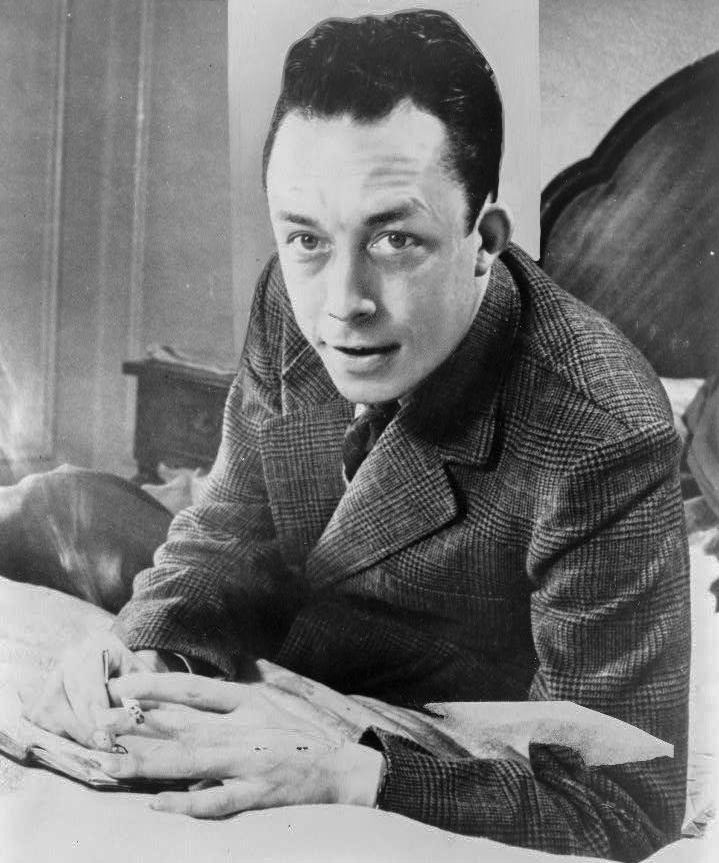
In 1942, Albert Camus published two books in the same season — a short novel and a philosophical essay — that he had conceived as a pair and worked on together over several years. The novel was L'Étranger (The Stranger), the essay Le Mythe de Sisyphe (The Myth of Sisyphus). Both were published in Paris under German occupation, by Gallimard, in a city where paper was scarce and the cultural life of France was threading itself through censors. Both were asking the same question: given that existence is absurd, what do you do with it?
Albert Camus was born in Mondovi, Algeria — now Dréan — in 1913. His father, a farm laborer, died at the Battle of the Marne in 1914, when Camus was less than a year old. His mother was nearly deaf, had never learned to read, and moved the family to a working-class district of Algiers, where they lived in poverty. Camus would later describe his childhood with a kind of clear-eyed affection that was itself part of his philosophical position: the poverty was real, and so was the light, and so were the beaches, and you could hold all of it at once without resolving it into either tragedy or gratitude.
He was a scholarship student — his primary school teacher, Louis Germain, recognized his ability and pushed for him to continue beyond the level his family's circumstances would otherwise have allowed — and he entered the University of Algiers on a partial scholarship to study philosophy. He was diagnosed with tuberculosis in 1930, at seventeen; the diagnosis interrupted his studies and would shadow his health for the rest of his life. He completed a degree in philosophy in 1936, then worked as a journalist, theater director, and writer in Algiers before moving to France.
Two books, one argument
Camus himself described his early work in terms of cycles. The first cycle — the cycle of the absurd — comprised The Stranger and The Myth of Sisyphus as its core, with the play Caligula also belonging to it. The second cycle would be about revolt: The Plague, The Rebel, The Just Assassins. He was thinking architecturally, in pairs of fiction and argument, novel and essay.
The Stranger was drafted in Algiers; Camus had been working on related material since around 1937 and 1938. The narrator is Meursault, an Algerian Frenchman who works in an office in Algiers, whose mother has just died in a care home. The novel opens with one of the most analyzed sentences in modern French literature: "Aujourd'hui, maman est morte. Ou peut-être hier, je ne sais pas." — "Today, mother died. Or maybe yesterday, I don't know."
Meursault does not weep at his mother's funeral. He drinks café au lait, smokes, and feels the sun. He begins a relationship with a woman, Marie. He attaches himself, through no particular intent, to a neighbor named Raymond, who has violent designs on a woman. On a beach, in the afternoon, in intense heat, Meursault shoots an Arab man — an unnamed figure identified only by his Arabness, which has drawn sustained critical attention since the 1960s. He fires once, then pauses, then fires four more times into the body.
Convicted of the wrong thing
In the second half of the novel, Meursault is tried for murder. What emerges is that the court is not primarily interested in the killing. It is interested in Meursault's emotional flatness at his mother's funeral — his failure to perform grief, to behave as a man who feels what men are supposed to feel. His indifference to social convention is the crime the court actually punishes. The killing is the occasion; the impassivity is what condemns him.
This inversion is the novel's philosophical center. The absurd, as Camus formulated it, arises from the collision between the human need for meaning and the universe's complete silence on the subject. Meursault does not experience this as anguish — he simply lives in it, without the social performance that normally covers the gap. The society around him cannot tolerate this. It needs the performance.
There is but one truly serious philosophical problem, and that is suicide.
The Myth of Sisyphus opens with this sentence and proceeds to spend its pages explaining why the answer is no — not because life is worth living in any conventional sense, but because suicide would be giving in to the absurd rather than living within it. The argument is not cheerful. Camus is not saying things are fine. He is saying that the honest response to the absurdity of existence is to continue anyway, without appeal to transcendence, without pretending the silence answers. The myth of Sisyphus — condemned by the gods to roll a boulder up a hill for eternity, only for it to roll back down — ends, in Camus's reading, with Sisyphus descending to the valley to begin again. "One must imagine Sisyphus happy."
Reception under occupation
Both books were published in Paris in 1942, while France was under German occupation. That Gallimard could publish them at all — with a Jewish protagonist's name on the cover of The Myth of Sisyphus (Camus had originally planned an essay on Kafka and the absurd) — required navigation through the occupation's cultural censorship. The Myth of Sisyphus was published with the essay on Kafka removed; Camus restored it in postwar editions.
Jean-Paul Sartre wrote a review of The Stranger in 1943, in the journal Les Cahiers du Sud, analyzing it with care and philosophical engagement. The review helped establish Camus's reputation among French intellectuals and launched a friendship between the two that would last, with increasing tension, for a decade. Their public rupture came in 1952 over Camus's book The Rebel, which Sartre and his circle found insufficiently committed to revolutionary politics. The break was bitter and complete. Sartre called Camus's reasoning confused; Camus thought Sartre had sacrificed honesty to ideology. They never reconciled.
He received the Nobel Prize in Literature in 1957, at forty-three — one of the youngest recipients. His acceptance speech in Stockholm described the writer's task in terms consistent with everything he had written since The Stranger: to serve truth and freedom, neither of which could be served by silence or by shouting, both of which required honesty about the conditions people actually lived in. He died three years later, with the novel he believed would be his best unfinished in his bag.
What the two 1942 books established — the fiction and the essay together — was a vocabulary for thinking about a question that had not previously had a name in French letters: how to live without illusion, and without despair, in a universe that offers neither explanation nor comfort. Camus's answer was not optimism. It was lucidity, and the refusal to look away from it, and the willingness to keep pushing the boulder.