Albert Camus
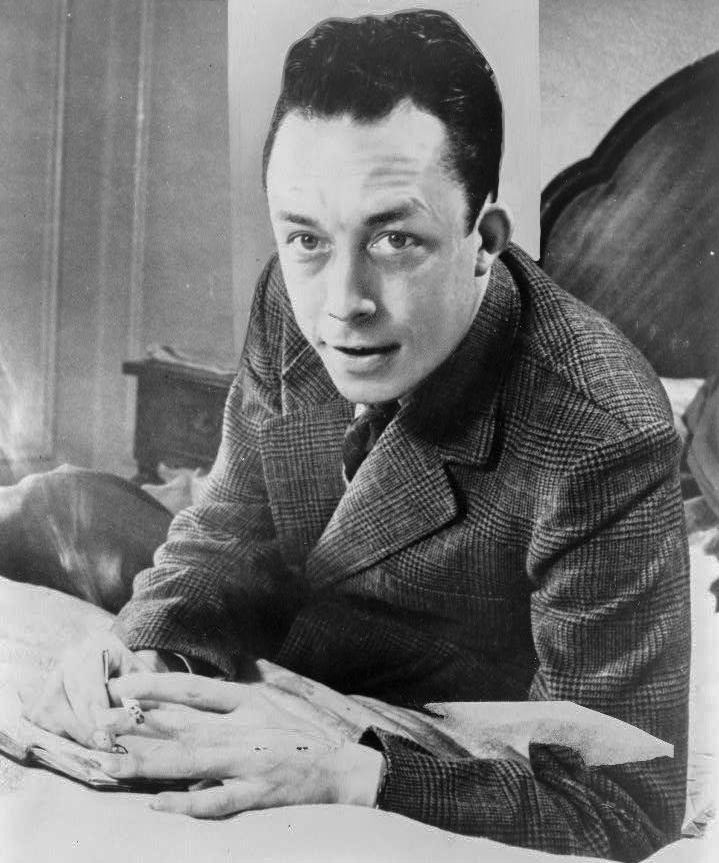
Born in colonial Algeria and shaped by poverty and Mediterranean light, Camus built an absurdist philosophy around the question of whether life is worth living — and answered yes, with clear eyes.
Albert Camus published his two most enduring works — the novel The Stranger and the essay The Myth of Sisyphus — in 1942, when he was twenty-eight years old and living under German occupation in France. Together they constituted a complete philosophical position: that human life has no inherent meaning, that this is a brute fact rather than a tragedy, and that lucid, defiant engagement with that fact is the only honest response. The Nobel Committee recognised him in 1957; he was dead three years later, at forty-six.
Origins
Camus was born on 7 November 1913 in Dréan (then Mondovi), French Algeria, to a working-class family. His father was killed in the First World War before Camus turned one. He grew up in Algiers in conditions of real poverty, raised by his mother and grandmother. The landscape of the Algerian coast — heat, sea, physical immediacy — runs through everything he wrote. He studied philosophy at the University of Algiers and was active in theatre and journalism before the war brought him to metropolitan France, where he worked for the clandestine resistance newspaper Combat.
Defining work
The Stranger (L'Étranger, 1942) opens with one of the most discussed sentences in twentieth-century literature and sustains throughout the flat affect of a narrator who kills a man on a beach and cannot perform the grief and remorse that society demands. The Myth of Sisyphus (1942), written in parallel, names and diagnoses the absurd — the confrontation between the human need for clarity and the world's refusal to provide it — and argues that the only philosophical question worth asking is whether suicide is the response it calls for. His answer is no: Sisyphus, condemned to push his boulder forever, must be imagined happy. The Plague (La Peste, 1947) shifted register to collective experience, using an Algerian epidemic as an allegory for occupation and resistance. The Rebel (L'Homme révolté, 1951) extended the argument into political philosophy and cost him his friendship with Sartre. The Fall (La Chute, 1956) was his last novel published in his lifetime.
Method and style
Camus wrote prose that was compressed, precise, and shaped by Mediterranean classicism rather than by the rhetorical density of existentialism proper. He was careful to distinguish his absurdism from Sartrean existentialism: where Sartre moved from the absurd toward commitment and meaning-construction, Camus held the absurd as a terminal condition to be inhabited rather than transcended. His journalism — he edited Combat through the Liberation — was declarative, short-sentenced, addressed to people making real decisions under pressure.
Legacy
Camus remains among the most widely read French authors of the twentieth century. His Nobel citation in 1957 recognised "his important literary production, which with clear-sighted earnestness illuminates the problems of the human conscience in our times." He died on 4 January 1960 when the car in which he was travelling left the road near Sens, in northern France. An unused train ticket was found in his pocket. The manuscript of an unfinished autobiographical novel, The First Man, was recovered at the scene and published posthumously.
"One must imagine Sisyphus happy."