My Client Is Not in a Hurry
Antoni Gaudí took charge of the Sagrada Família in 1883 and spent the rest of his life on it. He left no complete drawings. He believed the building would keep growing after him — and he was right. It is still not finished.
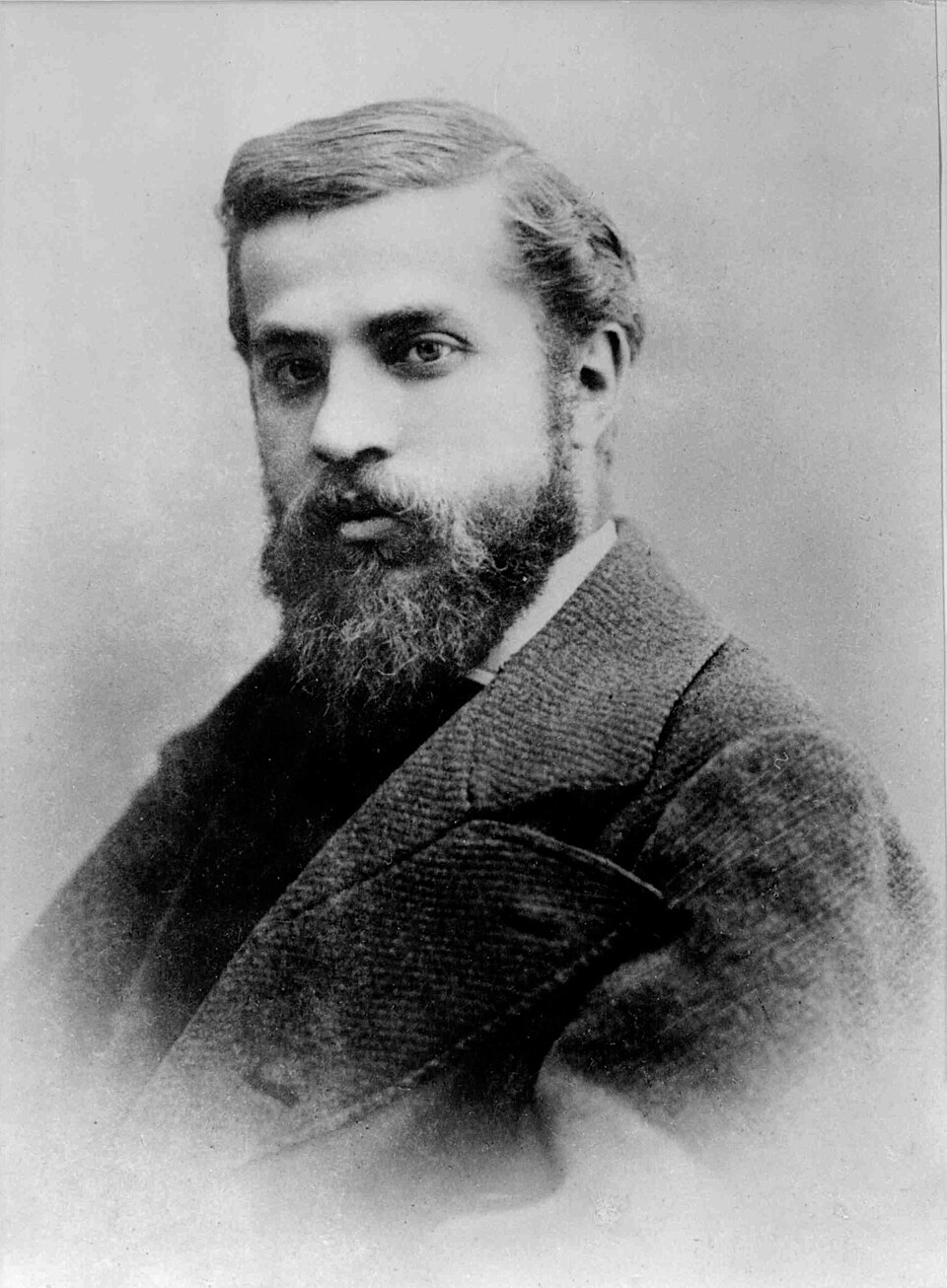
Antoni Gaudí took over the Sagrada Família in 1883, when the church was one year old and already going wrong. He was thirty-one, and what he inherited was a half-started neo-Gothic shell that had nothing to do with what he believed architecture could be. He spent the next forty-three years replacing it — building, rebuilding, calculating, praying — until a tram struck him on a Barcelona street and he died three days later. The church is still under construction. It will be, by some projections, the tallest church in the world when it is done.
The commission came from a private association, the Spiritual Association of Devotees of Saint Joseph, which had been raising funds since 1874 to build an expiatory church to the Holy Family in the Eixample district of Barcelona. The word expiatory matters: this was not a parish church or a cathedral, but a building whose very purpose was penance — paid for by voluntary donation, not the diocese, not the state. The first architect, Francisco de Paula del Villar, designed a conventional neo-Gothic crypt and resigned after a year over a disagreement about costs. The association turned to Gaudí, who had just finished his first significant commission, the Casa Vicens.
He accepted, and immediately understood the assignment differently from everyone else.
A building that could not be finished by one person
Gaudí did not try to produce a complete set of drawings from which builders could work. He never believed architecture could be fully captured in two dimensions. Instead he built physical models — intricate hanging chain models in which weighted cords, suspended from points on a board and allowed to droop under gravity, described the natural form of an arch. An arch that follows the catenary curve, the curve a hanging chain makes, requires no buttressing: it carries its load in pure compression, the way a stone naturally wants to work. Gaudí photographed these models, inverted the photographs, and read the resulting curves as the lines his vaults and arches would take.
The method was precise and empirical, but it was also inherently local — it described a relationship between forces, not a plan. No one could pick up Gaudí's models and know, without him, exactly what the finished building would look like. That was partly the point. He spoke of the building as a living thing, something that would grow and respond and be finished by people who were not yet born.
My client is not in a hurry.
The remark was his answer to anyone who pressed him on when the Sagrada Família would be complete. The client was God. God had no deadline. The church would take as long as it took.
What he was designing
The plan Gaudí developed — evolving continuously until his death — called for eighteen towers. Twelve for the apostles, four for the evangelists, one for the Virgin Mary, and the central tower of Jesus Christ, which would reach 172.5 metres when complete, a metre shorter than Montjuïc hill by Gaudí's own insistence: nothing built by human hands should overtop the natural landscape of Barcelona.
Three facades face three compass points. The Nativity facade, on the east, was the one Gaudí worked on most directly — its surface dense with carved stone, foliage, animals, figures from scripture, all in a geological profusion that later critics would describe as simultaneously Gothic and something else entirely, something for which there was no previous name. The Passion facade, to the west, was not begun until after his death; its sculptor, Josep Maria Subirachs, gave it a geometric austerity that Gaudí had not specified and that remains controversial. The Glory facade, the main entrance to the south, is still being built.
The interior structural system is what separates the Sagrada Família most radically from its predecessors. Traditional Gothic churches use flying buttresses — external stone arms that prop the walls against the outward thrust of the vaults above. Gaudí hated flying buttresses. He called them crutches. His solution was to branch the interior columns like trees, angling them so that the forces from the roof travel down through the column branches rather than pushing outward against the walls. The building supports itself from within, without external props. The roof thus becomes a stone forest, the columns rising to branch and fork before meeting the vaulted ceiling far above.
The last twelve years
In 1914, after completing work on other projects — the Park Güell, the Casa Batlló, the Casa Milà — Gaudí ended his private commissions entirely and moved his workshop into the crypt of the Sagrada Família. He was sixty-two. He would spend the remaining twelve years of his life on nothing else.
His habits grew severe. He ate little, dressed poorly, and walked from his studio to the church each day in clothes so worn that he was sometimes mistaken for a beggar. He refused fees; everything went back into the building. His personal life was long since stripped to almost nothing — his niece Rosa, who had kept house for him, had died in 1912; his friend and patron Eusebi Güell died in 1918. He had no heirs and no plans for his own future. The building was his entire remaining business.
On 7 June 1926, Gaudí left the church after his afternoon's work and walked toward the city centre, as he often did, to pray at the church of Sant Felip Neri. At the intersection of the Gran Via de les Corts Catalanes and Carrer de Bailèn, he was struck by tram number 30. He fell in the road. Passers-by, seeing a poorly dressed old man with no papers on him, assumed he was a tramp, and it was some time before anyone summoned adequate help. He was taken to the Santa Creu hospital — the hospital for paupers — and lay there for three days. By the time his identity was confirmed and his friends arrived to transfer him to a better clinic, he refused: he wanted to die among the poor. He died on 10 June 1926.
He was buried in the crypt of the church he had spent his life building.
What was lost, and what survived
Ten years after Gaudí's death, the Spanish Civil War reached Barcelona. In July 1936, anarchists burned the workshop attached to the church and smashed its contents. Gaudí's plaster models — the primary record of his intentions for the unbuilt sections — were destroyed or badly damaged. What survived were fragments, photographs, and the building itself: the Nativity facade, the crypt, the four towers of the Nativity transept, some of the interior columns.
The reconstruction of Gaudí's plans from the surviving fragments became a decades-long scholarly and architectural project. The architects who succeeded him worked to extrapolate from the physical evidence what the full building would have been. It is impossible to know with certainty how close the current construction is to what Gaudí would have made — the digital modelling tools now used to compute the complex geometries of the vaults are, paradoxically, far more powerful than anything he had, and yet their output is only an interpretation of his surviving intentions.
The building continued through the Franco years, the transition to democracy, and into the twenty-first century, funded by entrance fees and private donations, without a peseta of public money — maintaining the original condition of the association that began it. The projected completion date has been revised many times. A consecration of the central nave took place in 2010, performed by Pope Benedict XVI. The towers of the evangelists and the Virgin Mary rose through the 2020s.
Gaudí said the building would take two centuries to complete. He was more or less right about the time if not the arithmetic. The tram that killed him stopped him from seeing any of the nave he designed, any of the forest of columns, any of the interior light. What he left was a project that required other people to finish it on terms he could not fully specify — a building designed to grow beyond any single person's knowing. That it has, and that it remains unfinished more than a hundred years after his death, is not a failure of the project. It was the condition he set.