The Notes That Outgrew the Paper
Asked only to translate a French paper on a machine that did not yet exist, Ada Lovelace answered with a set of annotations three times longer — and quietly turned a calculating engine into a general one.
In 1842 a young mathematician was handed a routine job: translate an Italian engineer's French account of a machine that had never been built. She returned it a year later with a set of appended notes so far-reaching that they, and not the paper, became the founding document of computing.
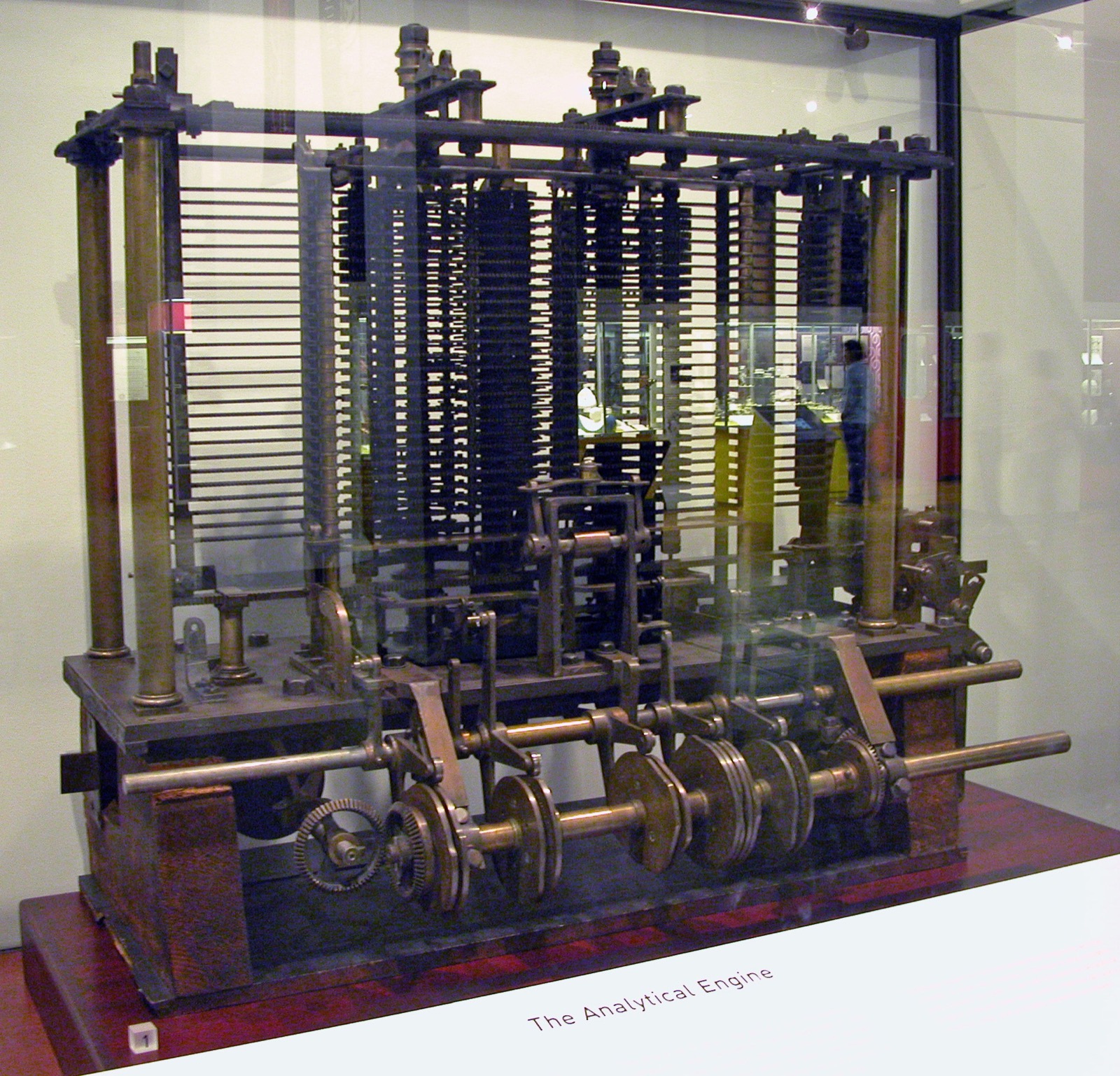
The machine was Charles Babbage's Analytical Engine — a general-purpose mechanical computer, designed in extraordinary detail but never completed, that would read its instructions from punched cards borrowed from the Jacquard loom. Its arithmetic would happen in a unit Babbage called the mill; its numbers would wait in a store. In outline it is the architecture of a modern computer, worked out in brass a century early. Babbage had described it in a series of lectures in Turin in 1840, but he never wrote the machine up himself in any sustained way. That task fell, by an accident of circumstance, to someone else.
How the job reached her
Lovelace had known Babbage since 1833, when, at seventeen, she was taken to see the working portion of his earlier Difference Engine and understood at once what most guests treated as a parlour curiosity. She had been schooled in mathematics from childhood — unusually for a woman of her class — and she pursued it as an adult, tutored by correspondence by the logician Augustus De Morgan, who thought her capable of original work. She described her own cast of mind as that of "an Analyst and Metaphysician," and meant both halves.
The Turin lectures were written up by Luigi Federico Menabrea, an Italian military engineer and future prime minister of Italy, and published in French in 1842. When the paper needed an English translation, the physicist Charles Wheatstone — a friend of Lovelace's — suggested she was the right person for it. She was fluent in the mathematics and trusted by Babbage himself. She took the work on.
A translation that would not stay a translation
She translated the paper. Then, at Babbage's suggestion, she began adding notes of her own, lettered A to G. She worked through 1842 and into 1843, and by the time she finished, the notes ran to roughly three times the length of the original text. More importantly, they were doing something the original had not attempted: they were reasoning about what such a machine could mean.
The Analytical Engine weaves algebraical patterns just as the Jacquard-loom weaves flowers and leaves.
Menabrea had described a superior calculator. Lovelace described something else. In Note A she drew a distinction that had escaped almost everyone, Babbage included: the engine did not have to operate on numbers at all. If a thing — a pitch, a relationship, a rule of harmony — could be represented by symbols, and if the rules for combining those symbols could be stated exactly, then the engine could operate on it. She reached for music as her example: were the fundamentals of composition reducible to such rules, the machine "might compose elaborate and scientific pieces of music of any degree of complexity or extent."
That sentence is the hinge of the whole document. It is the moment a calculating machine becomes, on paper, a general one.
Written by correspondence, under pressure
The notes were not composed in tranquillity. Through 1843 Lovelace and Babbage exchanged a stream of letters — drafts, corrections, sharp disagreements over proofs and over who was responsible for what — as the paper moved toward print in Taylor's Scientific Memoirs. Babbage supplied material and argument; the structure, the framing, and the philosophical reach of the notes were Lovelace's, and she defended them line by line. In one letter she scolds him for muddling her instructions; in another she lays out, with real steel, the terms on which she would continue.
The collaboration nearly broke. Babbage wanted to attach an unsigned preface attacking the British government for its treatment of his funding. Lovelace, who had done the work and would carry the paper's reputation, refused to let her notes go out fronted by an anonymous grievance. The dispute went to the edge of withdrawal before a compromise held. The episode is worth remembering because it cuts against the myth of Lovelace as a decorative amanuensis: she was the one who decided what the document would and would not be.
She signed the work only with her initials, "A.A.L." — the convention for a woman of her rank publishing science — and it appeared in September 1843.
The only part of the Analytical Engine Babbage built in his lifetime — a trial assembly. The complete machine existed on paper, and in Lovelace's notes, alone.
What she had actually made
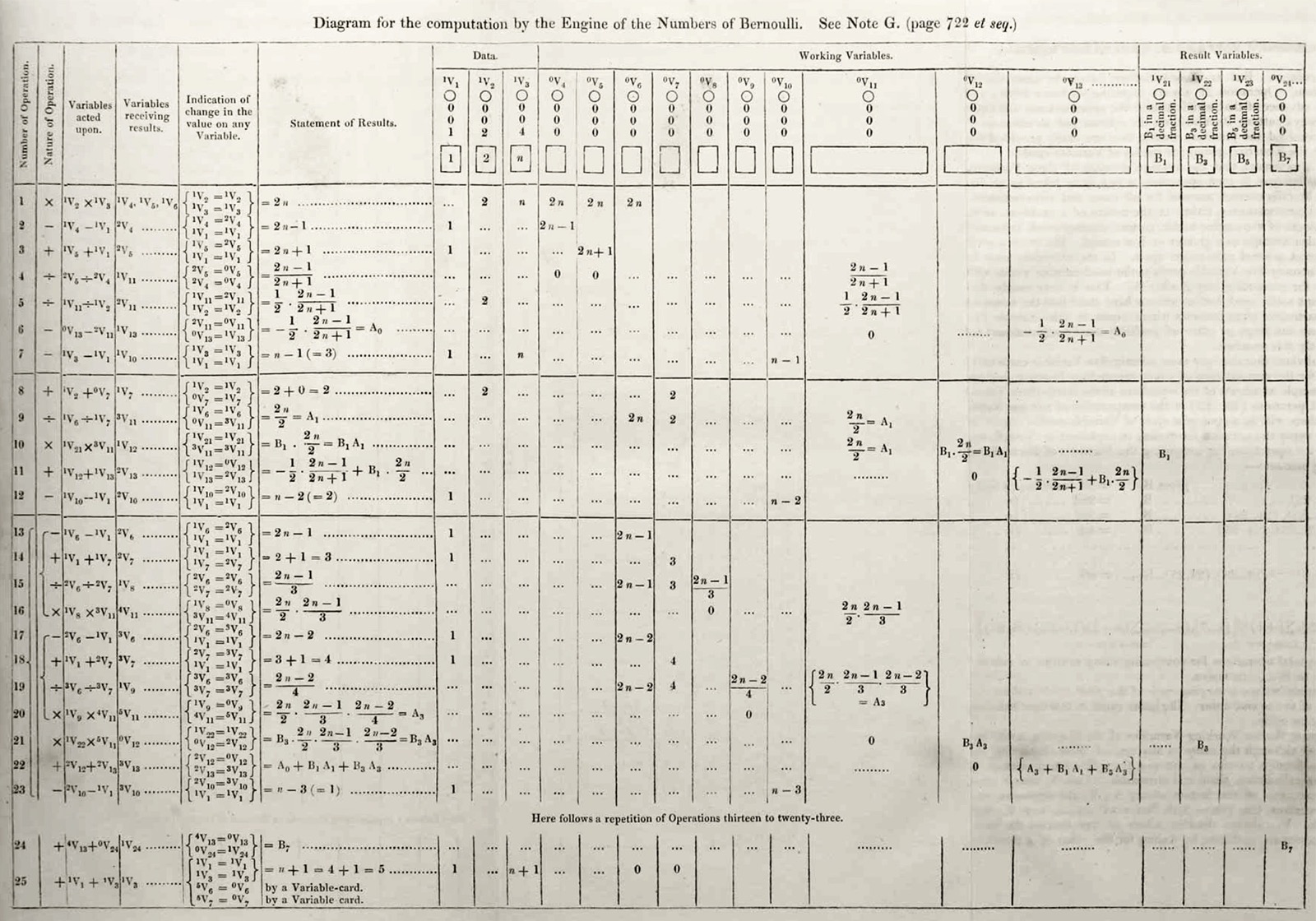
What she produced was not a program manual and not quite a manifesto. It was the first sustained attempt to say what a computer is for: a machine whose power lies not in speed of arithmetic but in the generality of what it can be instructed to do. The final note, Note G, went further still and showed the machine at work on a real problem — the piece of the paper that would later be read as the first published computer program.
The engine was never finished. Babbage died in 1871 with it still in pieces; the British government had long since stopped paying, and no complete Analytical Engine was ever built. The notes, however, survived their subject. When the first electronic computers arrived in the 1940s, engineers rediscovered in Lovelace's 1843 appendix a description of their own machines that was, in its essentials, already correct — written about a device that had never run, by someone who had never seen one work.
More on Ada Lovelace
1 more