The Row
For years after the First World War, Arnold Schoenberg barely composed. When he emerged from that silence in the early 1920s, he had invented a method for writing music without a key — and claimed it would determine the course of serious music for a century. The argument about whether he was right is still going.
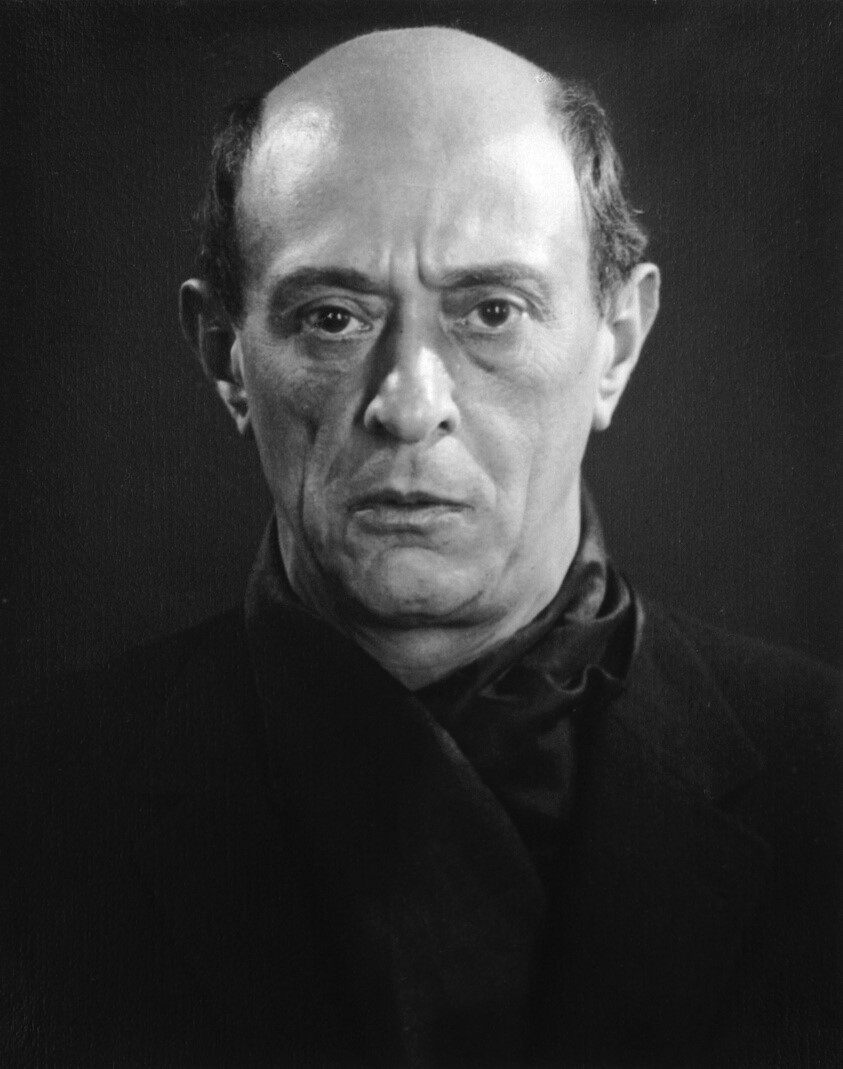
The twelve-tone method was not the beginning of Arnold Schoenberg's radicalism — it was the solution to a problem it had created. By 1908 Schoenberg had already abandoned tonality, the system of keys that had organised Western music for three centuries. What he had not found was anything to replace it. He spent the next decade writing music of great intensity and no system, and then, after a long silence, emerged with a procedure that gave the new music its structure. Whether the cure was better than the disease is a question serious musicians still argue.
Schoenberg was born in Vienna in 1874 and largely taught himself music. He had lessons in counterpoint from Alexander Zemlinsky, whose sister he later married, but was otherwise self-educated — a fact he mentioned frequently, and which coloured his sense of himself as an outsider working within a tradition he had not been formally initiated into. His early works are deeply embedded in the late-Romantic German tradition: Verklärte Nacht (Transfigured Night, 1899), written for string sextet, is lush, chromatic, and unmistakably in the line of descent from Wagner and Brahms. His cantata Gurrelieder, begun in 1900 though not orchestrated until 1911, calls for a massive orchestra, five soloists, three choruses, and a narrator — a work of Wagnerian ambition and scale.
These early works were, by the standards of the day, already extreme in their chromaticism — their constant shift from key to key, their dense harmonic language. But they were still anchored to tonality. Every phrase, however complex, eventually resolved; every tension was released. This was the convention that Schoenberg, in the years around 1908, found himself no longer able to follow.
The atonal decade
The break came in the Three Piano Pieces, Op. 11, composed in 1909. They have no key signature. The harmonic logic that governed where a chord could go and what it had to do next is absent. What replaced it was something closer to free association — a constant motion through dissonance, with no points of rest in the traditional sense. The pieces are short, dense, and disturbing in a way that is not rhetorical but structural: the discomfort has nowhere to resolve.
This "free atonality," as it came to be called — Schoenberg himself did not like the term — continued through some of his most compressed and intense works. Pierrot Lunaire (1912), a setting of Belgian symbolist poetry for a reciter and chamber ensemble of five players, uses the technique of Sprechstimme — speech-song, a notation that indicates approximate pitch and rhythm without specifying exact note values. It became one of the most influential chamber works of the century.
I am the slave of an inner compulsion which is stronger than my education. I know that a great man is one who finds a form to fit his content, who never forces his content into a foreign form. I am always looking for such a form.
But free atonality carried a structural problem. If there is no key, no tonic — no note to which all others refer — there is nothing to prevent a composition from falling into shapelessness. Schoenberg managed it, in the atonal works, by keeping the pieces short and by relying on a near-constant emotional intensity to hold them together. For longer forms, for the symphony or the string quartet, something more was needed. He knew it. After the premiere of Gurrelieder in 1913, and especially after the First World War, he fell largely silent. For nearly six years he produced almost nothing.
The discovery
The method that ended this silence emerged gradually between 1920 and 1923. Around 1921 Schoenberg told his pupil Josef Rufer that he had "discovered something which will ensure the supremacy of German music for the next hundred years." The claim was characteristic — defensive, grand, half-serious — but the discovery was real.
The twelve-tone method, or dodecaphonic technique, works as follows. The composer selects a "tone row" or "series": an ordering of all twelve notes of the chromatic scale (the twelve semitones within an octave) in which each note appears exactly once. This row is not a melody; it is an ordering principle. The row can be used in four forms: the original (prime), backwards (retrograde), upside down (inversion), and upside down and backwards (retrograde inversion). Each of these four forms can also be transposed to begin on any of the twelve notes — yielding forty-eight possible forms in total. The composition is built from these forty-eight forms, alone and in combination, horizontally (as melodic lines) and vertically (as chords).
The crucial feature is the constraint: no note is repeated until all twelve have appeared. This prevents any single note from accumulating the weight of a tonic — from sounding like "home." All twelve notes are, in a precise formal sense, equal.
The first twelve-tone work
The first composition to apply the method consistently throughout is the Suite for Piano, Op. 25, composed between 1921 and 1923. It is in the form of a Baroque suite — Prelude, Gavotte, Musette, Intermezzo, Menuett, and Gigue — a deliberately archaic choice of form for a radically new method. Schoenberg would return to this kind of structural irony: using old forms — the concerto, the variation set, the string quartet — as containers for the new language, demonstrating that the method could sustain large, organised works.
His pupils took the method in very different directions. Alban Berg, whose musical temperament was more lyrical and emotional than Schoenberg's, found ways to make twelve-tone rows that contained tonal allusions — rows that, depending on their partitioning, could suggest a triad or a familiar harmonic motion. His Violin Concerto (1935) uses a row that ends with four notes of a whole-tone scale, and he quotes a Bach chorale harmonised in D major in the final movement. The result is twelve-tone music that sounds, at times, like music. Anton Webern went the other way: his twelve-tone works are radically compressed, often aphoristic, each note isolated by silence and dynamic contrast, the method pushed to an austerity that makes Schoenberg's own twelve-tone works sound almost romantic by comparison.
Exile and legacy
After the Nazis came to power in 1933, Schoenberg's music was classified as "degenerate art" (entartete Musik). He was dismissed from his position in Berlin — he was teaching at the Prussian Academy of Arts — and emigrated to the United States, eventually settling in Los Angeles, where he joined the faculty at UCLA. The irony of the exile was layered: in America, his music was largely unknown; he was surrounded by émigré colleagues — Stravinsky, Klemperer, Thomas Mann — but remained artistically isolated, teaching theory to students who had no particular interest in atonality.
The lasting influence of the twelve-tone method was exerted not primarily through Schoenberg's own compositions but through the generation of composers who came after the Second World War — Pierre Boulez, Karlheinz Stockhausen, Luigi Nono — who took the principle of the row and extended it to other musical parameters: duration, dynamics, timbre. This "total serialism" of the 1950s was not what Schoenberg had invented or intended, but it was a direct consequence of taking his logic further than he had. He had said no note should be privileged; the post-war serialists asked why any musical element should be. The music that resulted was often unlistenable to general audiences and fuelled the debate — still unresolved — about whether the twelve-tone tradition led Western art music into a dead end from which it has not fully escaped.
Schoenberg believed he had not ended tradition but continued it. The method, in his account, was not a rejection of Brahms and Beethoven but their logical extension — the next step in a development that had been moving, through increasing chromaticism, away from simple tonal resolution for a hundred years. The argument is not absurd. But it is still an argument, and the audience that has settled it has yet to appear.