Arnold Schoenberg
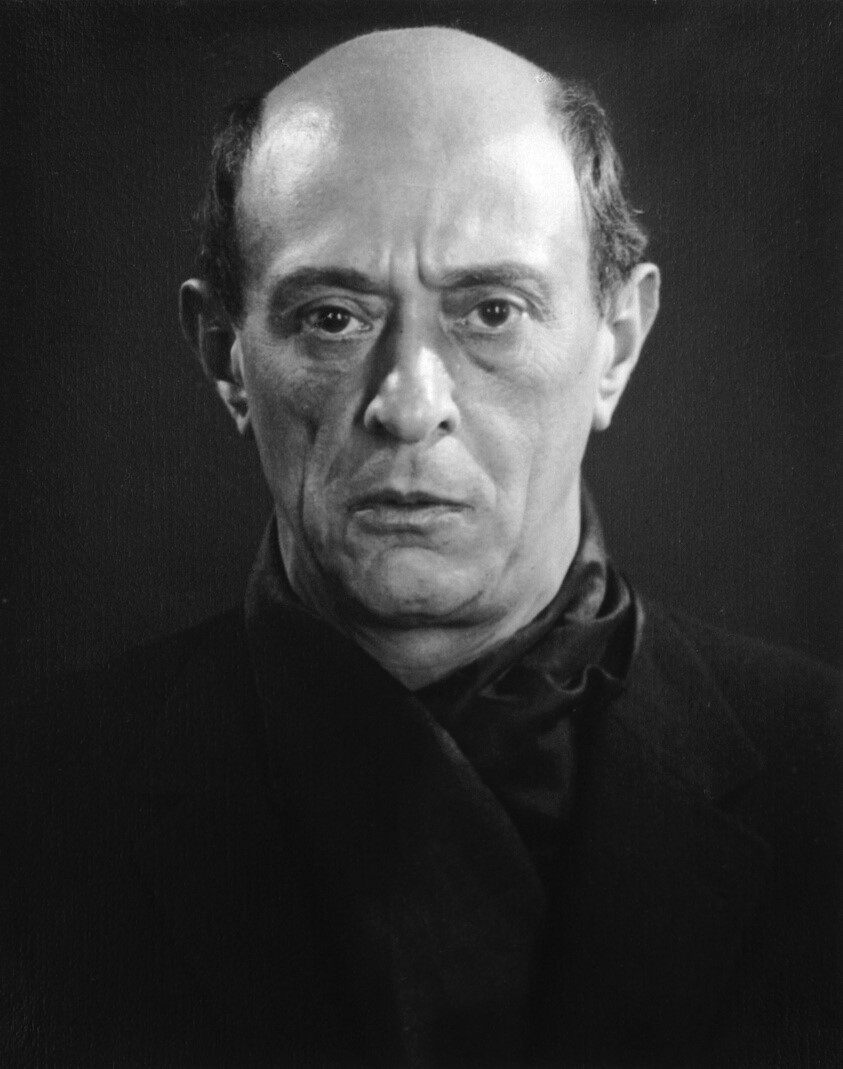
The Viennese composer who dismantled the tonal hierarchy of Western music and replaced it with a systematic alternative — then spent his life watching the world argue about whether he was right.
Arnold Schoenberg began as a late-Romantic composer in the tradition of Brahms and Wagner, moved through a period of radical atonality, and arrived at the twelve-tone technique — a method that reorganised all twelve pitches of the chromatic scale into a governing row. What he dismantled was four centuries of tonal practice. What he built in its place is still contested.
Vienna and the late-Romantic inheritance
Schoenberg was born in Vienna in 1874 and was largely self-taught as a composer, absorbing the tradition by copying, conducting, and orchestrating. His earliest mature work, Verklärte Nacht (1899) — a string sextet cast in the form of a symphonic poem — is openly Wagnerian in its chromaticism yet formally controlled. The score suggests a composer entirely at home in the late-Romantic idiom; nothing in it predicts the ruptures ahead.
Gurrelieder, begun in 1900 and not performed until 1913, is the most extreme expression of that Romantic ambition: a massive cantata for soloists, multiple choirs, and an orchestra requiring a page-wide score. By the time it premiered, Schoenberg had already moved elsewhere entirely.
Atonality and expressionism
The step into free atonality came around 1908–1909. Without a tonal centre to organise harmony, the music organised itself through motivic intensity, through the logic of the expressive moment rather than the grammar of the key. The Three Piano Pieces Op. 11 (1909) are the first freely atonal piano works in the literature.
Pierrot lunaire (1912) — twenty-one melodramas for voice and chamber ensemble — is the period's defining document. The voice part employs Sprechstimme, a half-spoken, half-sung declamation that sits between speech and song. The work is spare, strange, and precisely organised; its expressionist surface conceals a rigorous contrapuntal architecture.1
I am a conservative who was forced to become a radical.
The twelve-tone method
After several years of relative compositional silence, Schoenberg arrived at the twelve-tone technique around 1921. The method requires that all twelve chromatic pitches be ordered into a row and that this row — and its inversions, retrogrades, and transpositions — generate the work's pitch material. The Piano Suite Op. 25 (1921–1923) is the first complete twelve-tone composition. The technique was not, as its critics sometimes claimed, arbitrary; it was a way of establishing coherence in the absence of tonality, replacing the gravitational system of keys with a self-imposed serial logic.
His students Alban Berg and Anton Webern, together with Schoenberg himself, constituted the Second Viennese School — the most influential compositional circle of the twentieth century's first half.
Exile and California
Schoenberg had been teaching at the Prussian Academy of Arts since 1925. In 1933, anticipating the consequences of Nazi civil-service laws, he resigned and emigrated — first to France, where he publicly reaffirmed his Jewish faith, and then to the United States. He taught at the University of California, Los Angeles from 1936 to 1944. He became a US citizen in 1941, and at that point anglicised the spelling of his name from Schönberg.
He died in Los Angeles on 13 July 1951 — a Friday, and the thirteenth day of the month. He had suffered from triskaidekaphobia for most of his adult life.
Footnotes
- Schoenberg described Pierrot lunaire as a work in which he had "renounced a tonal centre" while still maintaining strict formal control through canon, passacaglia, and other contrapuntal devices — a combination that disoriented contemporary audiences expecting either the old order or simple chaos. ↩
Stories
All stories →