Thirty-Two Varieties
Andy Warhol spent his first career drawing shoes for advertisements. In 1962, he displayed thirty-two paintings of soup cans on a shelf at a Los Angeles gallery. The question was whether what he had done was art — and that was exactly the point.
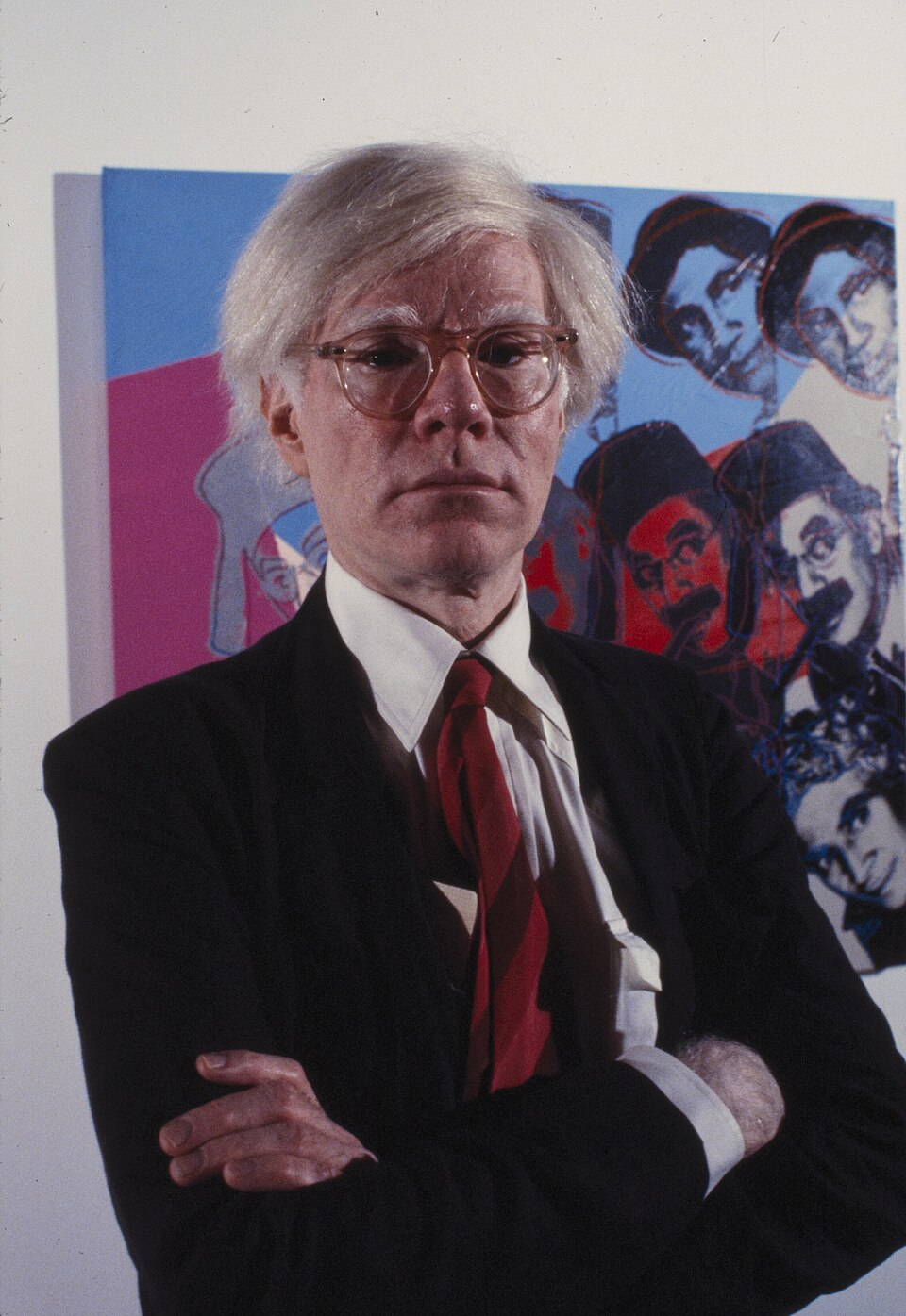
Andy Warhol had a successful career as a commercial illustrator before he decided to make art. Through the 1950s he was one of the most sought-after advertising artists in New York — his blotted-line drawings of shoes ran in Vogue and Harper's Bazaar, and his work for I. Miller shoes made him wealthy by the standards of the field. In 1962 he gave all of that up by painting, by hand, thirty-two canvases of Campbell's Soup cans and putting them in a gallery in Los Angeles. What he was giving up, and what he was proposing instead, took years to fully understand.
Andrew Warhola was born in Pittsburgh, Pennsylvania, in 1928, the youngest of three sons of Carpatho-Rusyn immigrants from what is now Slovakia. His father, Ondrej Warhola, worked in construction; his mother, Julia, was a devout Byzantine Catholic who would eventually move to New York to live with her son. Warhol graduated from the Carnegie Institute of Technology (now Carnegie Mellon University) with a degree in pictorial design in 1949 and moved to New York almost immediately, dropping the final "a" from his name. Within a few years he was one of the busiest commercial artists in the city.
The work was good — his drawings were technically accomplished, playful, and recognizable — and it paid well. But Warhol wanted to be taken seriously as a fine artist, and the art world of the late 1950s was not inclined to take him seriously. His early attempts to show fine art were rejected or ignored. He tried different approaches: painted dollar bills, paintings based on advertisements, drawings of comic-strip characters. Roy Lichtenstein was working on similar material at the same time, and when Warhol's dealer, Leo Castelli, took Lichtenstein instead of Warhol, Warhol pivoted.
The question of what to paint
By late 1961, Warhol was searching for a subject that would be entirely his — something no one else was doing, something that was not quite painting in the traditional sense. He reportedly paid his friend Muriel Latow, who ran an art gallery, fifty dollars for an idea. Her suggestion was simple: paint what you love, or paint something everyone sees every day. She mentioned money. She mentioned Campbell's Soup.
Warhol had, by his own account, eaten Campbell's Soup for lunch almost every day for twenty years. The soup was not exotic or ironic to him; it was genuinely what he ate. He began painting the cans.
There were thirty-two varieties of Campbell's condensed soup available in 1962 — from Tomato and Chicken Noodle to Black Bean, Beef, Clam Chowder, and Cream of Mushroom. Warhol painted one canvas for each variety, each 20 by 16 inches, each identical in format: a white ground, the red-and-white label, the product name and variety in their standard typography, the company seal. The paintings are not identical to each other — they are not silkscreens, which would come later — but they are clearly meant to read as a set. The differences between them are the differences between product varieties, not between artistic decisions.
I wanted to paint nothing. I was looking for something that was the essence of nothing, and the soup can was it.
The Ferus Gallery, July 1962
The works were first shown at the Ferus Gallery in Los Angeles in July 1962. The curator was Irving Blum, who had been introduced to Warhol by mutual acquaintances and had made the trip to New York to see the paintings in Warhol's studio. Blum recognized that the correct way to show them was all thirty-two together — not hung on walls as individual paintings, but arranged on a narrow wooden shelf running continuously around the gallery, one canvas per variety, reading like products on a supermarket shelf. This is how they were installed.
The response from the Los Angeles art community was mixed, to put it gently. A gallery nearby — the Gemini Gallery, according to accounts — displayed actual cans of Campbell's Soup in its window with a sign offering "the real thing" for $0.29 or $0.33 a can, depending on the variety. The mockery was effective as mockery and also, perhaps without intending to, as commentary on exactly the question Warhol was raising: what is the difference between the painting and the can? Warhol's answer was that the difference was not in the image but in the act of choosing the image — in the decision to look at an ordinary thing as if it were worth looking at.
Sales during the show were slow. At the end of the run, Irving Blum made an arrangement with Warhol: he would buy all thirty-two paintings for $1,000, paid in monthly installments of $100. Warhol agreed. Blum later donated the complete set to the Museum of Modern Art in New York, where they remain, displayed as a single work along one wall.
The breakout year
The Ferus show was only one event in what became Warhol's complete reinvention in 1962. That same year he exhibited his Marilyn Monroe silkscreens — produced in the weeks after Monroe's death in August — and began the Disaster series, which applied the same mechanical reproduction logic to photographs of car crashes, electric chairs, and race riots. He also made paintings of dollar bills.
What these works shared was a method and a proposition. The method was to take an existing image — a product label, a news photograph, a publicity still — and reproduce it, often many times, with a flatness that neither commented on the image nor aestheticized it in the traditional sense. The proposition was that this act of selection and reproduction was itself sufficient — that art did not require transformation of its source material, only the decision to frame it.
This was not, as critics initially sometimes assumed, nihilism or cynicism. Warhol was genuinely interested in fame and in death and in the way American culture produced images of both at industrial scale. The soup can is the opposite of death — it is the ordinary, the daily, the banal — but it exists in the same visual economy as the electric chair and the car crash, all of them images you have seen before, all of them flattened by repetition into something like wallpaper.
The soup cans are hand-painted because they precede this shift, and they bear traces of decisions that would later be delegated or eliminated. Each canvas is slightly different; the label details are slightly off; the painting is clearly a painting. Warhol looked at them and concluded that the next step was to remove the hand altogether. What he was working out, with the soup cans, was what it would mean to paint nothing — and what nothing, framed and repeated in sufficient quantity, might be worth.