Andy Warhol
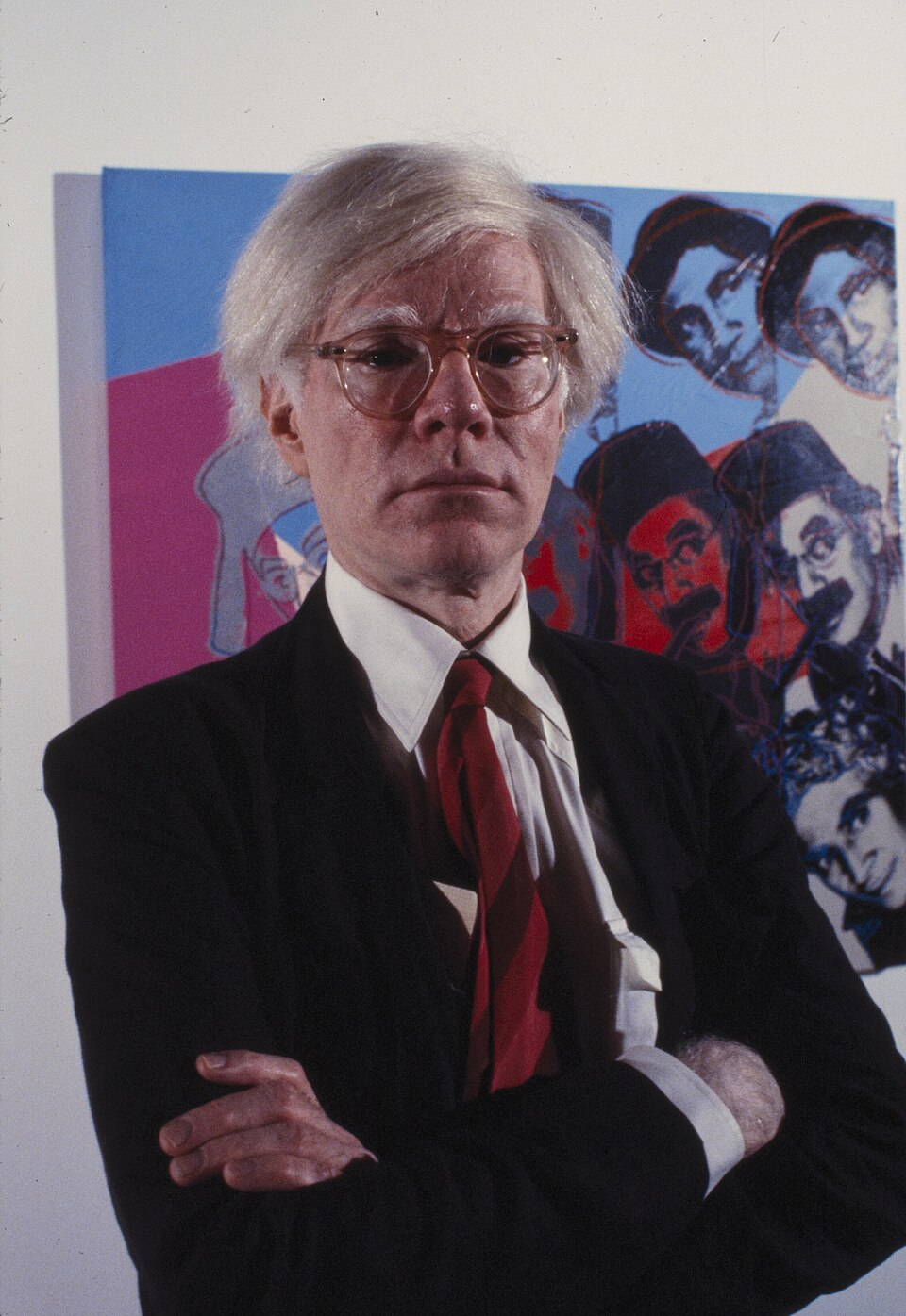
The Pittsburgh commercial artist who turned the supermarket shelf into a hall of mirrors, making Pop art the defining lens of American consumer culture.
Andy Warhol did not merely reflect American mass culture — he revealed its structure. By silkscreening Campbell's soup cans and Marilyn Monroe with equal detachment, he made visible the mechanisms by which repetition, desire, and commerce flatten everything into a single bright surface. Half a century on, that surface has only expanded.
Formation in commercial art
Andrew Warhola was born in Pittsburgh in 1928, the youngest child of Carpatho-Rusyn immigrants from what is now Slovakia. His father died of tuberculosis when Warhol was thirteen. He moved to New York in 1949; his mother, Julia, joined him there in 1952. He had studied pictorial design at the Carnegie Institute of Technology (now Carnegie Mellon University) and arrived in New York already technically accomplished. He found immediate work as a commercial illustrator, his blotted-line drawings appearing in Vogue, Harper's Bazaar, and window displays for I. Miller shoes. Success in commercial art gave him both financial independence and a formed sensibility: he understood that illustration was always already in the service of desire, and that this was not a limitation but a subject.1
The Factory and Pop art
In 1962, Warhol began exhibiting the paintings that would define Pop art: hand-painted and then silkscreened Campbell's Soup Cans, Coca-Cola bottles, and dollar bills. The choice of subject was deliberate provocation: if Abstract Expressionism claimed painting's sacred interiority, Warhol's canvases insisted on exteriority — the supermarket, the billboard, the television set. That same year he began his Marilyn series, derived from a publicity still taken shortly before Monroe's death, multiplied and colour-shifted until the image became both icon and erasure simultaneously.
He established The Factory on East 47th Street in Manhattan, a silver-foiled studio that functioned as production facility, social scene, and laboratory for thinking about fame, mass production, and the art world's pretensions. Assistants silkscreened canvases by the dozen. Films were made with minimal direction. The atmosphere was deliberately industrial; Warhol insisted he wanted to be a machine. The Factory attracted superstars — Edie Sedgwick, Lou Reed, Nico, Truman Capote — and Warhol filmed them in long, static takes that challenged every convention of narrative cinema.
Method and media expansion
Warhol's practice spread across every available medium. His Screen Tests (1964–66) were portrait films — four minutes of a subject staring into a 16mm camera — that inverted the conventions of celebrity photography. Chelsea Girls (1966) was a double-projection feature film running simultaneously on two screens. He founded the magazine Interview in 1969, which ran artist and celebrity conversations in raw, unedited transcript form. He produced albums — including the Velvet Underground's debut — and managed the band in its early years.
The critical establishment resisted him for decades. The ease of reproduction, the frank commercialism, the deliberate blankness of his public persona — all seemed disqualifying. By the 1980s, the resistance had collapsed; Warhol's late Oxidation Paintings, Camouflage series, and collaborations with Jean-Michel Basquiat were received as major work. He died unexpectedly in New York on 22 February 1987, following routine gallbladder surgery, aged 58.
In the future, everyone will be world-famous for 15 minutes.
Footnotes
- Warhol changed the spelling of his surname from Warhola in his early career; his mother continued to use the original spelling throughout her life. ↩