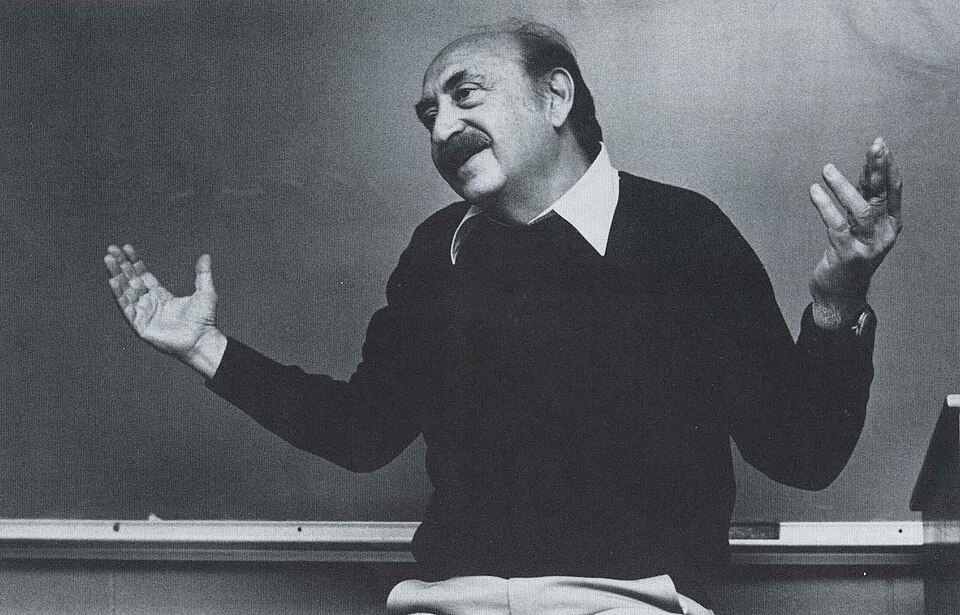
Achille Castiglioni
The Milanese designer who found his best ideas in the everyday, turning a tractor seat and a fishing-rod base into canonical objects of postwar Italian design.
Achille Castiglioni worked from curiosity rather than doctrine. With his brothers Livio and Pier Giacomo he helped define what Italian design could be — not a style imposed on objects but a way of looking at the world and asking what any given thing could become. His lamps, furniture, and domestic objects entered production in the 1950s and 1960s and have remained in continuous manufacture ever since, an unusual measure of their practical rightness.
Origins
Castiglioni was born in Milan in 1918, the youngest of three designer brothers. He studied architecture at the Politecnico di Milano, graduating in 1944. The studio he shared with Pier Giacomo — and earlier with Livio — became one of the most productive design partnerships in postwar Italy, contributing industrial design, exhibition design, and product development across several decades.
Defining work
The year 1962 alone produced three lamps that remain in the Flos catalogue: Arco, Toio, and Taccia. Arco extended a steel arc eighteen metres to hold a light source over a dining table without ceiling fixing — an engineering solution with the lightness of a gesture. Toio pointed an industrial floodlight bulb skyward on a fishing-rod stand, reframing readymade components as design. Taccia placed a glass diffuser atop a cylindrical aluminium base, playing with reflection and ambient light. The Mezzadro stool (1957) used an actual tractor seat bolted to a sprung steel stem — a found object elevated by relocation.
Method and style
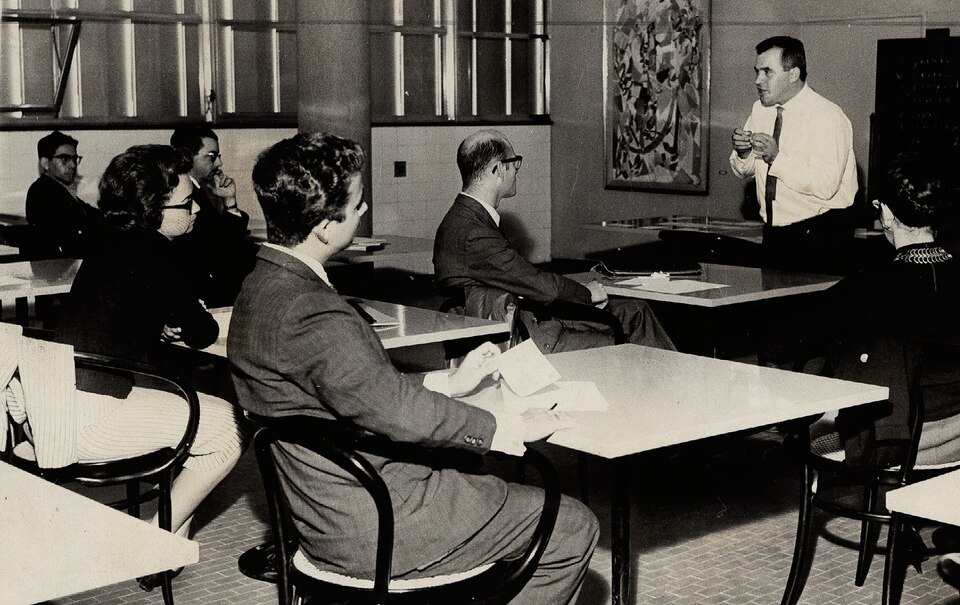
Castiglioni's method was explicitly inquisitive. He advised students that curiosity — about materials, about how people actually use objects, about the overlooked logic in existing things — was the designer's essential faculty. His practice was consistent with this: he observed before he invented, and he often found that the most resolved solution involved the least intervention. The readymade was not a shortcut but a discipline, a proof that the problem had already been partly solved by the world.
Legacy
Castiglioni received multiple Compasso d'Oro awards over his career, Italy's principal design honour. He taught at the Politecnico di Milano for decades, shaping successive generations of designers. His studio in Milan was kept as a museum after his death in 2002. Objects he designed with Pier Giacomo remain in production by Flos and Zanotta, sold without alteration — the clearest evidence that the work was right.
"If you are not curious, forget it. If you are not interested in others, what they do and how they act, then being a designer is not the right job for you."