Alvar Aalto
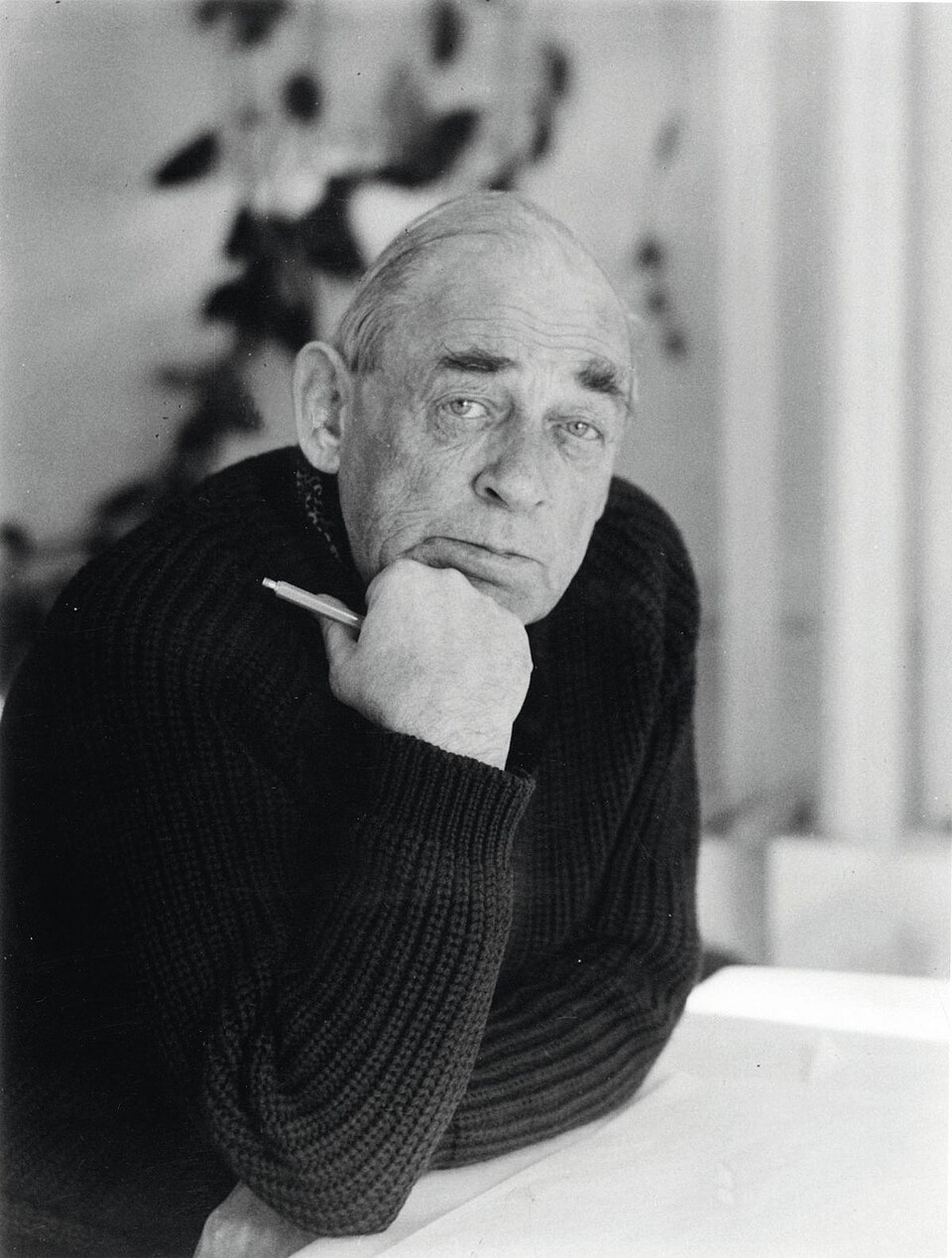
The Finnish architect who proved that modernism could be warm — bending wood, light, and landscape into buildings that feel, not just function.
Alvar Aalto gave modernism a conscience. Where the International Style dealt in abstraction and universals, he answered with birch, brick, undulating ceilings, and the particular light of the Finnish forest — buildings and objects scaled not to ideology but to the human body and its need for warmth.
Origins and training
Aalto grew up in central Finland and studied architecture at the Helsinki University of Technology, graduating in 1921. His early practice absorbed the Nordic Classicism fashionable across Scandinavia in the 1920s — civic symmetry, rendered facades, classical allusion — before a decisive encounter with European functionalism redirected his thinking. Contact with figures including Swedish architect Erik Gunnar Asplund and the Bauhaus circle persuaded him that modernism was the right instrument; what he resisted was its coldness.
His first wife and collaborator Aino Marsio-Aalto was a constant co-author from their marriage in 1924 until her death in 1949. Their practice operated on the principle of Gesamtkunstwerk — every element of a project, from the structural frame to the door handle, designed as a unified whole. Aalto never regarded painting and sculpture as separate disciplines; he saw them as "branches of the tree whose trunk is architecture."
The sanatorium and the chair
The commission that carried Aalto to international attention was the Paimio Sanatorium (1929–1933), a tuberculosis hospital in southwest Finland. Functionalism required the building to serve the patient's recovery: south-facing wards for maximum sun, roof terraces for fresh air, a plan that separated patient and service circulation. But Aalto's functionalism ran deeper than hygiene. For the patients' rooms he designed the Paimio Chair — a cantilevered loop of bent birch plywood angled to support the chest of a reclining figure breathing with difficulty.1 The chair's form came from the body's specific need, yet it reads as pure sculpture.
The same logic governed his investigation of bent and laminated wood. Working with cabinetmaker Otto Korhonen, Aalto developed the L-leg — a solid birch stave sliced at the joint and steam-bent, requiring no metal armature. The resulting furniture was warm, resilient, and stackable. Stool 60 (1933), three L-legs splayed under a circular birch seat, became one of the most produced pieces of the twentieth century and remains in Artek's catalogue today.
God created paper for the purpose of drawing architecture on it. Everything else, at least for me, is an abuse of paper.
Material intelligence and the organic turn
Where Mies van der Rohe chose steel and glass and Le Corbusier reinforced concrete, Aalto's palette was consistently organic: birch and pine, brick, copper, and natural light channelled through ingenious ceiling apertures. The Viipuri Library (1935) introduced an undulating ceiling of laminated wood — acoustic sculpture that looks spontaneous but was precisely engineered. The Villa Mairea (1938–1940), built for the Ahlström-Gullichsen industrial family, wrapped a canonical modernist villa in a forest of slender columns, rough-pole screens, and a sauna that seemed to grow from the granite bedrock.
His glassware extended the same intelligence into domestic scale. The Savoy Vase (1936), created for a Helsinki restaurant competition and put into production by Iittala, has a silhouette often compared to Finnish lake shorelines. It has never left production.
| Element | Aalto's approach |
|---|---|
| Structure | Brick and concrete, humanised with timber linings |
| Acoustics | Sculpted wood ceilings and fan-shaped skylights |
| Furniture | Bent laminated birch; stackable, hygienic, warm |
| Glassware | Asymmetric organic forms; industrial production |
Legacy
Aalto's influence on post-war modernism was both wide and largely constructive: he demonstrated that rigor and warmth were not opposites. The Baker House dormitory at MIT (1948) — a serpentine brick slab set obliquely to the Charles River so that every room gets an angled view — showed American architects that a functional brief could yield a romantic form without sentimentality. His bent-plywood experiments directly informed the work of Charles and Ray Eames and George Nelson, who acknowledged Aalto's technical patents as a precondition of their own laminated furniture.
His later civic work, including Finlandia Hall in Helsinki (1971), was more contested: the white Carrara marble cladding expanded and contracted with Finland's freeze-thaw cycles in ways the specification had not anticipated, requiring prolonged repair. The building remains a landmark of the capital nonetheless.
Artek — co-founded in 1935 with Aino Aalto, patron Maire Gullichsen, and art historian Nils-Gustav Hahl — continues to manufacture his designs to original specifications. The Alvar Aalto Museum in Jyväskylä, designed by Aalto himself, holds the principal archive of drawings, models, and correspondence.
Footnotes
- The Paimio Chair's backrest angle was calculated to ease breathing for patients with pulmonary tuberculosis. Aalto also specified that all screws be countersunk flush so that patients could not injure themselves on the furniture during recovery. ↩