Virgil Abloh
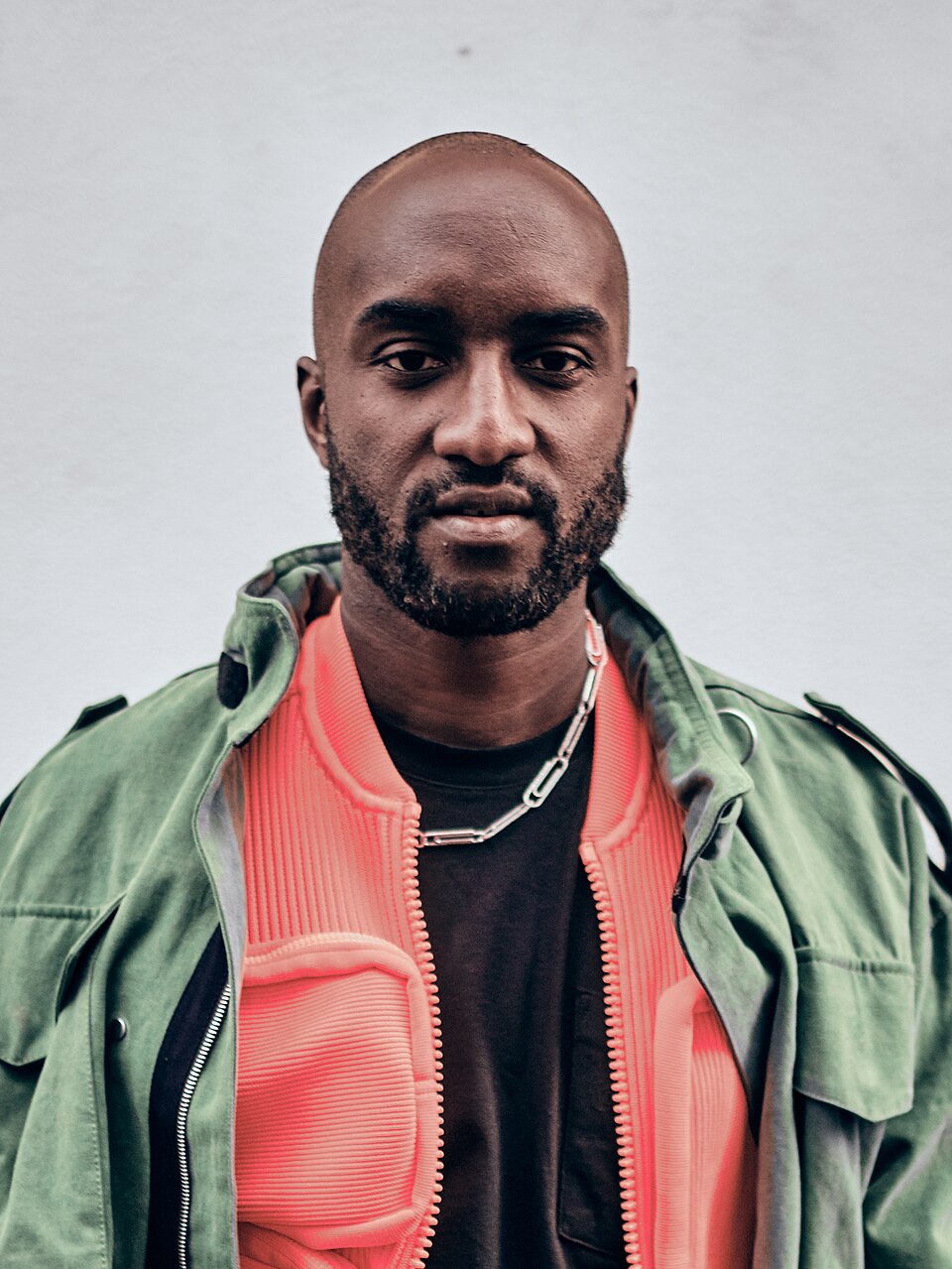
The architect-turned-designer who unlocked luxury fashion for a generation raised on streetwear — and paid for it with every ounce of his abbreviated life.
Virgil Abloh arrived at fashion through engineering blueprints and an architecture thesis, and he left it having dismantled a century-old barrier: no Black designer had ever held the artistic directorship of Louis Vuitton menswear before him. In the decade between those two facts he built Off-White into a global phenomenon and redefined what luxury could borrow from the street.
Engineering and architecture as foundation
Abloh grew up in Rockford, Illinois, the son of Ghanaian immigrant parents. He completed a degree in civil engineering at the University of Wisconsin–Madison before pursuing a Master of Architecture at the Illinois Institute of Technology — an institution still saturated with the rigour of Ludwig Mies van der Rohe, who had led its curriculum for two decades. The IIT formation was not incidental: Abloh would return throughout his career to structural thinking, to the idea of the diagram, and to the question of what a thing communicates before it is used.
His entry into fashion came through Chicago, and through Kanye West. The two interned together at Fendi in Rome in 2009 — a deliberate step into the world they intended to occupy. Abloh subsequently became creative director of Donda, West's multidisciplinary agency, directing album art, stage design, and merchandise with the same systems-level eye he had trained on buildings.1
Pyrex Vision, Off-White, and the readymade
In 2012 Abloh launched Pyrex Vision, purchasing deadstock Ralph Lauren Rugby flannel shirts and screen-printing them with the word PYREX and the number 23. The gesture was openly Duchampian: the object already existed; the intervention was the meaning. Pyrex was short-lived but precise in its logic.
Off-White followed in Milan in 2013, and it was here that Abloh's vocabulary crystallized: quotation marks placed around banal words ("SHOELACES," "SCULPTURE"), zip ties as signature hardware, diagonal industrial stripes, and the arrow motif. These elements functioned as what he called the 3% approach — alter an existing object by the minimum necessary to signal that something has happened to it, and make that signal the work.
I subscribe to the idea that a three-percent change is enough to make something new.
The brand's position — squarely between streetwear and high fashion — was not a compromise but a thesis. Abloh argued, and demonstrated, that the hierarchies separating the two were maintained by gatekeeping rather than aesthetics.
Method and visual language
Abloh's design process was explicitly conceptual before it was material. Collections were built around a central idea — "figures of speech," "corporate," "wizard" — and every garment, accessory, and graphic element was derived from that premise. He collaborated with Nike on "The Ten" project in 2017, reworking ten canonical sneakers with exposed construction details and quotation-mark labels; the series became one of the most discussed footwear releases of the decade.
| Signature device | Function |
|---|---|
| Quotation marks | Frame the everyday as consciously chosen |
| Zip ties | Industry hardware repurposed as luxury detail |
| Diagonal stripe | Nods to caution tape; signals transgression |
| "3%" alteration | Readymade philosophy; authorship through selection |
At Louis Vuitton — appointed in March 2018 — the vocabulary expanded to accommodate a house with 160 years of heritage. His debut runway show on a bridge over the Palais Royal gardens, with a cast that moved through the spectrum of Black experience against a rainbow sky, was received as both spectacle and statement.
Legacy and death
Abloh was diagnosed with cardiac angiosarcoma, a rare and aggressive cancer, in 2019. He disclosed his diagnosis publicly only after his death on 28 November 2021, aged 41, having continued to work — across Louis Vuitton, Off-White, and collaborations with IKEA, Mercedes-Benz, and Rimowa — throughout his treatment.
His significance as a barrier-breaking figure for Black designers in luxury fashion was stated plainly by the industry at his passing, though he had made the same point himself through his hires, his mentorship programmes, and his public insistence that fashion's gates were arbitrary constructions. The retrospective exhibition Figures of Speech had toured major institutions beginning in 2019, affirming his standing as both designer and cultural theorist before his death made the assessment permanent.
Footnotes
- Donda was named after West's late mother. Under Abloh its output ranged from the Watch the Throne album art (with Jay-Z, 2011) to stage rigs and touring merchandise, establishing Abloh's signature approach of treating commercial objects as deliberate design propositions. ↩