Alvin Lustig
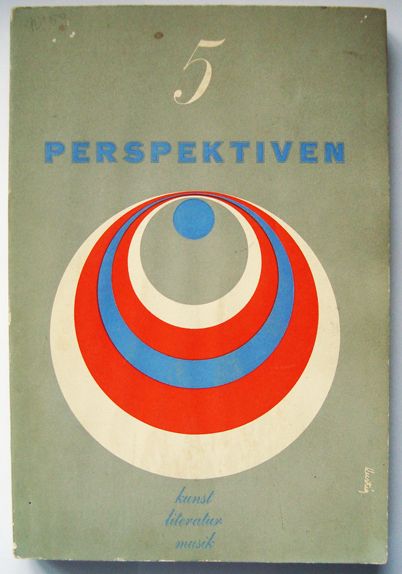
The American designer who made the book cover an arena for ideas — abstract, surreal, and decades ahead of what the publishing industry expected to see.
Alvin Lustig died at forty having transformed the American book cover from a decorative surface into a designed idea. He merged abstract art, surrealism, and Swiss typographic rigour before most American designers knew what to do with any one of them — and he did it in the years he had, which were not many.
Formation in Los Angeles
Lustig was born in Denver, Colorado in 1915 and grew up in Los Angeles. He attended the Art Center School briefly and studied, for a time, under Frank Lloyd Wright — an association that oriented him early toward architecture's synthesis of structure and surface. These were unconventional points of departure for a graphic designer of his generation, and they left permanent marks: Lustig's work would consistently treat the flat rectangle of a book cover as a space to be organised rather than a field to be decorated.
His practice emerged in Los Angeles in the late 1930s, when he began taking on book, magazine, and interior design commissions. He was self-directed and technically experimental, working in a city that was not, at the time, a design capital — which gave him room to develop without being corrected by convention.
New Directions and the cover as argument
The body of work that secured Lustig's place in design history was made for New Directions Publishing, beginning in the 1940s. New Directions, founded by James Laughlin, published experimental and international literature — Henry Miller, Tennessee Williams, Djuna Barnes, Anaïs Nin, Federico García Lorca — that had no natural home in mainstream American publishing. Lustig's covers matched the ambition of the editorial programme: abstract forms, layered symbols, unexpected type placements, palettes borrowed from Paul Klee and Joan Miró rather than from commercial illustration.
Each cover was an interpretation, not a description. Where a conventional book cover illustrated scene or character, a Lustig cover distilled atmosphere and register — a few marks and a typeface calibrated to give the reader a correct expectation of what kind of reading experience lay ahead. The covers worked as small posters, and they announced that American graphic design could operate at the level of European modernism.
Design should be a visual experience of the idea itself, not an illustration of it.
Teaching at Yale
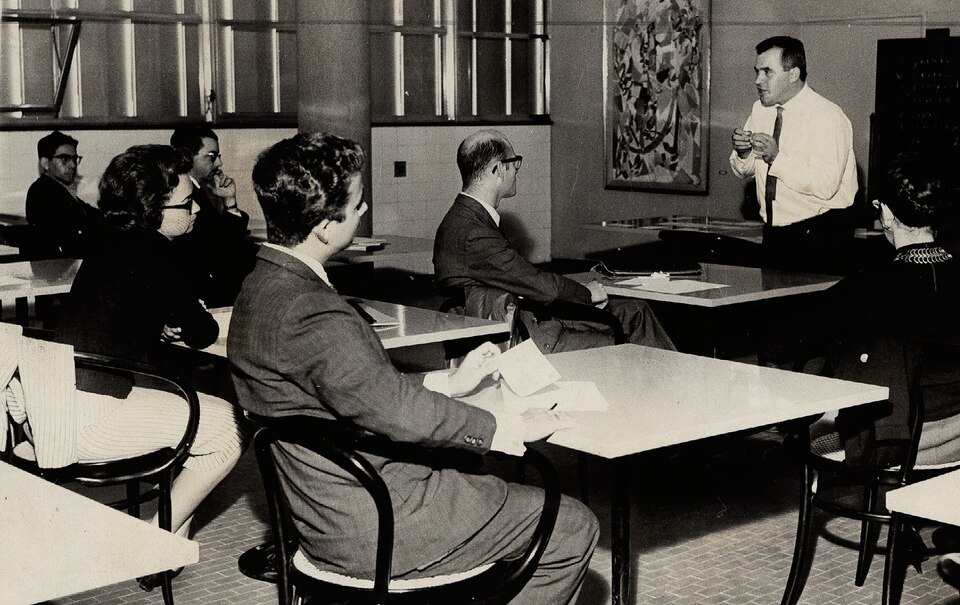
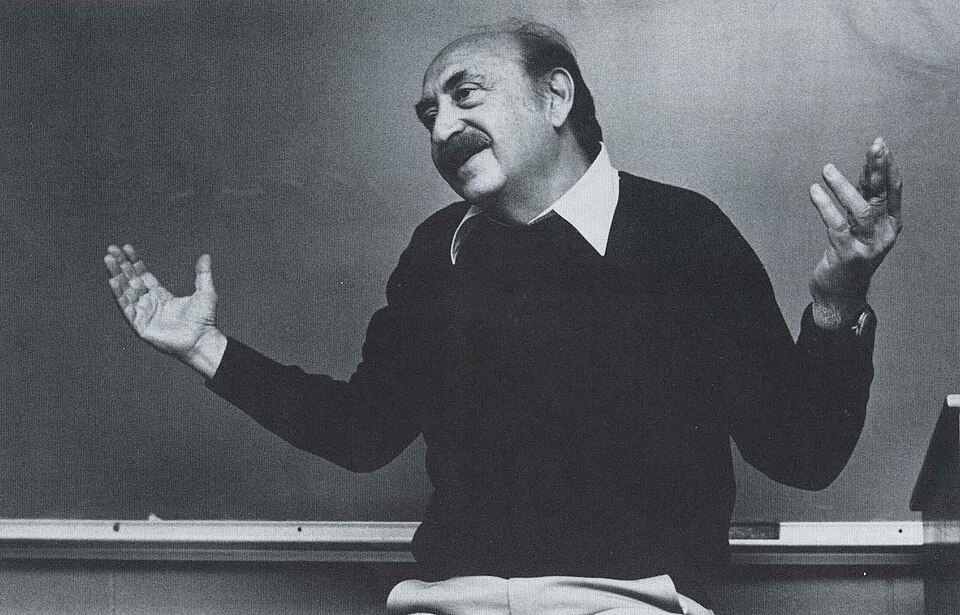
Lustig joined the faculty of the Yale School of Design — then being transformed under Paul Rand's influence into one of the leading design schools in the United States — and proved an exceptionally demanding teacher. He taught that design was a discipline of thinking as much as of making, and that a student who could not articulate why a form was placed where it was had not yet understood the form. His approach emphasised rigour alongside visual invention, and he influenced a generation of American designers.
His own practice continued alongside teaching: corporate identities, interior work, typographic systems — a range uncommon for the period, and evidence of his conviction that graphic design was not a minor applied art but a full discipline with structural principles applicable across media.
Blindness and the final years
By 1954, complications from diabetes had taken his sight entirely. He continued to work — directing and conceiving, relying on collaborators to execute — until his death in December 1955, at the age of forty. The fact that he designed his last work blind is not incidental: it confirmed that what drove him was the idea, not the hand.
He was posthumously honoured with the AIGA Medal and inducted into the Art Directors Club Hall of Fame. Both recognitions came after his death, and both acknowledged that American graphic design's maturation in the postwar period was inconceivable without his example.