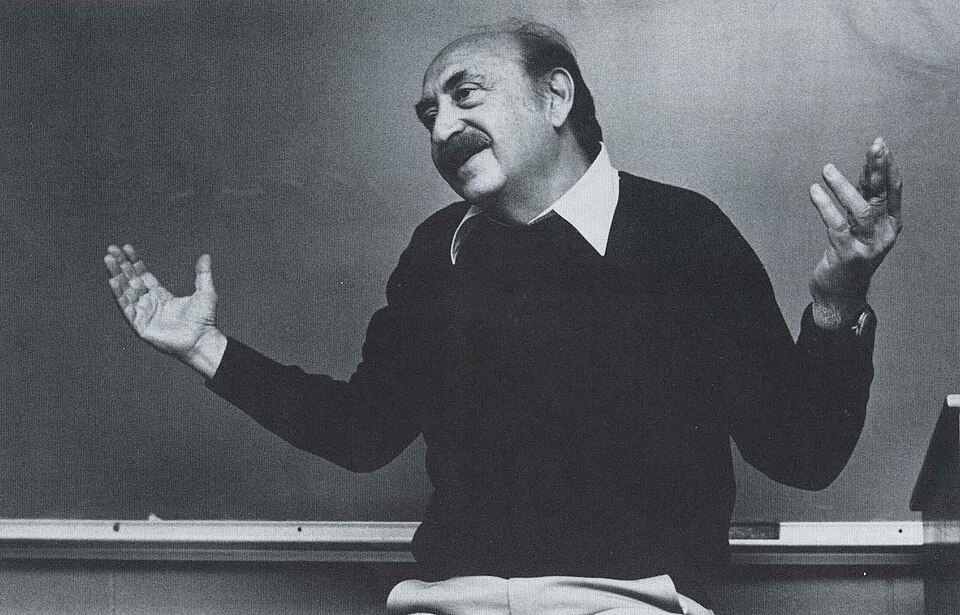
Beatrice Warde
The scholar who argued that the finest typography makes itself invisible — a conviction that shaped how Britain and the world thought about print.
Beatrice Lamberton Warde spent her career arguing that typography exists to serve the reader, not to announce itself. As publicity manager at the British Monotype Corporation for more than three decades, she translated that conviction into print standards felt across the English-speaking world.
Early Life and Training
Born in New York City on 20 September 1900, Warde grew up in a household attentive to books and learning. She worked at the American Type Founders before moving to Europe, where her interest in type history deepened into rigorous scholarship. Her command of archival sources was uncommon for someone outside the academy, and it brought her to the attention of the leading typographers of the era.
The Garamond Research and the Paul Beaujon Affair
In the mid-1920s, writing under the pen name Paul Beaujon, Warde published a landmark article in the Fleuron demonstrating that the typefaces then marketed as Garamond were not, in fact, cut by Claude Garamond but by the later punchcutter Jean Jannon. The correction embarrassed foundries and forced a reassessment of type-history scholarship. When her authorship became known, the episode confirmed her standing as a serious historian and brought her into the circle of Stanley Morison at Monotype.
The Crystal Goblet
Warde's most enduring contribution is the essay known as "The Crystal Goblet," first delivered as a lecture in 1932 and later reprinted widely. Her central image is a choice between two wine goblets — one of solid gold, one of clear crystal — to illustrate why the best typography should be transparent to its content. Type that calls attention to itself, she argued, is like a golden goblet that obscures the wine; type that effaces itself allows the reader to encounter meaning directly. The essay became a touchstone of typographic education through the remainder of the century.
Monotype and Broader Influence
As publicity manager for the British Monotype Corporation, Warde wrote, lectured, and edited on behalf of a programme that revived historic typefaces and commissioned new ones from leading designers. She was recognised at the time as one of the few women holding such a position in the typographic world. Her advocacy shaped printing standards in Britain and extended, through Monotype's international reach, to printers and publishers across the English-speaking world. She continued this work until late in her career, dying in London on 16 September 1969.
"Type well used is invisible as type, just as the perfect talking voice is the unnoticed vehicle for the transmission of words, ideas."