Claude Garamond
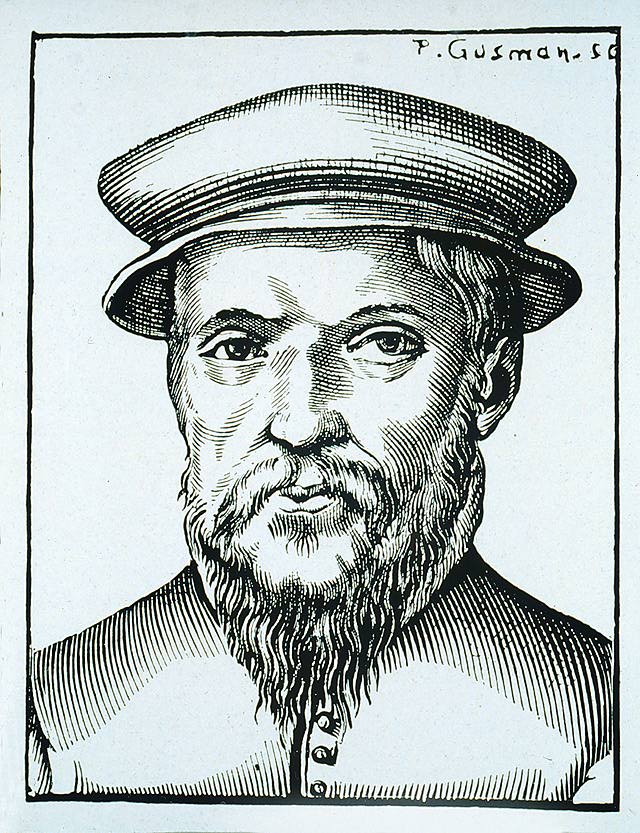
The sixteenth-century Parisian punchcutter whose old-style roman letters became so foundational that typefaces bearing his name remain in continuous use five centuries later.
Claude Garamond cut the metal punches that defined the roman type of the French Renaissance, producing letterforms of such organic clarity and proportion that they have never fully left use. The typefaces bearing his name today — interpretations rather than direct revivals, some based on his work and some on that of his successors — descend from a visual intelligence that understood, five centuries before digital type, what made a letter feel effortlessly readable.
The punchcutter's craft
Garamond was born in Paris around 1499 and learned the craft of punchcutting — the cutting of steel punches used to stamp the matrices from which type was cast in metal — under predecessors working in the tradition of early Venetian roman type. The canonical influence was the type of Aldus Manutius's Venetian press, particularly the letters cut by Francesco Griffo, which provided the model of a humanist roman with proportions derived from Renaissance calligraphy.
Working within that tradition, Garamond refined and extended it. His letters preserved the organic irregularity that connected roman type to the written hand while pushing the design toward greater consistency, a slightly more upright axis, and finer finishing. They were eminently suited to the printing requirements of learned publishers and became the preferred type of French scholarly printing in the mid-sixteenth century.
The Greeks and the royal commission
One of Garamond's most celebrated commissions was the cutting of the Grecs du Roi — three sizes of Greek type commissioned by King Francis I of France and intended as the royal standard for Greek printing. The design was based on the handwriting of the Cretan calligrapher Angelos Vergikios, and the result was among the most admired Greek types of the sixteenth century, used for decades in official French publishing.
The commission marked Garamond's standing as the leading punchcutter of his era. He worked as an independent craftsman, selling matrices and type to printers across France and beyond, and his influence on European typography through the latter half of the sixteenth century was considerable.
Letters should be as invisible as glass — the reader sees through them, not at them.
Legacy and the problem of attribution
Garamond died in 1561. His legacy is complicated by an attribution problem that took centuries to untangle: many of what were assumed to be Garamond's types were in fact cut by his contemporary and successor Jean Jannon in the early seventeenth century. Jannon's matrices, acquired by the Imprimerie Royale in Paris, were long attributed to Garamond himself, and most twentieth-century Garamond revivals — including those by Claude Garamond, Monotype, and Stempel — were based on Jannon's designs rather than Garamond's own.
The distinction matters for historical accuracy but does not diminish the continuous vitality of the old-style roman tradition Garamond established. Typefaces bearing his name remain among the most widely used in print and digital typography.