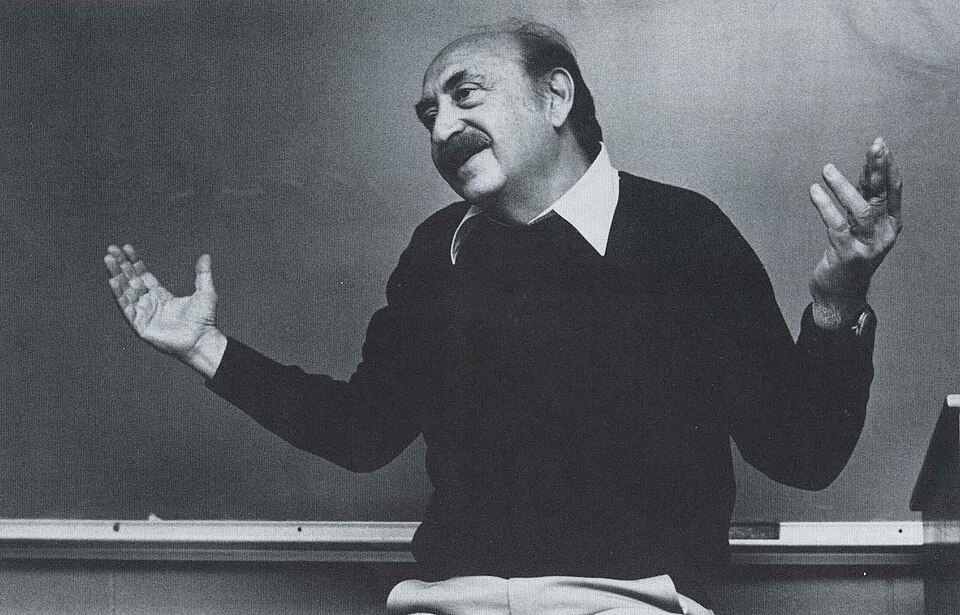
George Nelson
The American designer who, as Herman Miller's first design director, built the institutional conditions for modernist furniture — recruiting Charles Eames and Alexander Girard, shaping their contracts, and producing some of the period's most widely reproduced objects himself.
George Nelson arrived at Herman Miller in 1945 without a product line and left in 1972 with one of the most coherent catalogues in 20th-century furniture. His own designs — spare, formally inventive, often deceptively simple — earned their place alongside those of the designers he recruited. That he built the platform from which Charles Eames and Alexander Girard operated is Nelson's least-credited achievement.
Education and early writing
Nelson studied architecture at Yale University and won the Rome Prize, which took him to the American Academy in Rome for several years in the late 1930s. Returning to the United States, he wrote for Architectural Forum, becoming a visible critic and editor at a moment when modernist ideas about space and dwelling were moving from European theory into American practice.
In 1945 he co-authored Tomorrow's House with Henry Wright — a book that popularised the open-plan living room and the idea of the "family room" as a distinct domestic zone. The book reached a popular audience and positioned Nelson as a practical interpreter of modernist ideas rather than a polemicist.
Herman Miller and the design directorship
D. J. De Pree, president of Herman Miller, read Nelson's writing and offered him the position of design director in 1945 — a role Nelson accepted while continuing to operate his own studio, George Nelson Associates, in New York. The arrangement was unusual: Nelson had authority over the company's entire design output but was not a salaried employee.
His first act was to propose hiring Charles Eames, whose work he had encountered independently. Eames joined Herman Miller in 1946. Nelson subsequently brought in Alexander Girard to lead textiles in 1952. The combination — Nelson's systemic thinking, Eames's material intelligence, Girard's colour — gave Herman Miller a range few American manufacturers could match.
Nelson held the directorship until 1972, a span of 27 years that covered the company's transformation from a regional manufacturer to an internationally recognised design brand.
Objects and systems
Nelson's own studio produced work across a wide register. The Platform Bench (1946) — a slatted wood bench on tapered steel legs — remains in production. The Ball Clock (1949), designed with Irving Harper while Harper worked in Nelson's studio, became one of the most reproduced objects of postwar American design. The Bubble Lamp series (from 1952) used a spray-coated plastic film over a steel wire frame to produce pendant lights that diffused light softly and assembled cheaply.
The Marshmallow Sofa (1956) — eighteen circular upholstered discs arranged in two rows on a steel frame — was a formal provocation: not a soft object but a grid of discrete units. It sold poorly on first release and is now among the most recognised American furniture objects of the century.
Nelson's most consequential systems contribution was the Action Office (1965), developed with Robert Propst. Intended as a flexible, open workspace that would support concentrated work and movement, it was the direct precursor to the panel-based office cubicle — an outcome Nelson found distressing.
Writing and theory
Nelson wrote throughout his career. How to See (1977) applied design thinking to visual perception, addressing a general audience rather than a professional one. His lecture transcripts and essays — collected in part in George Nelson on Design (1979) — articulate a position: that design is a consequence of cultural conditions, not the other way around. He was skeptical of designers who claimed to transform culture from the outside.
Design is not what it looks like. Design is how it works — and who it works for.