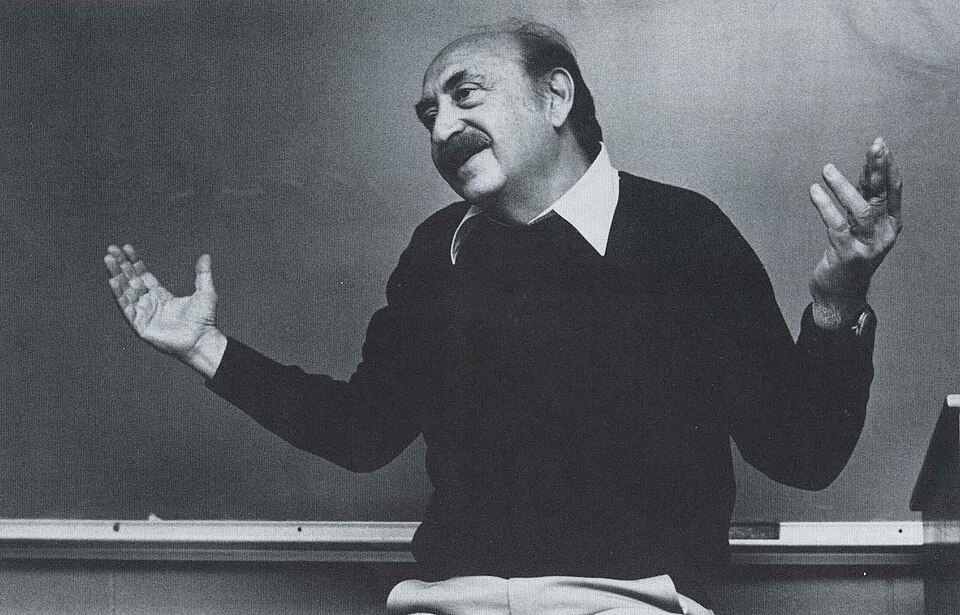
Karl Gerstner
The Basel designer who systematised visual decision-making with the Programme concept and spent his life showing that rigour and invention are not opposites.
Karl Gerstner was among the Swiss designers who converted the International Style's visual discipline into a theoretical method. His 1964 book Designing Programmes argued that design decisions can and should be encoded in advance as rule systems — programmes — so that any solution within a given task is already determined by its structure. It was a move that anticipated algorithmic and computational design thinking by decades.
Basel and the Swiss milieu
Gerstner was born in Basel on 2 July 1930. He trained as an apprentice at the studio of Fritz Bühler, one of the leading Swiss graphic designers of the postwar period, and later studied at the Allgemeine Gewerbeschule Basel — the school that produced or shaped a generation of Swiss design practitioners. The Basel milieu was typographically rigorous: Akzidenz-Grotesk, the grid, flush-left setting, and systematic structure were the working assumptions.
He came of professional age in the same cultural moment as Josef Müller-Brockmann, Emil Ruder, and Armin Hofmann, whose work collectively gave the International Typographic Style its canonical form. But Gerstner pushed further than most toward a systematic theory of design itself.
Designing Programmes
Published in 1964 by Arthur Niggli, Designing Programmes (Programme entwerfen) is his central theoretical contribution. The core argument: a design problem should be solved not by producing a single solution but by defining a programme — a set of rules and parameters from which all valid solutions can be generated. The programme is the design; specific instances are its outputs.
Gerstner illustrated the method across typography, colour systems, and image-making, developing visual grids and colour matrices that could produce infinite variation within controlled limits. The approach was prescient. The systematic relationship between design rules and their outputs anticipates variable fonts, design tokens, and procedural graphics — tools that arrived decades later in digital form.
He was also a practising artist. His "Carro" series of kinetic paintings and his colour studies occupied him in parallel with commercial and theoretical work.
To describe the problem is part of the solution.
GGK and practice at scale
In 1959 Gerstner co-founded GGK (Gerstner, Gredinger + Kutter) in Basel, which grew into one of the major Swiss advertising agencies. The agency's work applied the same systematic principles to commercial communication, demonstrating that the programme concept was not merely academic. GGK produced campaigns for clients across Europe over the following decades.
The combination — practising designer, agency founder, systematic theorist, and artist — was characteristic: Gerstner refused the division between thinking and making that separates theorists from practitioners in most fields.