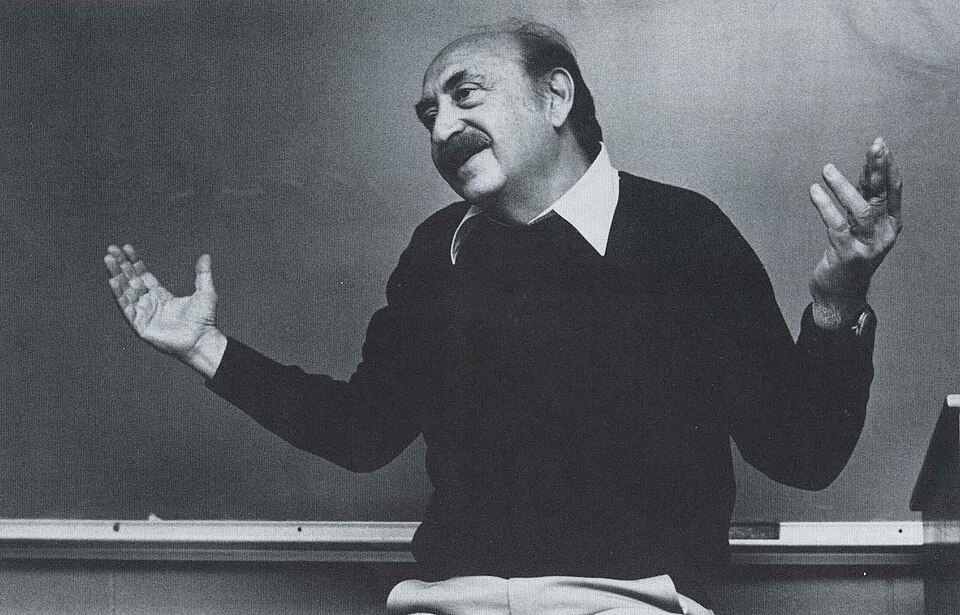
Kenji Ekuan
A designer who survived Hiroshima and a monastery to build one of Japan's largest design firms, and whose soy sauce bottle became one of the most-sold objects in the history of tableware.
Kenji Ekuan's biography is inseparable from the shock that shaped it: the loss of his father and sister in the Hiroshima atomic bombing in 1945 drove him first toward a Buddhist monastery and then toward design, which he pursued as a form of humane reconstruction. The red Kikkoman dispenser he designed in 1961 — carried in millions of kitchens and on restaurant tables across the world — is the object through which he is most remembered, though it represents only one strand of a career that spanned vehicle design, public infrastructure, and design philosophy.
Origins
Ekuan was born in Tokyo in 1929. The death of his father and sister at Hiroshima in August 1945 was a formative rupture; confronting the scale of the destruction, he entered Buddhist monkhood. He eventually returned to secular life and enrolled at the Tokyo National University of Fine Arts, where he trained in industrial design. In 1952, while still a student, he co-founded what would become GK Design Group — an organisation that grew into one of Japan's largest industrial design consultancies.
The Kikkoman bottle
In 1961 Ekuan was commissioned to redesign the container for Kikkoman's soy sauce. The existing packaging was standard glass, suitable for the table but not shaped for the hand or for controlled pouring. Ekuan's solution was a narrow-necked glass flask with a distinctive red cap — the neck designed to prevent drips, the proportions calibrated for single-handed use, the form legible at a glance. The bottle went into production and remained in production without fundamental alteration. By the time of Ekuan's death more than 400 million had been sold worldwide. It is among the most studied objects in postwar Japanese industrial design: an example of a functional problem solved so completely that the solution became invisible.
GK Design and broader work
GK Design Group expanded through the 1960s and beyond, working across vehicle design, Yamaha products, public transportation systems, signage, and urban space. Ekuan directed the firm's philosophical orientation as much as its projects: he wrote extensively about the relationship between Japanese cultural identity and industrial modernity, arguing that design was not a western import to be absorbed but a practice that Japanese makers had exercised in their own way across centuries. This position informed how GK Design approached commissions — not with nostalgic reference to tradition but with attention to the underlying values of Japanese craft.
Philosophy and legacy
Ekuan lectured and wrote about design as a moral activity, connecting his Buddhist formation to an ethic of care for the user. His experience of Hiroshima never left his public thinking; he returned to it as evidence that human creativity carries responsibility. He received recognition in Japan and internationally for his contributions to industrial design and for building an institution, GK Design, that trained generations of Japanese designers. He died in Tokyo on 8 February 2015, aged 85.
"Design is the human power to create a better environment, a better life."