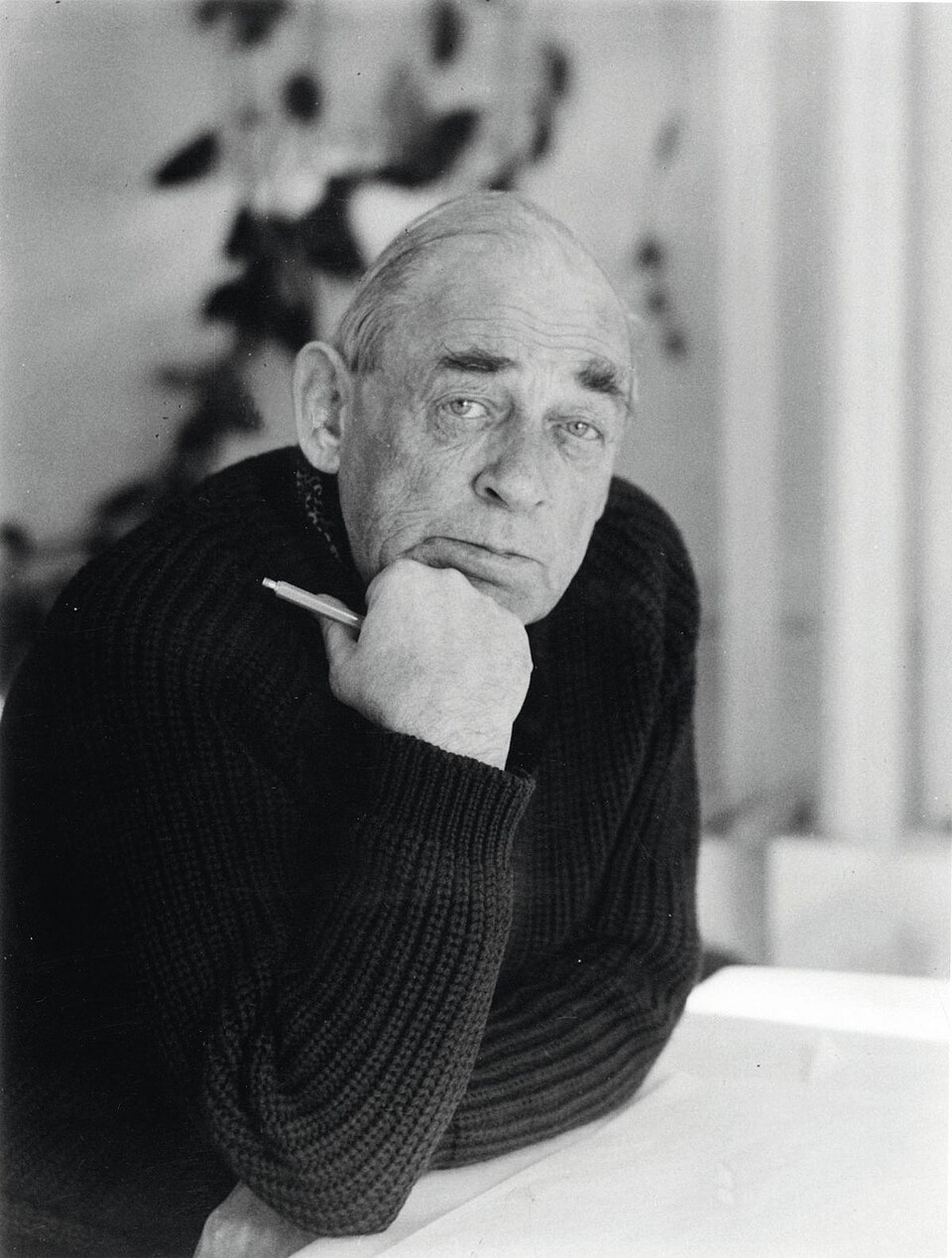
Ladislav Sutnar
The Czech émigré designer who brought constructivist rigour to American commercial information — inventing the parenthetical telephone area code format and pioneering what is now called information design.
Ladislav Sutnar arrived in New York in 1939 for the World's Fair and never returned to Czechoslovakia — and from that displacement built a practice that changed how commercial information was organised, presented, and read. He applied the formal lessons of European constructivism not to art posters but to catalogues, directories, and product specifications, treating the reader's cognition as the material to be designed.
Constructivism in Prague
Sutnar was born in Plzeň in 1897 and studied at multiple schools in Prague before establishing himself as a designer there in the 1920s and 1930s. He worked across graphic design, exhibition design, industrial design, and typography, absorbing the influence of Bauhaus functionalism and the Constructivist idea that design serves a social purpose. In Prague he became director of the State School of Graphic Arts and produced work for Czech industry and cultural institutions — book covers, glassware, ceramics — in a spare, geometry-led style. His exhibition designs for Czech participation in major international fairs attracted attention outside the country.
New York and information design
When the Czechoslovak government sent Sutnar to New York to oversee the Czech pavilion at the 1939 World's Fair, he brought with him his visual principles and his constructivist approach to structure. When the Nazi occupation made return impossible, he stayed. He found a position as art director of Sweet's Catalog Service — a company that published product catalogues for the American building industry — and held it for nearly two decades.
The Sweet's commissions were unglamorous by art-world standards: index tabs, column layouts, specification sheets. Sutnar treated them as problems in cognitive design. He introduced typographic hierarchy — size, weight, and colour to guide the eye through dense information. He restructured page layouts so that the most-needed data was immediately accessible. He codified the parenthetical area code format: writing a telephone number as (212) 555-0100 rather than the previously unseparated string, a convention so useful it was adopted universally and remains standard.
Design is not just what something looks like. Design is how something works for the person who uses it.
Books and legacy
Sutnar articulated his approach in several books. Controlled Visual Flow examined how the eye moves through designed information. Package Design: The Force of Visual Selling applied his principles to product packaging. Visual Design in Action (1961), his most comprehensive statement, laid out the logic of information design in systematic terms — a discipline that would not acquire that name until decades later. His work is held in the Museum of Modern Art and has been the subject of renewed critical attention as information design and UX research have claimed historical roots.
He received commissions from McGraw-Hill, IBM, and the United Nations, applying the same organisational principles to varying scales of information problem.