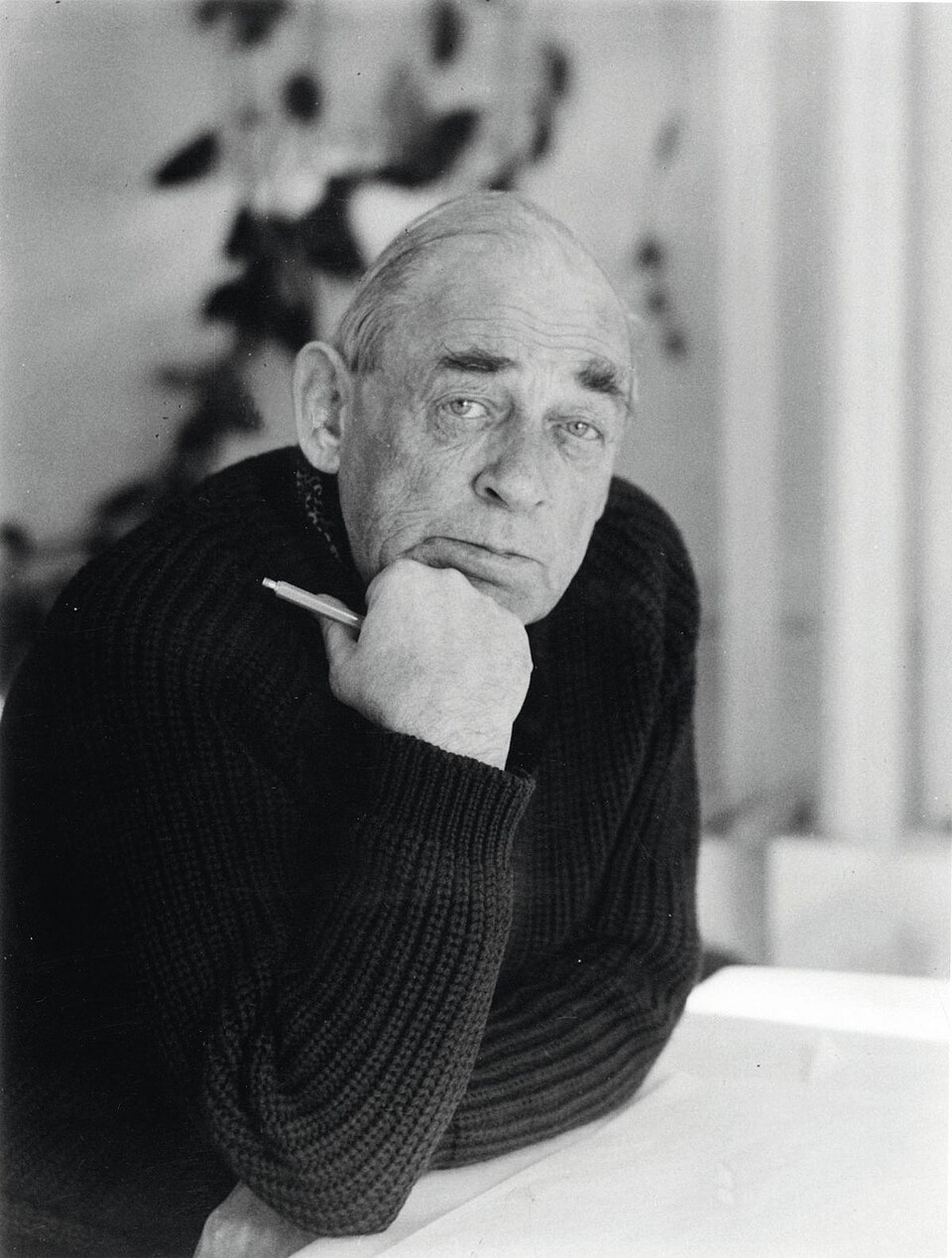
Lester Beall
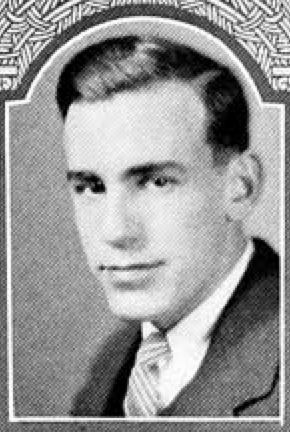
The Kansas City-born designer who brought European modernism into American commercial and government communication, working in a visual language of bold geometry and primary colour that has remained legible across eight decades.
Lester Beall worked in the 1930s and 1940s in a tradition largely without precedent in the United States — graphic design that borrowed the formal vocabulary of Constructivism, photomontage, and the Bauhaus and applied it to American commercial clients, federal agencies, and magazines, making a case that modern design and democratic communication were compatible projects.
Formation
Beall was born in Kansas City in 1903 and studied art history at the University of Chicago, graduating in 1926. He was largely self-taught as a designer, absorbing European modernism — particularly the work of El Lissitzky, Cassandre, and the Bauhaus — through magazines, books, and reproduction rather than through formal training in design. He set up a studio in Chicago in the late 1920s and moved to New York in 1935, where he quickly attracted attention from major clients and the design press.
The REA posters
His best-known work is the series of posters produced for the Rural Electrification Administration between 1937 and 1941. The REA was a New Deal programme bringing electricity to rural America; Beall was commissioned to produce posters that would communicate its purpose to rural audiences. The results — red, white, and blue palettes, bold silhouettes, photomontage, and hand-lettered sans-serif type — fused American vernacular imagery (farm buildings, fields, the American flag) with European avant-garde formal methods. They are among the most formally accomplished examples of American government communication design from the period.
The three poster series — the first commissioned in 1937, two further series following in 1939 and 1941 — track a development in Beall's confidence with these forms. The 1941 series is the most assured: compositions are cleaner, the photomontage integration more seamless.
Good design is not a matter of personal taste. It is a matter of clear communication.
Corporate and editorial work
Beyond the REA, Beall produced work for International Paper Company, Merck, Caterpillar, and other major American corporations, developing what was later described as corporate identity programmes — coordinating the visual presentation of a company across multiple media. He worked for Scope magazine (a house publication of Upjohn Pharmaceuticals) from the 1940s onward, producing covers and layouts of considerable formal invention. He also designed for Fortune, the New York Herald Tribune, and other publications.
He relocated from New York to a farm in Connecticut in 1951, working in relative isolation but without reducing his output or ambition. His practice at Dumbarton Farm became a model for the independent design studio operating outside the city.