Michael Bierut
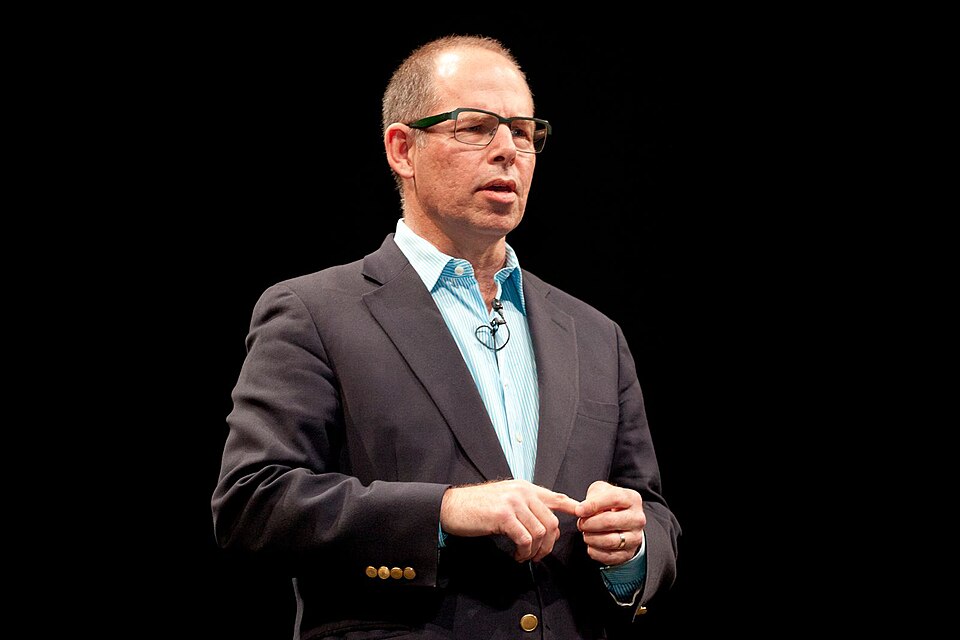
The Cleveland-born designer who elevated everyday identity — from political campaigns to shopping bags — into legible, lasting public language.
Michael Bierut has spent more than four decades arguing — through his work, his writing, and his teaching — that graphic design is not a service industry but a form of thought made visible. His client list spans election campaigns, luxury retail, universities, and airports, yet the common thread is design that earns attention without demanding it.
Formation in Cincinnati and New York
Bierut grew up in Cleveland and studied graphic design at the University of Cincinnati's College of Design, Architecture, Art, and Planning (DAAP), graduating in 1980. DAAP's rigorous curriculum placed him in the tradition of American pragmatic design education — problem-driven, craft-conscious, and alert to context. On graduating he moved to New York and joined Vignelli Associates, working directly under Massimo Vignelli for ten years. Vignelli's insistence on logic, hierarchy, and the subordination of decoration to meaning left a durable imprint on Bierut's sensibility.
Pentagram and the practice of identity
In 1990 Bierut became a partner at Pentagram, the New York office of the multinational design firm whose cooperative structure allows each partner to run an independent practice under a shared name. The arrangement suited a designer with broad curiosity: Bierut has designed identities for institutions as different as Saks Fifth Avenue, the New York Times, the Yale School of Architecture, and MIT Media Lab, as well as environmental graphics for Newark Liberty International Airport. His work on the Saks Fifth Avenue wordmark — fragmented into a flexible grid of identifiable squares — became a widely discussed example of how a luxury brand could embrace instability as a design principle rather than fear it.
The 2016 Hillary Clinton presidential campaign logo brought Bierut's work to a genuinely mass audience. The arrow-through-H mark, designed under acute time pressure and intense public scrutiny, demonstrated that a simple geometric symbol can concentrate a campaign's aspirations in a single, reproducible form.
Writing and criticism
Bierut is a co-founder and long-standing contributor to Design Observer, the online platform that helped establish design criticism as a legitimate discipline in the early internet era. His book "How to" (2015) collects case studies organised by verb — how to think, how to sell, how to distinguish — treating each commission as a problem that design had to think its way through rather than merely decorate. He is also co-editor of the "Looking Closer" anthology series, which gathered critical writing on graphic design at a moment when the field was defining its own discourse.
Teaching and recognition
As a senior critic at the Yale School of Art, Bierut has taught graduate design students for decades, serving as a bridge between professional practice and academic inquiry. He is a member of the Alliance Graphique Internationale (AGI) and a recipient of the AIGA Medal, the profession's highest honour in the United States. His public lectures and interviews have made him one of the most widely quoted voices on what graphic design is for.
Everything I know about design I had to learn by doing it badly first.