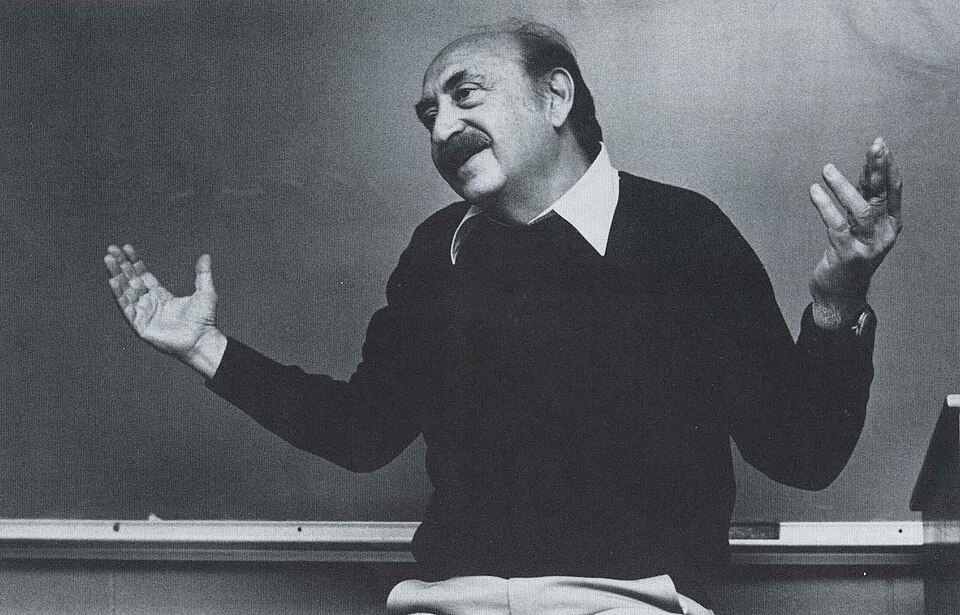
Ray Eames
The painter and weaver who co-invented the modern chair — and whose eye shaped everything the Eames Office ever made.
Ray Eames spent four decades working beside Charles Eames, yet the depth of her own contribution — as colorist, composition-maker, and formal thinker — has only recently received its due. Her training in painting under Hans Hofmann gave the Eames Office a visual intelligence that engineering alone could not have supplied.
From fine art to industrial form
Born Ray-Bernice Alexandra Kaiser in Sacramento, she studied painting with Hans Hofmann in New York from 1933 to 1939, absorbing his push-and-pull theories of pictorial space. She was among the founding members of American Abstract Artists, exhibiting alongside figures such as Lee Krasner. When she encountered Charles Eames at the Cranbrook Academy of Art in Michigan — where Eliel Saarinen presided and Eero Saarinen worked alongside them — the collaboration began almost immediately. They married in 1941 and established their office in Los Angeles.
The molded plywood experiments
The Eameses' first industrial breakthrough came through their wartime work for the US Navy: molded plywood leg splints that demanded exactly the compound-curve forming technique they would later apply to furniture. The LCW (Lounge Chair Wood) of 1945 and the DCM (Dining Chair Metal) grew from this research, produced by Evans Products and then by Herman Miller. Ray's role in determining the surface pattern, the color options, and the proportional language of these pieces was substantive — decisions that read as intuitive were the product of her systematic visual training.
Color, surface, and exhibition
Where Charles tended toward structure and mechanism, Ray governed surface and affect. The Eames Storage Units (1950) used sliding panels in primary colors that owed an obvious debt to De Stijl, yet the palette she chose was warmer and less doctrinaire. Her cover designs for Arts & Architecture magazine in the early 1940s showed a graphic sensibility — bold, geometric, inventive — that predated the Eames Office's public identity. She also co-directed films including Powers of Ten (1977), contributing to sequencing and visual rhythm throughout.1
| Work | Year | Role |
|---|---|---|
| LCW — Lounge Chair Wood | 1945 | Co-design, surface |
| House of Cards picture deck | 1952 | Design lead |
| Eames Storage Units | 1950 | Color and panel design |
| Powers of Ten (film) | 1977 | Co-director |
Legacy and reappraisal
Ray Eames outlived Charles by ten years, dying in 1988, exactly a decade after him. In the decades since, curators and historians have worked to disaggregate the partnership — not to diminish Charles but to give Ray the specific credit she earned as a painter-turned-designer whose eye was irreplaceable. The 2015 travelling exhibition The World of Charles and Ray Eames at the Barbican, London, was among the most sustained attempts to treat their contributions as parallel rather than hierarchical.
You can't tell where one of us starts and the other stops.
Footnotes
- The final version of Powers of Ten was released in 1977; an earlier sketch film was made in 1968. ↩