Raymond Loewy
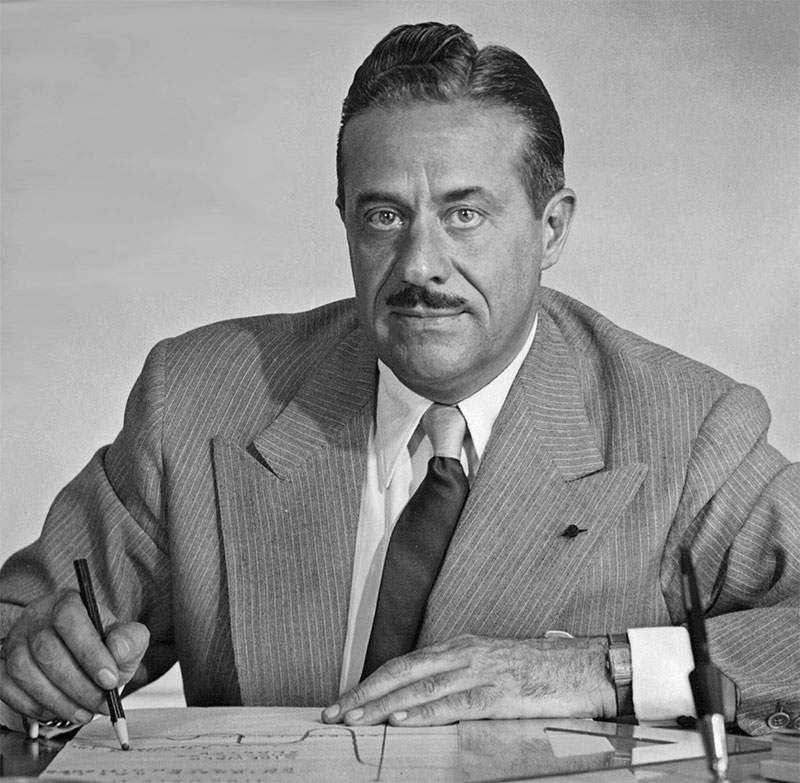
The French-American designer who reshaped everyday American life by making the machine-made beautiful — from locomotives to Coca-Cola bottles to NASA interiors.
Raymond Loewy arrived in New York in 1919 with little English and considerable conviction, and spent the next six decades redesigning the surfaces of American commercial life. His clients ranged from Studebaker and the Pennsylvania Railroad to Lucky Strike and NASA, and his instinct — that the public prefers beauty over ugliness, all else being equal — proved commercially correct at almost every turn.
Paris to New York
Loewy was born in Paris on 5 November 1893. He trained as an electrical engineer and served in the French army during the First World War before emigrating to the United States in 1919. He supported himself initially as a fashion illustrator for Vogue and Harper's Bazaar before finding his way into industrial design. His first major commission came in 1929, when he was asked to redesign a Gestetner duplicating machine — a typewriter-adjacent office device he stripped and rationalised into a cleaner form. The commission established the pattern of his career: improve the appearance of an existing product, demonstrate that the improvement sells, move to the next client.
Streamlining and the railroad age
In the 1930s Loewy became the leading figure in the American streamlining movement — the application of aerodynamic forms derived from aviation and naval engineering to trains, cars, and consumer goods. His Pennsylvania Railroad GG1 locomotive (1934) and the S-1 locomotive (1939) were among the most visually commanding machines of the era: long, low, rivet-free, their surfaces expressing speed even at rest. The Pennsylvania Railroad's Broadway Limited trains extended this language to the passenger experience inside.
The aesthetic translated readily to smaller objects. Loewy redesigned the Coldspot refrigerator for Sears (1935) with smooth, rounded lines that set the standard for domestic appliance appearance for a generation. His studio produced the Lucky Strike cigarette pack redesign (1942), arguably one of the most recognised packaging decisions of the century.
Good design keeps the user happy, the manufacturer in the black, and the aesthete unoffended.
Method: MAYA
Loewy articulated his approach through what he called the MAYA principle — Most Advanced Yet Acceptable. The designer's task was to push toward the unfamiliar exactly as far as the market could absorb without rejection. Too conservative and the design stagnates; too radical and the public turns away. It was a theory of calibrated novelty, and Loewy's record suggests he applied it with unusual accuracy across very different product categories.