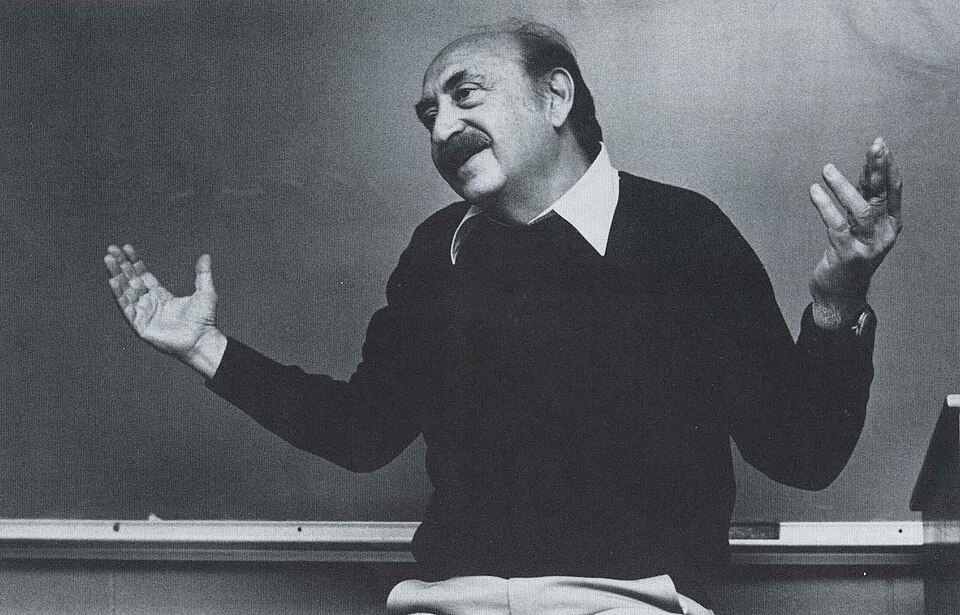
Shigeo Fukuda
A Japanese designer and sculptor who made visual deception into a philosophical practice — building images and objects whose meaning inverted when you looked again.
Shigeo Fukuda spent his career making things that were not what they appeared to be. His posters used optical illusion to embed competing images within a single composition; his sculptures used shadow to say something different from what the object itself showed. The wit was precise and the point was always political: Fukuda was an anti-war designer and environmentalist who used perceptual sleight of hand to make arguments about violence, power, and the gap between appearance and reality.
Formation in Tokyo
Fukuda was born in Tokyo on 4 February 1932 and studied at the Tokyo National University of Fine Arts and Music. He began working as a graphic designer and illustrator in the early 1950s, building a practice that moved between poster design, exhibition work, and three-dimensional sculpture.
He was one of Japan's most significant postwar graphic designers — a figure whose international reputation grew through poster biennials and exhibitions from the 1960s onward.
The optical illusion as method
Fukuda's defining graphic method was the figure-ground illusion: images in which positive and negative space contain equally legible but contradictory forms. A silhouette of a marching soldier becomes, in the negative space, a falling body. Women in one light become men from another angle. The technique was not new — Gestalt psychology had described it, and designers had used it — but Fukuda made it systematic and gave it a consistent political charge.
His poster work on environmental and anti-war themes used this reversibility to embody his arguments structurally, not just iconographically. The deception was the message.
The image that shows two things at once shows that two things are always true.
Sculpture and shadow
Beyond posters, Fukuda was a sculptor who worked with the relationship between object and cast shadow. His piece Lunch With a Helmet On — an assemblage of forks, knives, and spoons whose shadow resolved into a detailed motorcycle — is among the most celebrated demonstrations of the technique. The object and its shadow are in dialogue, each revealing what the other conceals.
He was also a medallist, designing commemorative medals that deployed the same economy of means and double reading.
Fukuda died in Tokyo on 11 January 2009.