Sori Yanagi
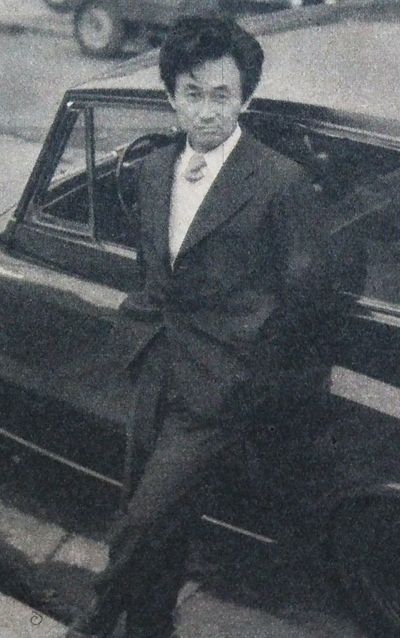
The son of Japan's foremost craft theorist became its most precise modernist, reconciling the silence of folk objects with the demands of postwar industrial production.
Sori Yanagi worked at the intersection of two inheritances — the folk craft tradition his father Soetsu Yanagi had theorised, and the structural logic of European modernism he had absorbed in Charlotte Perriand's studio. The objects he made from the 1950s onward belong to neither tradition exclusively, which is precisely why they endure: they are resolved without being doctrinaire, shaped by use rather than by argument.
Origins and formation
Yanagi was born in Tokyo in 1915, the son of Soetsu Yanagi, philosopher and founder of the mingei folk craft movement. The household was saturated with craft objects and the belief that anonymous makers working within tradition could produce things of greater beauty than self-conscious artists. Sori studied painting at the Tokyo National University of Fine Arts, but his decisive formation came from contact with European modernism. When Charlotte Perriand visited Japan in 1940 at the invitation of the Ministry of Commerce to advise on Japanese industrial design, Yanagi worked in her studio. Her rigorous approach to functional problems — inherited from Le Corbusier but applied with attention to material honesty — gave Yanagi a method to set against his father's aesthetics.
The Butterfly Stool
Yanagi established his own design office in 1952. Two years later he produced the object for which he remains most known: the Butterfly Stool, manufactured by Tendo Mokko. It consists of two identical pieces of molded plywood joined at the base by a brass rod and a bolt, their curves forming a symmetrical form that reads differently from every angle. The weight is minimal; the visual presence is not. It entered the permanent collection of the Museum of Modern Art in New York and has been in continuous production since. The same year produced the Elephant Stool — a low, stackable form in fiberglass whose three legs splay with the stable assurance of the animal it names.
Craft and industry
Yanagi's practice was never confined to furniture. He designed domestic objects — cookware, cutlery, ceramics — with the same insistence that form should arise from function and that function should be tested against the hand. He was not nostalgic about craft; he believed industrial production was capable of the same clarity that anonymous craftsmen had achieved over generations, provided the designer understood materials deeply enough. This position placed him between his father's world and the demands of postwar Japanese manufacturing, and he navigated it without resolving the tension into a formula.
Later career and legacy
In 1977 Yanagi became director of the Japan Folk Crafts Museum in Tokyo — the institution his father had founded — a role he held for decades. He continued to design and to argue for the integration of craft knowledge into industrial practice. He received the Good Design Award on multiple occasions. He died on 25 December 2011 in Tokyo, aged 96. The Butterfly Stool remains one of the most reproduced images in postwar Japanese design, and it continues to be manufactured unchanged.
"A good design is not something that cannot be improved. It is something that is right for its time."