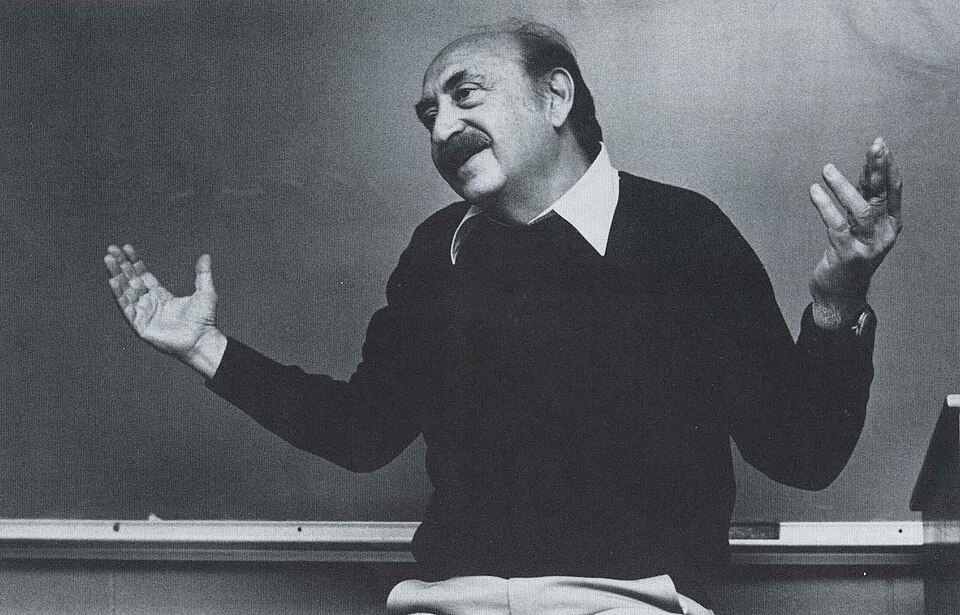
Tibor Kalman
A Hungarian-born New York designer who used graphic wit and deliberate discomfort to make culture argue with itself.
Tibor Kalman believed graphic design was too important to be left in the service of client comfort. From his New York studio M&Co he made objects that asked awkward questions, commissioned work that wrongfooted assumptions, and edited a magazine — Colors — that treated the world's inequalities as design problems worth confronting. He died of lymphoma at forty-nine, leaving behind a body of work inseparable from a position.
Budapest to New York
Kalman was born in Budapest in 1949. His family left Hungary after the 1956 uprising and settled in New York, where he grew up. He studied journalism briefly at New York University before dropping out and taking a job at the Books & Co. bookshop, where he eventually became manager and began remaking its visual identity — an early sign that he approached any visual environment as material to redesign.
M&Co and the argument for ideas
In 1979 Kalman founded M&Co with Carol Bokuniewicz and Liz Trovato. The studio took on a range of clients — restaurants, record labels, cultural institutions, apparel companies — and consistently produced work that prioritised a strong concept over decorative refinement. The watches M&Co designed for Swatchwatch ran their numbers backwards. The studio's restaurant menus and identity programmes had a found, ironic quality that felt unlike anything else in American commercial design of the period.
M&Co became one of the most discussed design studios of the 1980s, cited as an antidote to the polished corporate identity work that dominated the field.
Design is not a neutral activity — every choice is a statement about what matters.
Colors and the late period
In 1990 Kalman was invited by Benetton and its creative director Oliviero Toscani to become founding editor-in-chief of Colors, a magazine conceived as a global publication about culture, race, and difference. Kalman relocated to Rome to produce it. The early issues used graphic design as journalism — confrontational photography, stark layouts, text pared to the minimum — to address race, AIDS, poverty, and political violence with a directness that advertising-funded magazines typically avoided.
He returned to New York in 1993, re-opened M&Co as a smaller practice, and continued working until illness prevented it. He died in Puerto Rico on 2 May 1999.