Alberto Giacometti
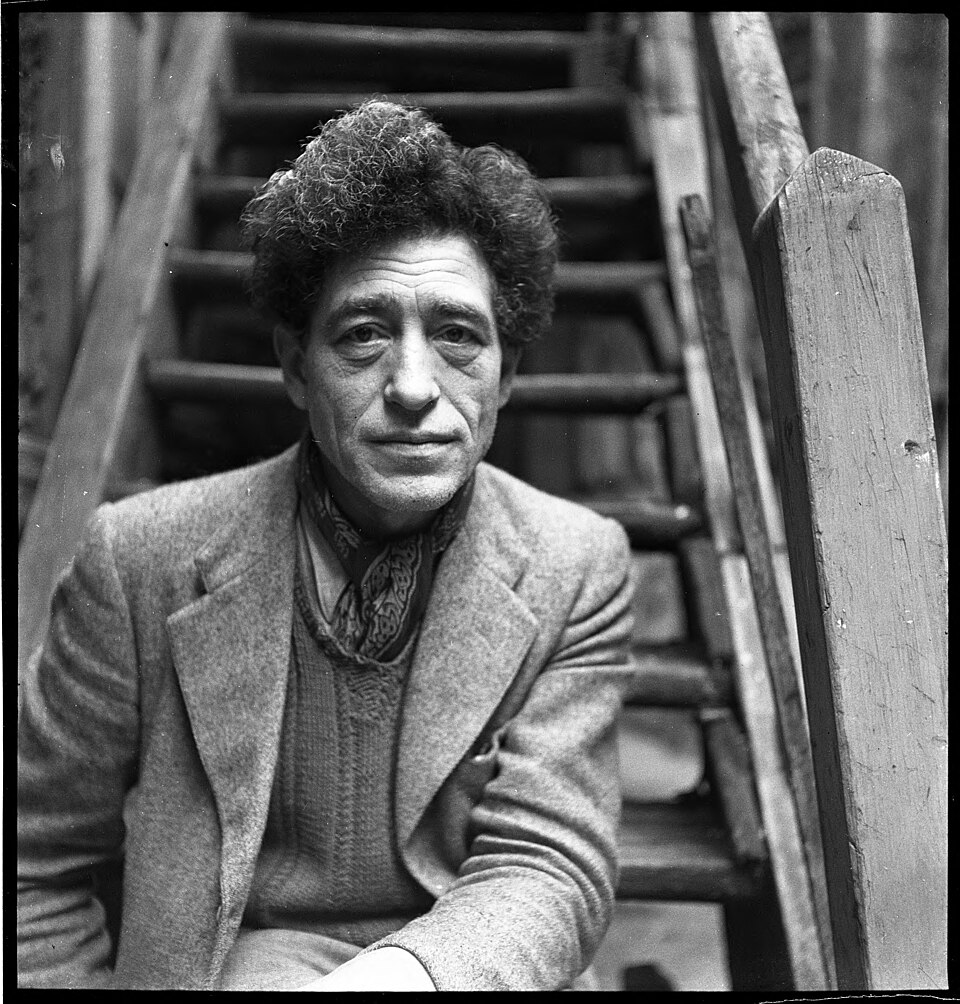
The Swiss sculptor whose elongated, solitary bronze figures made the existential condition of human isolation visible in three dimensions.
Alberto Giacometti spent his career reducing the human figure to its barest essentials — thin, pitted, upright — until what remained was less a body than a presence surviving at extreme distance. Working from a cramped studio in Montparnasse that he occupied for the rest of his life after settling in Paris in 1922, he became the sculptor of postwar existentialism: associated with Sartre, admired by Beckett, and impossible to separate from the philosophical climate of mid-century Europe.
Origins and formation
Giacometti was born in 1901 in Borgonovo, a small village in canton Graubünden in the Swiss Alps. His father, Giovanni Giacometti, was a well-regarded Post-Impressionist painter, and art was present from childhood. After early studies in Geneva, Alberto moved to Paris in 1922 to study sculpture with Antoine Bourdelle at the École des Beaux-Arts. Bourdelle had himself studied under Rodin, and the transmission of a serious figurative tradition was direct.
Paris brought Giacometti into contact with the leading artistic movements of the interwar period. By the late 1920s he had entered the orbit of the Surrealists, and in the early 1930s he produced some of the movement's most formally inventive works — open cages, symbolic objects, and suspended structures that behaved more like propositions than conventional sculptures.
Defining works
His Surrealist period produced The Palace at 4 a.m. (1932), an open skeletal construction in wood suggesting a stage set for some unnarrated dream event. It was admired by André Breton and remains one of the most cited objects from the Surrealist canon.
After a break from Surrealism in the late 1930s and years of intensive experimentation, Giacometti arrived at the spare figurative language for which he is now known. The figures grew tall, thin, and roughened. Their surfaces retained the marks of constant reworking. He described the difficulty of fixing a likeness as absolute — the more he worked on a figure, the more it seemed to recede.
Walking Man (L'Homme qui marche, 1960) is the concentrated statement of this mature period: a striding bronze male reduced to essential structure, the surface alive with the evidence of process, the stance asserting forward movement against apparent fragility.
Method and studio
Giacometti's studio on the rue Hippolyte-Maindron in the 14th arrondissement was famously small and permanently encrusted with plaster. He worked on multiple figures simultaneously, reducing them, abandoning them, beginning again. Scale fluctuated; he produced figures both monumental and miniature, sometimes within weeks of each other. The material process was inseparable from the perceptual problem he was trying to solve — how the eye constructs a person in space, how distance and duration affect what we recognise as human.
Jean-Paul Sartre, who wrote the preface to a 1948 Giacometti exhibition catalogue, saw the figures as demonstrations of freedom burdened by facticity. Samuel Beckett, whose friendship with Giacometti was long and genuine, referenced a tree by the sculptor when designing the stage for Waiting for Godot.
Legacy
Giacometti received the Grand Prize for Sculpture at the Venice Biennale in 1962, one of the most significant honours in international contemporary art. He died in Chur, Switzerland on 11 January 1966. His influence on subsequent sculpture has been less one of direct formal imitation than of conceptual permission — the demonstration that reduction and uncertainty could be as powerful as resolution and mass.
The more I work, the more I see things differently — that is, everything gains in grandeur every day, becomes more and more unknown, more and more beautiful.