Jean-Michel Basquiat
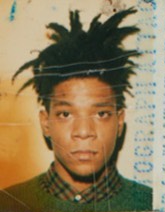
A Brooklyn-born painter who burned from graffiti-tagged walls to the international art market in under a decade, leaving behind a body of work that fused street vernacular with art-historical confrontation.
Jean-Michel Basquiat emerged from the downtown New York underground in the late 1970s, first as the street tagger SAMO©, then as a painter whose canvases absorbed anatomy diagrams, corporate logos, blues music, police violence, and Black history into dense, crackling surfaces. He achieved mainstream gallery success by his early twenties and died of a drug overdose at twenty-seven, his career compressing a generation of influence into less than a decade.
Origins and the street
Basquiat was born in Brooklyn to a Haitian father and a Puerto Rican mother. His mother introduced him to museums and encouraged his drawing; his parents' divorce and his mother's mental illness later shaped the sense of dislocation that runs through his work. He left home at seventeen and lived on the streets of lower Manhattan, surviving by selling hand-painted postcards and T-shirts while tagging buildings in SoHo and Tribeca with the cryptic SAMO© slogans he co-created with friend Al Diaz. The tags — dry, sardonic aphorisms aimed at commodity culture — attracted the attention of artists and critics before Basquiat had set foot inside a gallery.
The painting years
His transition from wall to canvas accelerated after he appeared on Glenn O'Brien's public-access television programme TV Party and was noticed by Andy Warhol and dealer Annina Nosei. His first solo shows in New York and Los Angeles in 1982 sold out. By 1983 he was exhibiting at the Gagosian Gallery and participating in the Whitney Biennial; documenta 7 in Kassel that same year confirmed his European standing.
The paintings are layered and physically dense — text fragments, anatomical drawings, crowns, copyright symbols, and erased words coexist on raw canvas or wooden supports. Works such as Defacement (The Death of Michael Stewart) addressed police brutality directly. Untitled (1982), depicting a skull-like head in acid yellow and black, has become one of the most reproduced images in postwar American art. His collaboration with Warhol, which produced dozens of joint canvases between 1984 and 1985, proved controversial at the time but is now seen as a genuine creative exchange between two artists obsessed with brand, image, and mortality.
Method and reference
Basquiat worked fast, often on the floor, using oil stick, acrylic, and collaged paper. His notebooks — filled with drawings, lists, and copied texts — functioned as visual databases he mined continuously. He drew heavily on Charlie Parker, Dizzy Gillespie, and the history of jazz as counter-narratives to white institutional authority. Medical textbooks, Gray's Anatomy in particular, supplied the flayed figures and organ diagrams that suggest both vulnerability and the museum's cold taxonomy of Black bodies.1
| Influence | How it appears |
|---|---|
| Jazz and blues | Named works, musician portraits, musical notation fragments |
| Gray's Anatomy | Exposed musculature, organ labels, skeletal diagrams |
| Heraldry | Crowns, three-pointed symbols as marks of authority and self-coronation |
| Street typography | SAMO© tags, stencilled letters, crossed-out words |
Legacy
Basquiat's market ascent after his death has been extraordinary, with major works selling at auction for tens of millions of dollars. More significantly, he opened space for artists engaging with race, identity, and popular culture that subsequent generations — from Kerry James Marshall to Kehinde Wiley — have built upon. His influence on hip-hop visual culture, fashion, and graphic design is pervasive if difficult to fully trace.
I am not a Black artist, I am an artist.
Footnotes
- Basquiat's use of medical illustration has been linked by critics to a copy of Gray's Anatomy given to him by his mother during a childhood hospitalisation. ↩