Albrecht Dürer
The Nuremberg master who carried the Italian Renaissance across the Alps — and in his prints made it available to every artist in Europe who could not travel south.
Albrecht Dürer was the first Northern European artist to understand fully what the Italian Renaissance had achieved and to find a language for translating it into a context where oil paint and printmaking, not fresco, were the primary media. His woodcuts and engravings — distributed across Europe within weeks of their completion — made him famous in his twenties and established the woodcut as a medium capable of the same complexity and nuance as painting.
Nuremberg and the goldsmiths' tradition
Dürer was born in Nuremberg on 21 May 1471, the son of a goldsmith who had emigrated from Hungary. He trained first with his father and then, from 1486, with the painter and woodcut designer Michael Wolgemut. Nuremberg was ideally placed for his ambitions: a prosperous trading city with strong connections to Venice, a developed printing industry, and a tradition of applied craftsmanship in metalwork and woodcarving that gave him a technical foundation.
After completing his apprenticeship in 1490 he spent four years travelling — first to the Upper Rhine region, then to Italy in 1494–95. The first Italian journey was brief but decisive: he saw Mantegna's prints and paintings, absorbed the Venetian colourists, and encountered the systematic study of proportion and perspective that Italian theory had made the basis of painting.
The woodcut series
Returning to Nuremberg, Dürer published the Apocalypse (1498), a series of fifteen large woodcuts illustrating the Book of Revelation. The series was unlike any Northern woodcut previously published: the figures have the sculptural weight of Italian art, the compositions organise multiple overlapping planes with a spatial clarity derived from perspective, and the cutting is of a fineness that rivals engraving. It was an immediate success, reprinted and copied across Europe.
The Large Passion and the Life of the Virgin, published in the following years, consolidated his reputation. His greatest engraving, Melencolia I (1514), is an allegorical image of the creative mind — a winged figure surrounded by the tools of measurement and construction, unable to act — that has generated more interpretation than any other Northern Renaissance print.
Theory and later career
Dürer was the first Northern European artist to write systematically about the theory of art. His Four Books on Human Proportion (published posthumously in 1528) apply the Italian method of proportional analysis to the human figure across a range of body types — an expansion of the classical approach that anticipated the diversity of figure types a painter might actually need. His treatises on measurement, fortification, and perspective are equally systematic.
From 1512 he worked under the patronage of Emperor Maximilian I, contributing to large collaborative print projects. A second Italian visit in 1505–07 deepened his engagement with Venetian colour. He met Raphael by correspondence and exchanged works with him.
What beauty is I know not, though it adheres to many things.
Legacy
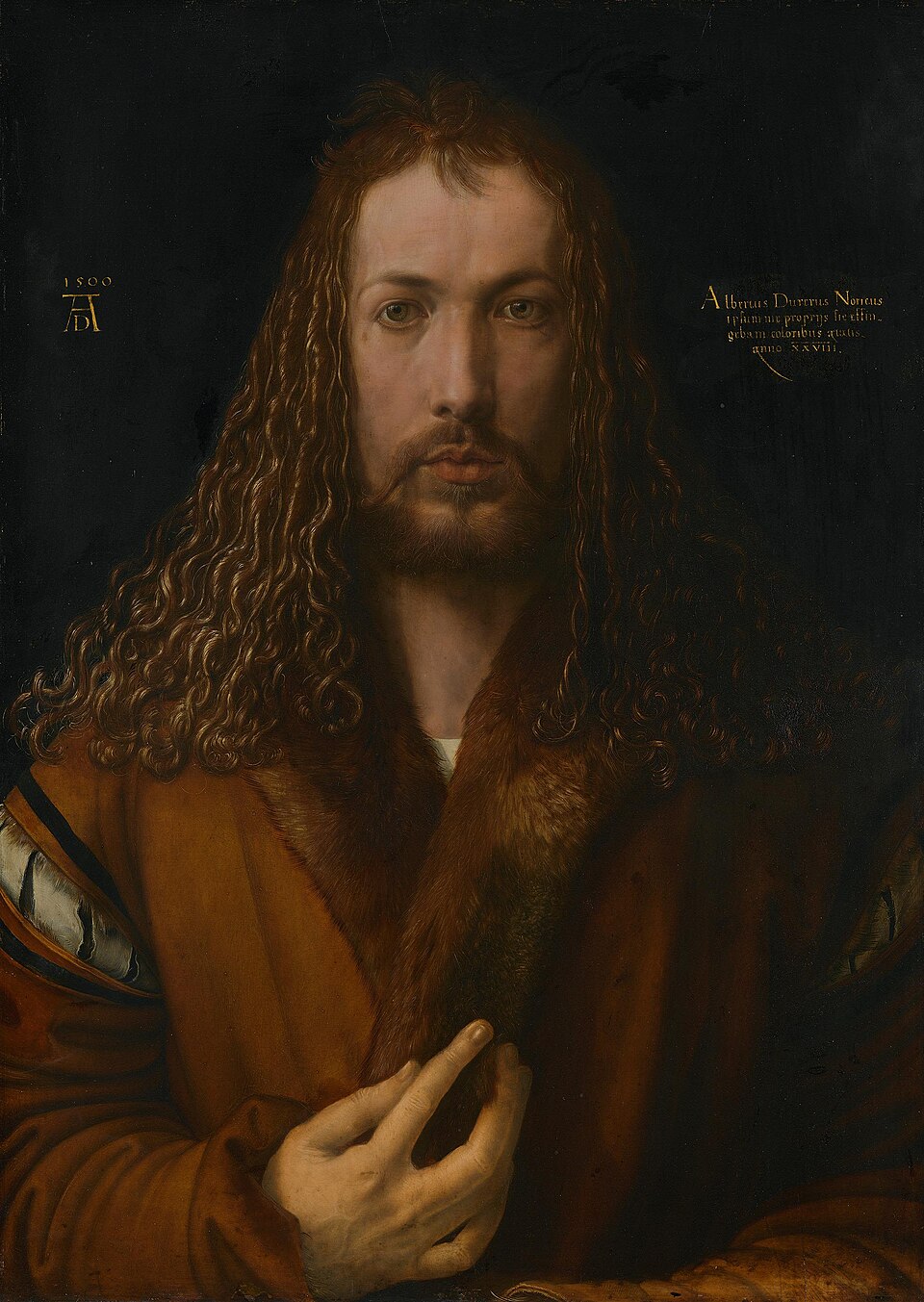
Dürer's prints circulated throughout Europe during his lifetime, making him the most internationally known artist of his generation. Raphael sent him drawings; Erasmus compared him to Apelles. His self-portraits — particularly the 1500 painting in the Alte Pinakothek, in which he depicts himself full-face in the manner traditionally reserved for Christ — constitute the most assertive statement of artistic dignity made before Velázquez.