Alexander Calder
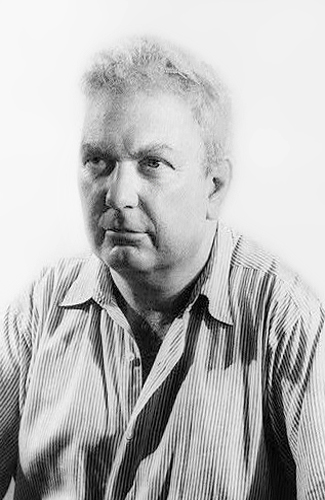
The American sculptor who set art in motion, inventing a form of kinetic work that balances mass, air, and chance into a single coherent language.
Alexander Calder arrived at kinetic sculpture through an unusual route — mechanical engineering followed by a miniature wire circus — and spent the rest of his career elaborating on what happens when sculptural form is given to movement and air. His mobiles hang and turn and respond; his stabiles stand firm at monumental scale in public plazas. Between them they represent the most thoroughgoing investigation of balance, weight, and spatial relationship in twentieth-century sculpture.
Origins and formation
Calder was born in 1898 in Lawnton, Pennsylvania (now absorbed into the Philadelphia area) into a family of sculptors: his grandfather Alexander Milne Calder made the bronze figure of William Penn that stands on Philadelphia City Hall; his father Alexander Stirling Calder was a well-regarded figurative sculptor. Despite this inheritance, Calder first trained as a mechanical engineer, graduating from Stevens Institute of Technology in 1919. He worked in industry for several years before turning decisively toward art, enrolling at the Art Students League of New York in 1923.
He moved to Paris in 1926, where he built Calder's Circus (Cirque Calder) — a portable miniature performance of wire, cork, cloth, and found material, operated by hand and performed for Parisian audiences through the late 1920s and early 1930s. The circus was both an artwork and an ongoing act; its humour, its precision of movement, and its delight in improvised mechanism were all continuous with the work that followed.
The mobile and the stabile
In 1930, Calder visited the studio of Piet Mondrian in Paris and was struck by the coloured rectangles arranged on white walls. The visit prompted a question: what if those elements moved? Within months he had begun producing kinetic works — first driven by motors, then, crucially, suspended so that air currents alone produced movement. Marcel Duchamp, seeing these works, named them mobiles — a word that in French carries connotations of both movement and motive.
The mobile's defining quality is the embrace of chance: no two positions repeat in the same sequence, and the relationships between hanging elements shift continuously. Calder built them in wire and sheet metal, painted in primary colours plus black and white, achieving a visual clarity that gave the works immediate presence at almost any scale.
For the larger, floor-standing works that could not be hung, Jean Arp coined the complementary term stabile. These anchored pieces — often monumental, often sited outdoors — share the mobile's elemental geometry but concentrate force downward rather than distributing it through air.
Public presence
Calder's public stabiles occupy civic spaces across the United States and beyond. Flamingo (1973), installed at the Federal Plaza in Chicago, is among the largest and most visited: a towering red structure of curved steel flanges whose scale and warmth hold their own against the surrounding glass towers of Mies van der Rohe. The choice to paint it red — Calder's signature vermilion — in that particular setting was deliberate and effective.
The commissioning of large public Calders became, from the 1960s onward, a marker of serious cultural ambition in American civic and corporate architecture.
Legacy
Calder received the Grand Prix at the Venice Biennale in 1952. He died in New York on 11 November 1976, two weeks after attending the opening of a major retrospective at the Whitney Museum of American Art. His influence extends in at least two directions: kinetic sculpture as a category — explored by George Rickey, Len Lye, and others — and public sculpture as an encounter rather than a monument. The Calder mobile has also become so thoroughly absorbed into design culture that miniature versions appear as objects of nursery and domestic decoration, a domestication the sculptor himself found broadly agreeable.
Theories may be all very well for the artist himself, but they shouldn't be broadcast to other people.