Amedeo Modigliani
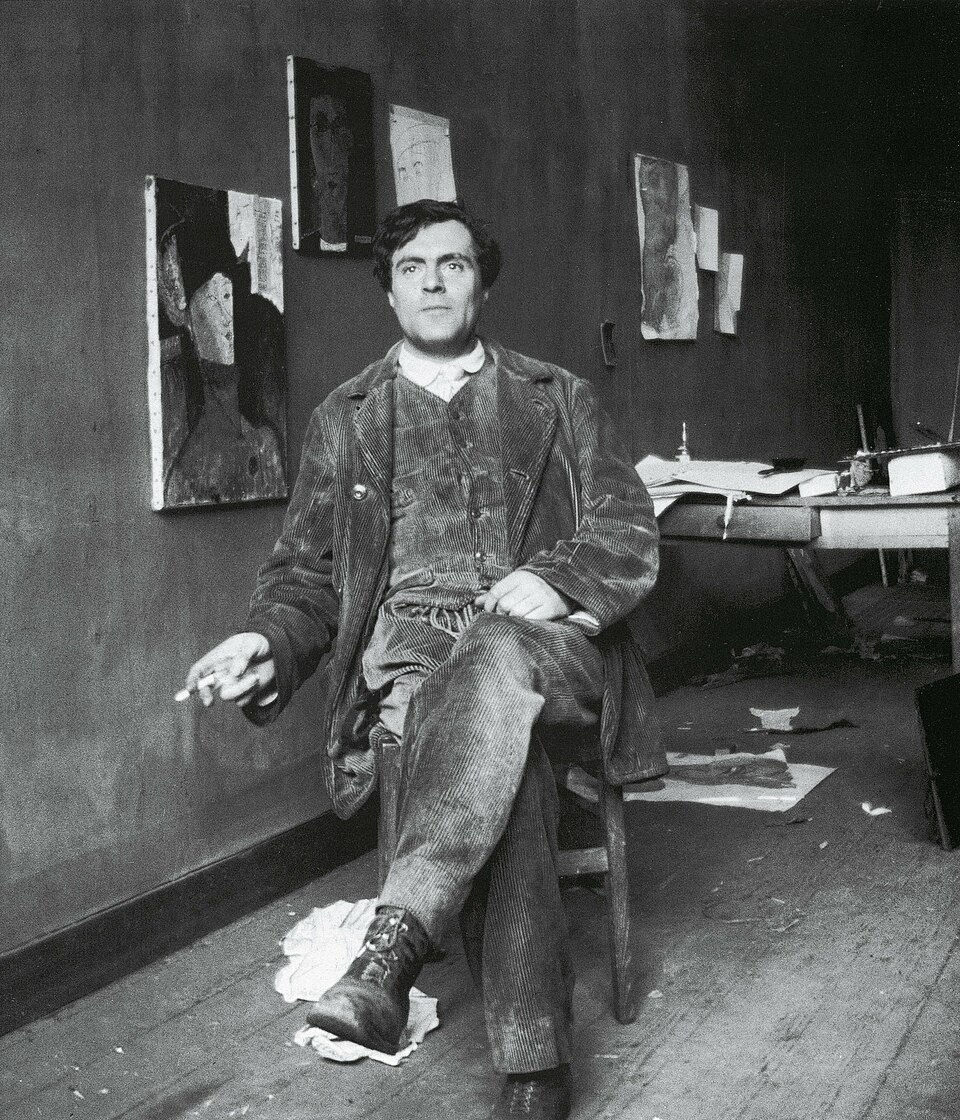
An Italian sculptor and painter of the École de Paris whose elongated portraits and nudes — cool, mask-like, tender — were ignored in his lifetime and became icons after his death at thirty-five.
Amedeo Modigliani spent fourteen years in Paris producing portraits and nudes of surpassing formal elegance — the face reduced to an oval mask, the neck lengthened, the eyes often depicted without pupils, the body a continuous flowing contour — and died in poverty at thirty-five before a single major institution had acquired his work. The retrospective recognition was total: his paintings are now among the most valuable of the twentieth century, and his brief life has been mythologised to the point of obscuring the rigour of his method.
Livorno and Italian formation
Modigliani was born in 1884 in Livorno, Tuscany, into a Sephardic Jewish family of modest but educated circumstances. Tuberculosis, first contracted in childhood, would follow him throughout his life. He began formal art training in Livorno and continued in Florence and Venice, studying the Italian Renaissance and classical sculpture. His engagement with ancient Egyptian and African art began in these years.
In 1906 he moved to Paris, settling in Montmartre, then Montparnasse — the crowded geography of the Parisian avant-garde. He met Picasso, Brancusi, and the dealer Paul Guillaume, who became one of the few consistent supporters of his work.
Sculpture and the African influence
From approximately 1909 to 1914 Modigliani devoted himself primarily to sculpture, producing a series of elongated stone heads influenced by African sculpture and Khmer art — forms he had encountered in the Trocadéro collections. Only twenty-seven of these carvings survive; stone dust aggravated his lung condition and he eventually abandoned the medium.
The sculptures are the key to understanding the paintings: the elongation, the asymmetries, the simplified facial planes that appear in his portraits were formal discoveries made in three dimensions first.
The portraits and nudes
By 1915 Modigliani had returned to painting almost exclusively. His portraits — of dealers, poets, artists, models — are immediately identifiable: the subject is placed frontally or at a slight angle, the neck elongated, the features schematised, the eyes often blank ovals. The effect is simultaneously intimate and remote — as if the sitter's inner life has been registered and withheld simultaneously.
His female nudes, exhibited briefly in 1917 by the dealer Berthe Weill, caused a scandal for their frank pubic hair — the police shut the show on its opening day. The nudes are among the most formally resolved paintings of the period: the body follows a single unbroken arabesque from shoulders to feet, colour warm and skin-like, background reduced to near-nothing.
When I know your soul, I will paint your eyes.
Death and posthumous recognition
Modigliani's health collapsed in early 1920. He died of tubercular meningitis on 24 January; his companion Jeanne Hébuterne, nine months pregnant, died the following day. He was thirty-five.
Within a year the market for his work had begun to rise. By mid-century his prices were among the highest for any modern painter. The legend of the doomed bohemian artist — drinking, tuberculosis, poverty — was fixed and has never entirely released his reputation from its grip.