Anish Kapoor
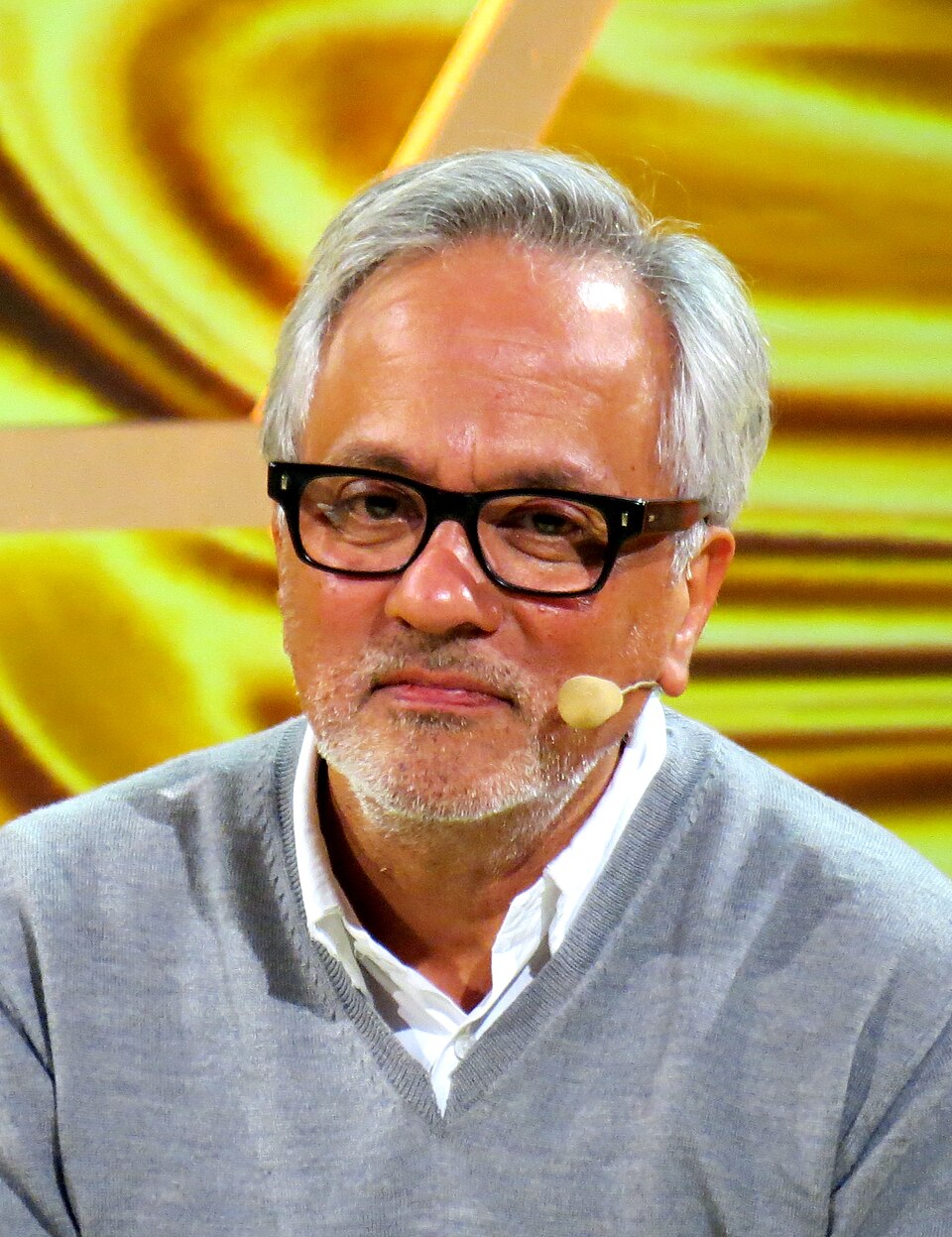
A sculptor of voids and surfaces who turned public space into a mirror, a wound, or an infinite interior.
Anish Kapoor has spent five decades engineering encounters between the body and the uncanny: reflective steel that returns a distorted world, deep pigment that seems to absorb light itself, apertures in stone that open onto apparent nothingness. His practice is among the most publicly visible in contemporary sculpture — and among the most philosophically concentrated.
Formation
Kapoor was born in Mumbai in 1954, the son of an Indian father and an Iraqi-Jewish mother. He attended The Doon School before moving to the United Kingdom in the early 1970s to study art. Training at Hornsey College of Art and then Chelsea School of Art and Design gave him technical grounding, but his first serious development came through repeated visits to India in the late 1970s, where he was struck by the use of powdered pigment at temple sites.
The early pigment works — mounds and simple geometric forms dusted in vivid, dry powder — established the terms of his practice: form partly dissolved by sensation, material that exceeds its container. These pieces won him rapid attention and a Turner Prize in 1991.
The defining body of work
Kapoor's range spans scale from intimate to monumental. The Void series (1989–) used dark pigment applied to shallow wall niches to produce the illusion of infinite depth within a flat plane. Sky Mirror (2001), a concave stainless-steel disc that inverts the sky, brought his reflective work to museum forecourts; larger versions followed at the Rockefeller Center and Kensington Gardens.
Cloud Gate (2004–2006), the 110-tonne bean-shaped steel ellipsoid installed in Chicago's Millennium Park, became one of the most visited public sculptures in the world. Its polished surface folds the city skyline and the viewer's own image into a single continuum — approachable, genuinely popular, and formally precise.
| Work | Date | Location |
|---|---|---|
| 1000 Names | 1979–1980 | Series, various |
| Void | 1989 | Various |
| Marsyas | 2002 | Tate Modern Turbine Hall |
| Cloud Gate | 2004–2006 | Chicago |
Material and method
Kapoor has described his work in terms of absence rather than presence — the void as subject, the surface as illusion. His choice of materials — polished steel, dark PVC, biomorphic wax — consistently serves the purpose of undermining the viewer's confidence in their own perception. Svayambh (2007), a massive wax block dragged through a series of gallery doorways by mechanical means, left red imprints suggesting a wound; Shooting into the Corner (2008–2009) fired a compressed-air cannon of wax at a gallery wall over a sustained period, producing an accumulation that reads as violence domesticated.1
His 2016 acquisition of exclusive rights to Vantablack — the darkest artificial substance then available — prompted public controversy with fellow artists, particularly Anish Kapoor's vocal critic Stuart Semple, who responded by creating the "pinkest pink" pigment and excluding Kapoor from purchasing it.
Recognition and legacy
Kapoor received the Turner Prize in 1991 and was knighted in 2013. Major retrospectives have been held at the Royal Academy, the Guggenheim Bilbao, and Palazzo Reale in Milan. His influence on subsequent generations of sculptors lies chiefly in the legitimacy he gave to affect and phenomenology as sculptural aims — the idea that a work succeeds when it alters the viewer's experience of space and self.
I am really working with darkness. The work is not about the object. It's about what is not there.
Footnotes
- Kapoor has repeatedly cited the body and its boundaries — skin, cavities, orifices — as primary sculptural references. ↩