Artemisia Gentileschi
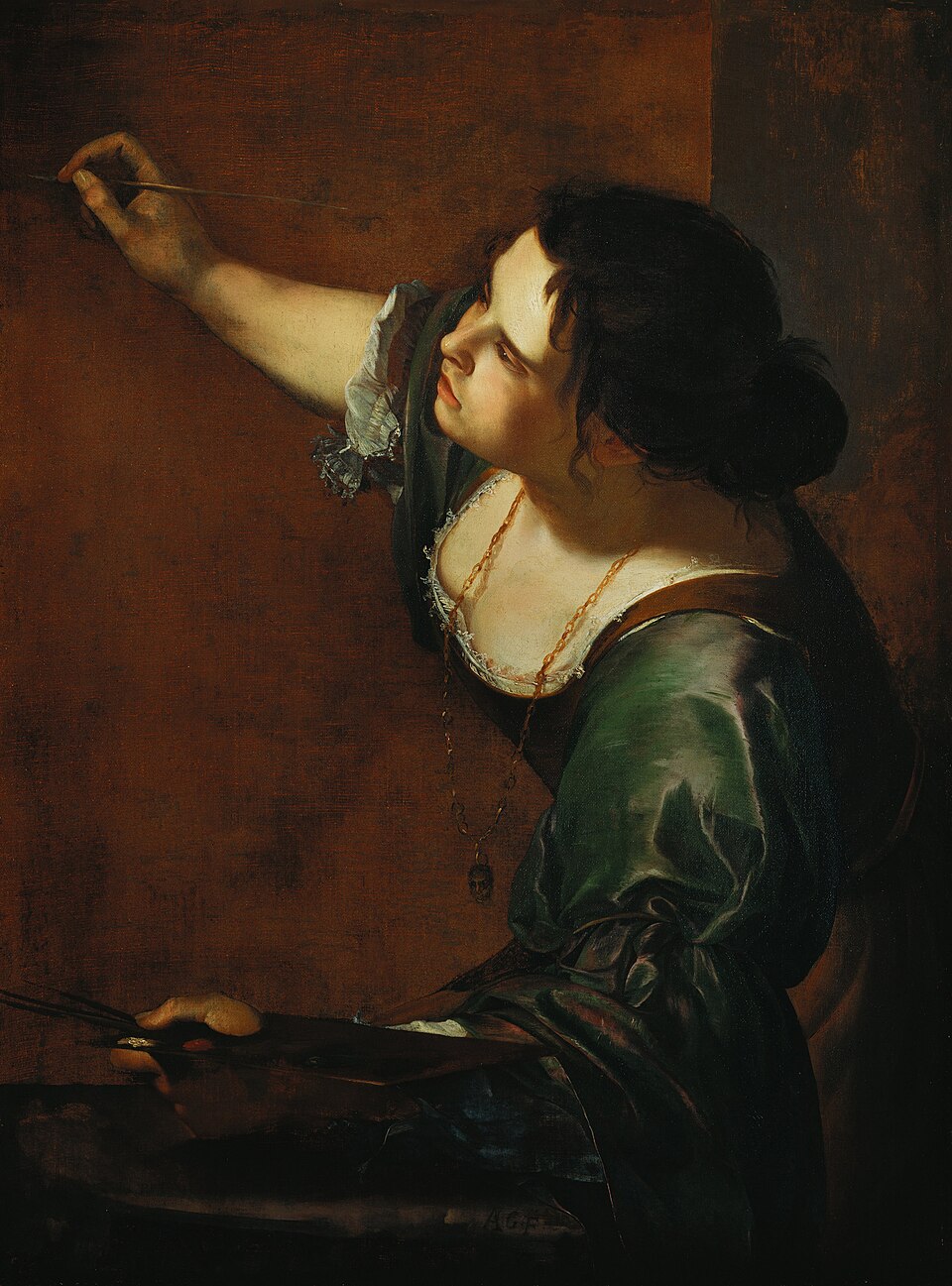
The first woman admitted to Florence's Accademia di Arte del Disegno, whose Caravaggesque canvases set a standard of dramatic power that her male contemporaries rarely surpassed.
Artemisia Gentileschi was producing professional-grade oil paintings by the age of fifteen in a period when institutional training and guild membership were almost entirely closed to women. She studied under her father, Orazio Gentileschi, and absorbed the tenebrism of Caravaggio with enough authority to surpass many contemporaries. Over a career spanning Rome, Florence, Venice, Naples, and the court of Charles I, she built an international clientele and left a body of work defined by technical command and psychological intensity.
Formation in Rome
Born in Rome on 8 July 1593, Artemisia was the eldest child of Orazio Gentileschi, himself a skilled painter in the orbit of Caravaggio. Her mother died when she was twelve; she grew up in her father's workshop, handling pigments and observing studio practice from childhood. Lacking access to the life-drawing academies that trained male artists, she developed her figure draftsmanship through direct studio instruction — an advantage few women of her generation had. Her earliest attributed work, Susanna and the Elders (1610), already shows controlled handling of form and a willingness to render the female figure with uncommon directness.
In 1612 she was the principal witness in a Roman court case against Agostino Tassi, her father's collaborator, for rape. The nine-month trial — during which she was tortured to test the consistency of her testimony — is extensively documented in surviving court records. The verdict against Tassi was eventually set aside. Within months of the trial she married Pierantonio Stiattesi and relocated to Florence.
Florence and institutional recognition
In Florence, Gentileschi worked under the patronage of Cosimo II de' Medici and found access to the city's learned circles. In 1616 she became the first woman admitted to the Accademia di Arte del Disegno — an institutional breakthrough with no precedent. She corresponded with Galileo Galilei and Michelangelo Buonarroti the Younger, both of whom commissioned work from her. The Florentine years produced some of her most celebrated canvases, including multiple versions of Judith Slaying Holofernes, which deploys Caravaggesque chiaroscuro at full dramatic force.
You will find the spirit of Caesar in this soul of a woman.
International career and later years
After returning to Rome and subsequently working in Venice and Naples, Gentileschi accepted an invitation to the English court of Charles I in 1638, joining her father, who was already established there. She collaborated with Orazio on an allegorical ceiling cycle at the Queen's House, Greenwich, and painted several works for the royal collection. The onset of the English Civil War apparently prompted her departure, though the precise date is unrecorded. She resurfaced in Naples by 1649. Her last known letter, dated 1650, confirms she was still working. Her last documented commission dates to January 1654; the exact year of her death remains uncertain.
Stories
All stories →