Barbara Hepworth
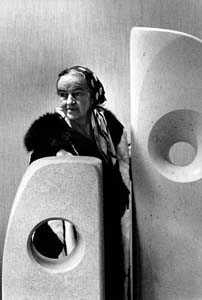
A sculptor who opened form from the inside, making the void as load-bearing as the stone.
Barbara Hepworth spent five decades proving that sculpture could hold landscape, breath, and light inside a single pierced form. Working in stone, wood, and bronze from a studio garden in Cornwall, she became one of the defining figures of international Modernism.
Formation and early ambition
Hepworth was born in Wakefield in 1903 and showed early determination: she won a scholarship to Leeds School of Art, then entered the Royal College of Art in London alongside Henry Moore, with whom she would share a lifelong parallel — and occasionally fraught — trajectory. A travelling scholarship took her to Italy in the 1920s, where she learned direct stone carving from the Pietrasanta tradition and rejected the academic practice of working through plaster intermediaries.
By the early 1930s she was part of the London avant-garde, closely associated with Ben Nicholson — who became her partner and second husband — and connected through him to the European networks of Naum Gabo, Piet Mondrian, and the Abstraction-Création circle. The encounter with continental abstraction confirmed what her hands were already discovering: that form did not need to represent anything outside itself.
The pierced form
The move Hepworth made in 1931 — drilling a hole through a carved figure — seems simple in retrospect. At the time it was a rupture. The void became a positive element: not absence but cavity, not emptiness but interior space that the eye and hand could enter. String and wire strung across openings added a further tension, playing against the mass of the stone.
Her vocabulary settled into biomorphic abstraction: ovoid bodies, concave surfaces polished to reveal grain and light, openings that framed sky or garden depending on where the work was placed. Works such as Pelagos (1946) — its interior painted white, wire strung across the hollow — achieved an almost musical tension between containment and release.
I rarely draw what I see — I draw what I feel in my body.
Cornwall and the public scale
In 1939, as war approached, Hepworth and Nicholson left London for St Ives in Cornwall. She spent the rest of her life there. The landscape — sea horizon, granite, harbour light — pressed into the work without appearing in it. The Trewyn Studio, which she acquired in 1949, gave her an outdoor garden where finished bronzes could stand in proximity to the hedged enclosure she cultivated around them.
From the 1950s her practice expanded into large public commissions and bronze casting. Single Form (1963), erected outside the United Nations headquarters in New York as a memorial to Secretary-General Dag Hammarskjöld, is among the most prominent pieces of modern sculpture in public life. She was appointed DBE in 1965, the year that recognition matched the scale of her influence.
Studio and legacy
Hepworth died on 20 May 1975 in a fire at Trewyn Studio. She was 72. The studio and garden were preserved and reopened as the Barbara Hepworth Sculpture Garden, administered by Tate St Ives, where works remain installed in the settings she intended for them.
Her influence on subsequent British sculpture — and on the understanding that abstract form can carry emotional weight without representation — has only grown with distance. Retrospectives at the Tate (1968, 2015) and international exhibition loans have sustained a reputation earned across five productive decades.