Bridget Riley
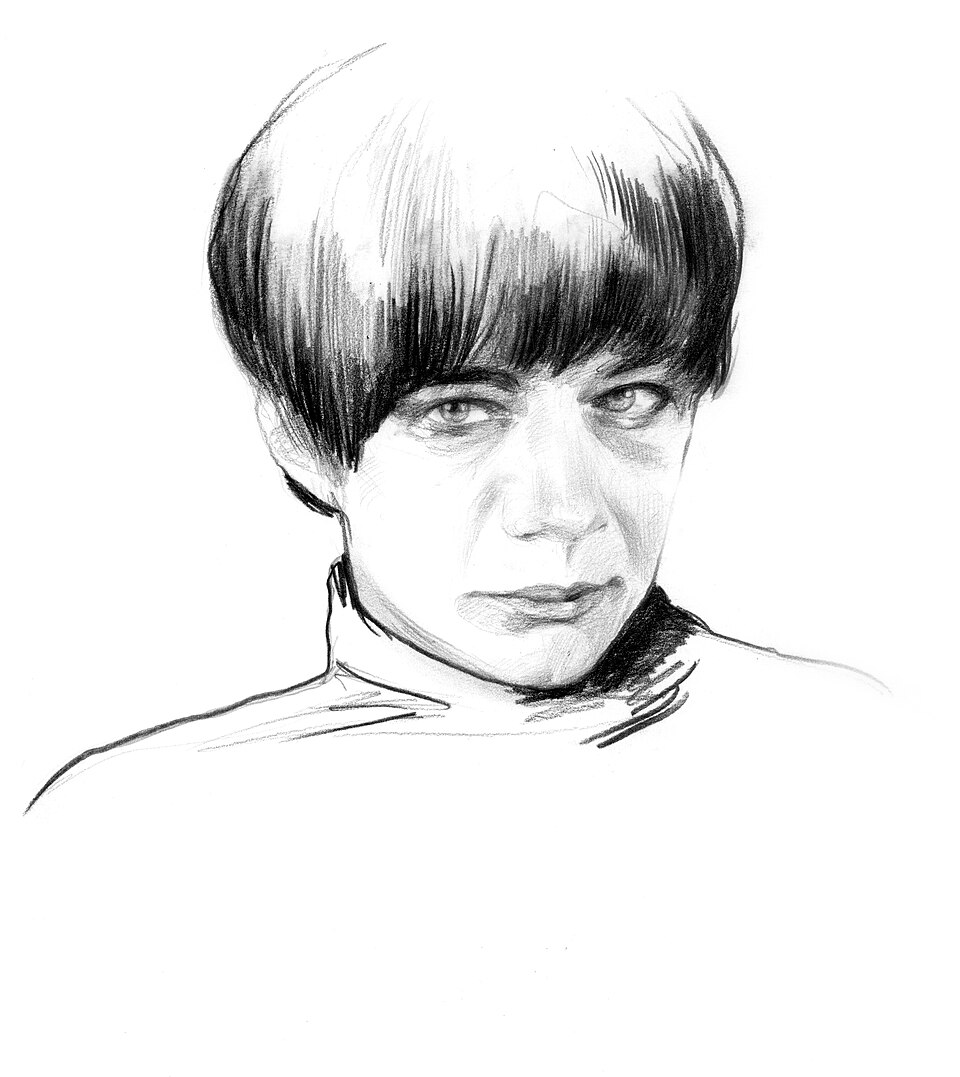
The British painter who made perception itself her medium, building a body of Op art that remains among the most optically rigorous work of the twentieth century.
Bridget Riley's paintings do not represent the world — they enact it. Working from first principles of visual physiology, she constructs canvases in which the retina itself is the subject, and where the instability of perception becomes a form of knowledge. Her work has continued to deepen and surprise for more than six decades.
Training and early influences
Riley was born in London in 1931 and grew up partly in Cornwall, where the quality of coastal light would later inform her use of colour. She studied at Goldsmiths College and then at the Royal College of Art, graduating in 1955. Her early paintings were representational and followed the influence of John Constable and the post-Impressionists; a particularly important encounter was with Georges Seurat, whose pointillist method she studied closely, understanding it as a system for decomposing colour into its constituent sensations. A breakdown in the late 1950s was followed by a period of renewed intensity: she began working in black and white, exploring the kinetic effects that could be produced purely through geometry and contrast.1
The black and white works
The paintings that established Riley's international reputation — produced roughly between 1960 and 1966 — are constructed from repeated geometric units in black and white. Movement in Squares (1961) stacks rows of alternating black and white rectangles that compress gradually toward the centre, creating an optical convexity that appears to breathe. Blaze (1962) uses concentric rings that pulse. Fall (1963) deploys gently curved parallel lines that seem to undulate across the canvas surface. These works are not illusions of three-dimensional space but activations of the visual nervous system: they produce afterimages, vibrations, and sensations of movement that originate in the eye, not the picture.
Her work appeared in the landmark 1965 exhibition The Responsive Eye at the Museum of Modern Art in New York, which brought international attention to Op art. Riley was critical of the commercial co-optation that followed — Op art patterns appeared immediately on textiles and fashion without credit — but the exhibition confirmed her position at the centre of a genuinely new direction in painting.
Colour and late development
From the late 1960s Riley introduced colour into her systematic investigations, first with off-whites and warm/cool contrasts, then with fully chromatic compositions. The shift was not cosmetic: colour introduced new variables of interaction and instability that required entirely new compositional systems. Works like Cataract 3 (1967) and the later Egyptian paintings, influenced by trips to Egypt in the 1980s, demonstrate her ability to sustain rigour across decades of new problems. She has continued working into the twenty-first century, each body of work constituting a distinct inquiry rather than a repetition.
| Period | Palette | Example work |
|---|---|---|
| 1961–1966 | Black and white | Movement in Squares |
| 1967–1980 | Limited chromatics | Cataract 3 |
| 1980s–present | Full colour | Nataraja |
The basis of my paintings is this: that in each of them a particular situation is stated visually. Certain forces are called into play which effect the relationship between the stated positions.
Footnotes
- Riley has cited the study of Seurat's Pont de Courbevoie as a turning point; she made a careful copy of it as a student exercise, which she credited with teaching her how optical mixture actually functioned. ↩