Camille Pissarro
The only painter to exhibit at all eight Impressionist shows — and then reinvent his method at fifty-four.
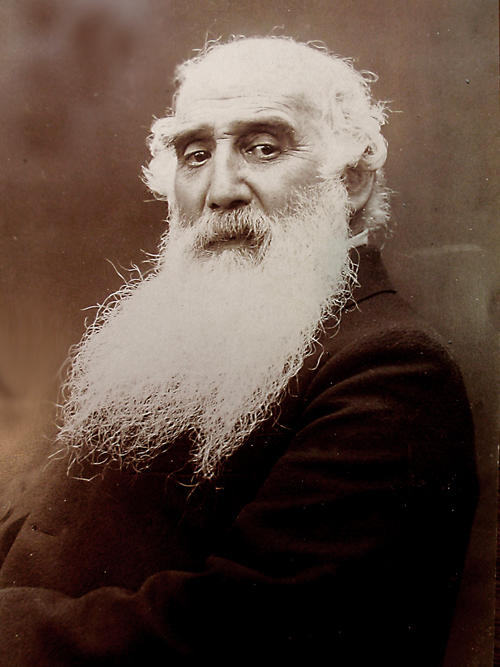
Camille Pissarro was born on the then-Danish island of Saint Thomas in 1830 and spent his career at the centre of every significant shift in French avant-garde painting for three decades. He was the organisational backbone of the Impressionist movement, the only member to show in all eight of its exhibitions, and a mentor to Cézanne, Gauguin, and Van Gogh — yet at fifty-four, dissatisfied with his own habits, he discarded them and adopted the rigorous chromatic science of Pointillism.
Origins and path to Paris
Born Jacob Abraham Camille Pissarro to Sephardic Jewish parents of French descent, he grew up on Saint Thomas, which was then a Danish colony. At twenty-five he left for Venezuela to paint, then moved definitively to Paris in 1855, where he encountered Gustave Courbet and Jean-Baptiste-Camille Corot. Corot's influence — the quiet authority of landscape, the priority of observed tone — shaped Pissarro's early work. He settled at Pontoise and later Louveciennes, finding his subjects in market towns, rural roads, and working peasants.
Impressionism and its organisation
When Monet, Degas, and their circle organised the first independent exhibition in 1874, Pissarro was there — and remained present for every subsequent show through 1886. His practical temperament and willingness to help younger painters made him the group's unofficial connective tissue. He studied alongside Cézanne, whose structure he encouraged, and opened his door to Gauguin when the latter was still an amateur. Hoarfrost (1873) shows the clarity of observation that characterised his Impressionist landscapes: frozen ground, bare trees, winter light calibrated with precision rather than sentiment.
He could have been my teacher.
The Neo-Impressionist turn
In 1885, at the age of fifty-four, Pissarro encountered Georges Seurat and Paul Signac and became a committed convert to their Divisionist method — applying paint in discrete dots of pure colour calculated to mix optically in the viewer's eye. He exhibited with Seurat at the final Impressionist show in 1886 and pursued Pointillism for roughly four years. By 1890, finding the method too mechanical for the scale and spontaneity he needed, he returned to a looser Impressionist handling. The Boulevard Montmartre series (1897), painted from a fixed hotel window at different times of day and in varying weather, is the summation of his mature landscape method.
Legacy
Pissarro's career spans the full arc from Realism through Impressionism to Post-Impressionism. His generosity toward younger artists — Cézanne explicitly cited him as a formative influence — shaped the next generation of French painting. He died in Paris in November 1903, still working.