Caravaggio
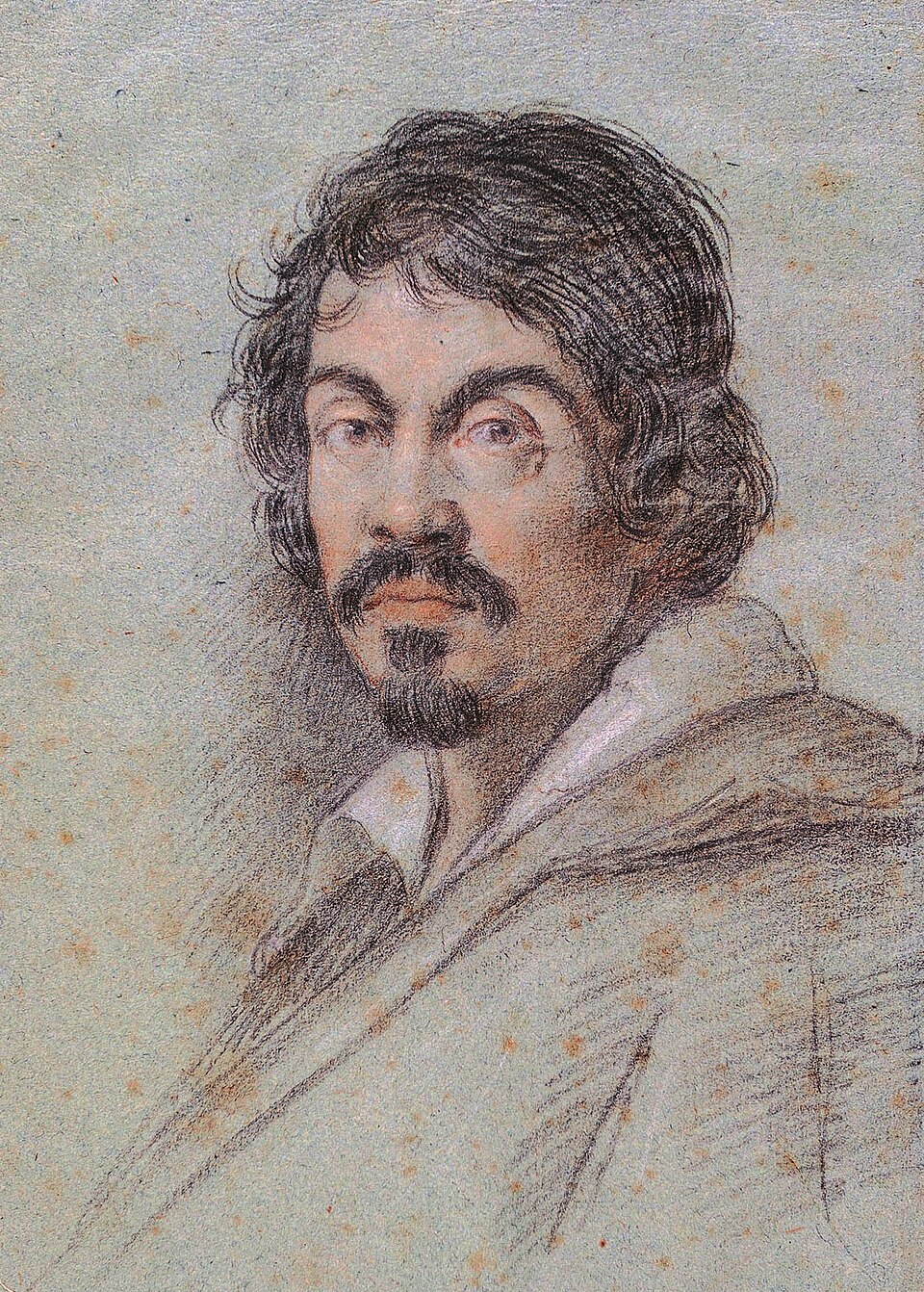
The Roman painter who replaced Renaissance idealism with raw physical truth and violent light — and whose fugitive life made him the most dramatic figure in the history of European art.
Caravaggio spent fewer than twenty years as an active painter, killed a man in 1606, fled Rome as a wanted murderer, and died at thirty-eight under unclear circumstances while seeking a papal pardon. In that time he invented a way of painting — intense directed light against near-total darkness, figures drawn from life rather than classical models, saints given the faces of street people — that became the dominant visual language of the Baroque and has never entirely lost its power.
Milan and the Roman breakthrough
Michelangelo Merisi was born in Milan on 29 September 1571 and taken as a child to the village of Caravaggio, from which he took his name. He trained in Milan under the painter Simone Peterzano before arriving in Rome around 1592. After several years of poverty and irregular employment, he came to the attention of Cardinal Francesco Maria Del Monte, who became his first significant patron and installed him in his palazzo.
The small devotional paintings and genre subjects he produced for Del Monte in the mid-1590s show his method already formed: figures set against a dark ground, light falling sharply from a single source, the subject depicted with an immediacy that made them unlike anything being produced in Rome at the time.
The great Roman commissions
Between 1599 and 1601 Caravaggio painted three large canvases for the Contarelli Chapel in San Luigi dei Francesi — scenes from the life of St Matthew — that made him the most discussed painter in Rome. The Calling of Saint Matthew shows the future apostle at a table with other men, Christ's hand entering from the right in a gesture that both points and summons. The light slants across the scene like a shaft of window light. The models are not idealised; they are people from the street.
The same deliberate choice of ordinary physical truth, pushed further, led to repeated rejection of his major altarpieces by the commissioning clergy. The first version of St Matthew and the Angel was rejected because the saint appeared too common. The Death of the Virgin, painted for Santa Maria della Scala, was rejected — reportedly because the model for the Virgin was a drowned prostitute. In each case another buyer immediately acquired the rejected version.
Flight and late work
In May 1606 Caravaggio killed Ranuccio Tomassoni during a brawl, probably over a gambling debt. He fled Rome and spent his remaining four years in Naples, Malta, and Sicily, still painting major works for churches and patrons while seeking a papal pardon. The late paintings — the Beheading of Saint John the Baptist in Valletta, the Burial of Saint Lucy in Syracuse — are austere and spacious, the backgrounds emptied, the light bleaker than in the Roman works. He died in Porto Ercole in July 1610, apparently of a fever contracted on his final journey back toward Rome.
He said that he had learned more from a gypsy girl than from all the Raphael.
Legacy
Caravaggio's influence, which he could not have anticipated given the brevity and violence of his life, was immediate and enormous. A generation of painters across Europe — Artemisia Gentileschi, Orazio Gentileschi, Hendrick ter Brugghen, Georges de La Tour, José de Ribera — absorbed his method of tenebrism and made it the foundation of European Baroque painting. Rubens and Velázquez both collected his work. The formal rediscovery of his importance in the twentieth century — above all through the scholarship of Roberto Longhi — confirmed what his contemporaries had already sensed: that he had permanently changed the available options in painting.