Caspar David Friedrich
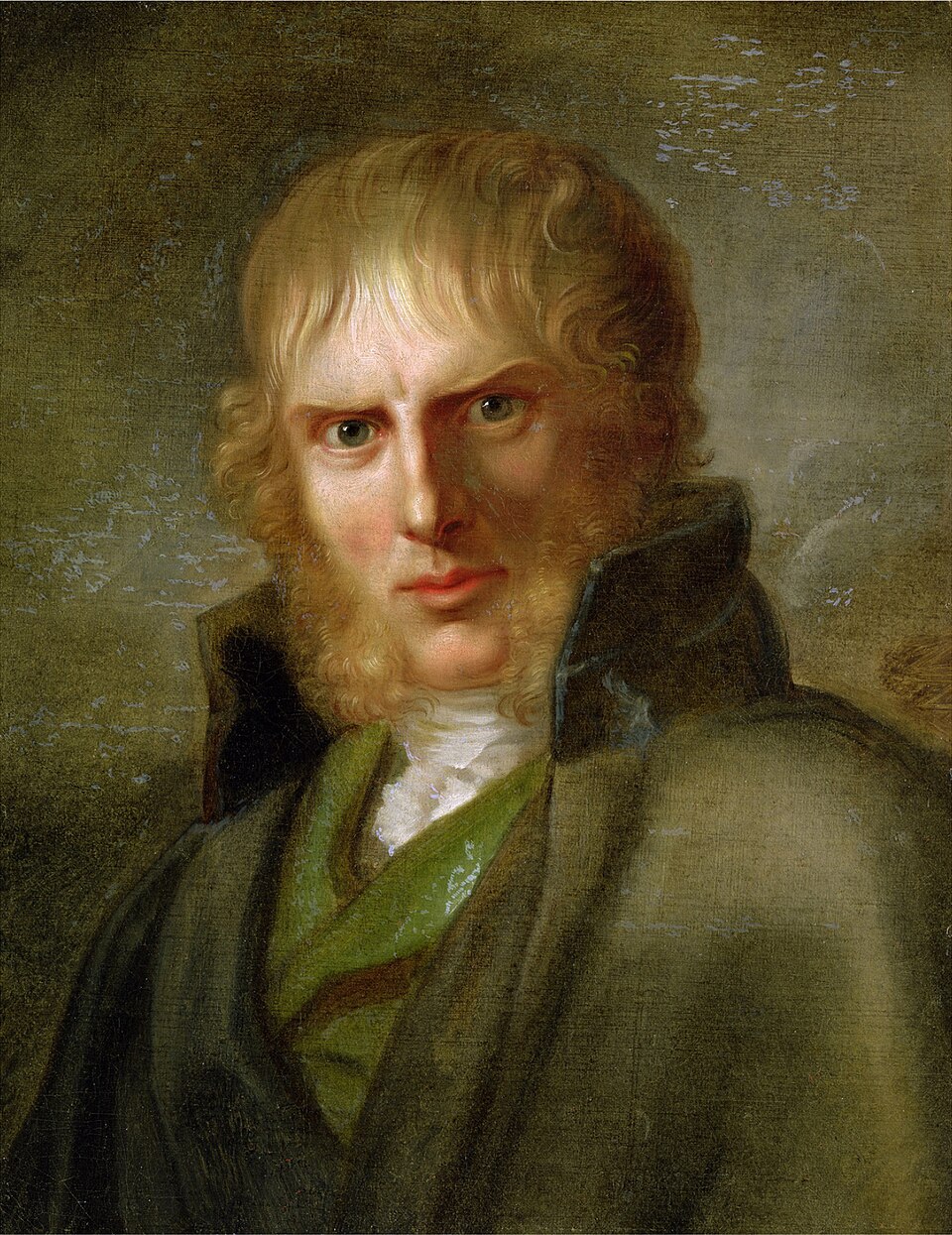
The supreme painter of German Romanticism, whose brooding landscapes made solitude, faith, and mortality visible through fog and granite.
Caspar David Friedrich was the defining painter of German Romantic landscape. Working in oil and sepia from his studio in Dresden, he transformed the north German coastline, the Riesengebirge, and the fog-wrapped Baltic into allegories of human transience and spiritual longing. His signature device — a solitary figure seen from behind, dwarfed by an immensity of sky or sea — gave viewers a surrogate eye while insisting on their own smallness before nature.
Formation in Greifswald and Dresden
Friedrich was born on 5 September 1774 in Greifswald, a small Pomeranian harbour town then under Swedish rule. His childhood was marked by loss: his mother died when he was seven; a brother drowned in an ice-skating accident when Friedrich was thirteen — an event that reportedly haunted him throughout his life. He studied drawing in Greifswald under Johan Gottfried Quistorp and moved to Copenhagen's Royal Danish Academy of Fine Arts in 1794, receiving a rigorous academic grounding in northern landscape traditions. By 1798 he had settled in Dresden, the city where he would spend the rest of his working life.
Dresden's intellectual circle — including Goethe, the philosopher Schelling, and the poet Novalis — provided a context in which painting landscape as metaphysics was not eccentric but programmatic. Friedrich absorbed Romantic philosophy's equation of nature with the infinite and found pictorial means to make that equation felt.
The Rückenfigur and symbolic method
Friedrich's mature paintings deploy a consistent grammar. A human figure — monk, pilgrim, couple — stands at the edge of a precipice or shore with their back to the viewer. The spectator cannot read a face; they must inhabit the figure's vantage, confronting the same abyss of fog, ice, or sky. This compositional strategy — later given the German name Rückenfigur — was Friedrich's most radical invention. It refuses anecdote and demands contemplation.
His symbolism was equally systematic: the oak tree signified Germanic strength and endurance; Gothic ruins stood for the superseded but spiritually living Christian past; dawn and dusk marked spiritual transitions; ice and rock evoked the permanence against which human life is measured.
Recognition and eclipse
Friedrich's work won early royal patronage. Crown Prince Friedrich Wilhelm of Prussia purchased Monk by the Sea and Abbey in the Oakwood after they were shown in Berlin in 1810, and Friedrich was elected to the Dresden Academy the same year. Yet his reputation declined sharply after 1820 as Neoclassical taste reasserted itself and younger artists found his allegory too obscure. A stroke in 1835 ended his ability to paint in oil; he continued working in pencil and sepia until his death in Dresden on 7 May 1840.
His rehabilitation came posthumously. Nineteenth-century critical neglect gave way to renewed interest after the painter and critic Johan Christian Dahl began preserving his legacy. By the early twentieth century — and especially through the Surrealists and Expressionists who claimed him as a forerunner — Friedrich was recognized as one of the essential painters of European modernity.
The artist should paint not only what he sees before him, but also what he sees within him.