Charles Rennie Mackintosh
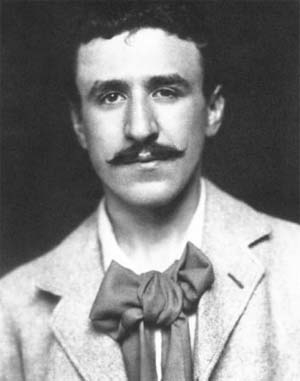
The Glasgow architect who fused Celtic ornament, Japanese spatial logic, and early modernism into a style so singular it became an international movement of its own.
Charles Rennie Mackintosh designed buildings, furniture, interiors, and textiles as a single unified system — each element tuned to the others in a way that anticipated total design by decades. Working in Glasgow at the turn of the twentieth century, he created a visual language that European modernists admired even as his own city largely ignored him.
Glasgow formation
Mackintosh was born in Townhead, Glasgow, in 1868, one of eleven children of a police superintendent. He was apprenticed to an architectural firm at sixteen and attended evening classes at the Glasgow School of Art, where he met the artist Margaret Macdonald, his lifelong collaborator and wife. With her and two other artists — her sister Frances and Herbert MacNair — he formed "The Four," a group whose elongated, symbol-laden work became the nucleus of what critics would call the Glasgow Style.
His work absorbed European Symbolism and the spare geometry of Japanese design, blending them with the vertical tension and organic ornament of Celtic art. The result was neither pure Art Nouveau nor early Modernism but something unstable and precise at the same time — buildings that feel both ancient and entirely new.
The Glasgow School of Art
The defining commission came in 1896, when Mackintosh, still in his twenties and working for Honeyman and Keppie, won the competition for a new Glasgow School of Art building. The east wing was completed in 1899, the west wing in 1909. The library wing of 1909 is considered his masterpiece: a double-height space with a dark wood grid of columns and galleries that owes nothing to historical precedent. The building was damaged by fire in 2014 and destroyed by a second fire in 2018; its reconstruction is ongoing.
Interior design and the Willow Tea Rooms
In parallel with architecture, Mackintosh designed complete interior environments — furniture, textiles, metalwork, stencilled surfaces. His high-backed ladder chairs became immediate icons of the Glasgow Style, exhibited at the Vienna Secession in 1900 to considerable acclaim. Josef Hoffmann and other Viennese designers acknowledged his direct influence.
Miss Catherine Cranston commissioned him to design a sequence of Glasgow tea rooms; the Willow Tea Rooms on Sauchiehall Street (1903) survive in restored form and remain the best intact example of Mackintosh's complete interior vision.
There is hope in honest error; none in the icy perfections of the mere stylist.
Later years and recognition
Mackintosh received little professional recognition in Britain. In 1914 he left Glasgow for London, then moved to Port-Vendres in southern France, where he spent his final decade painting landscapes in watercolour — work now regarded as some of his finest. He died in London in 1928, little celebrated. Posthumous recognition grew steadily through the twentieth century; his work now commands major collections and has been subject to continuous commercial reproduction, particularly in Glasgow's tourist economy.