David Adjaye
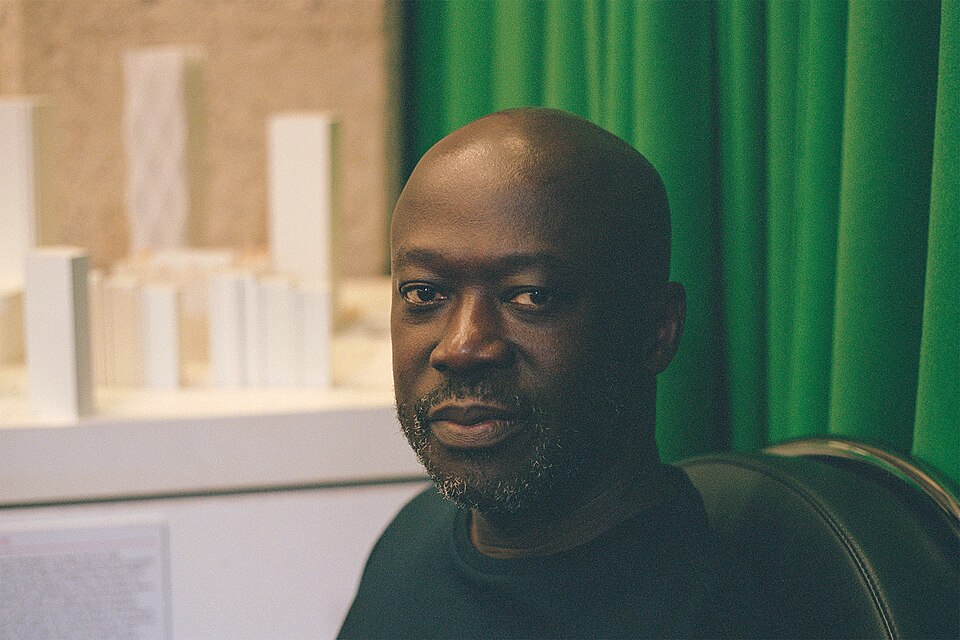
The architect who taught buildings to carry memory — in bronze, concrete, and calibrated light.
David Adjaye is among the most significant architects of his generation — a designer whose buildings do not merely shelter but remember, translating cultural identity into material form through bronze lattice, board-marked concrete, and precisely controlled daylight. His career spans continents and scales, from intimate London houses to national monuments.
Origins and formation
The son of a Ghanaian diplomat, Adjaye spent his childhood moving across Africa, the Middle East, and Europe — an itinerant education in vernacular buildings, different kinds of light, and the way space encodes social meaning. He eventually settled in Britain for formal training, studying first at Southbank University and then at the Royal College of Art, where he completed his postgraduate degree in 1993.
Early practice in London produced a series of houses — dense, material-rich structures that attracted attention for their deliberate refusal of conventional finishes. The Dirty House in Shoreditch (2002), a live-work space for artists Tim Noble and Sue Webster, is the period's emblem: its anti-graffiti blacked exterior and suppressed street windows created a building that reads as an introverted object, dark and specific to its occupants. These early commissions established Adjaye's signature move — treating the exterior as a social statement and the interior as a landscape of modulated light.
The Idea Stores and civic ambition
The Idea Stores commission for the London Borough of Tower Hamlets (Whitechapel, 2005; Chrisp Street, 2004) marked a shift in scale and purpose. Conceived as public libraries rebranded for communities historically alienated from civic institutions, the Idea Stores placed their functions on high-traffic shopping streets, clad in vivid coloured glass and designed with interiors as open and unhierarchical as possible. The project was credited with reviving public library use in the borough and established Adjaye as an architect committed to the social contract of public buildings.1
The National Museum of African American History and Culture
No project defines Adjaye's practice more fully than the Smithsonian National Museum of African American History and Culture on the National Mall in Washington, D.C., completed in 2016 after more than a decade of design and construction. The building's exterior — a three-tiered corona of bronze-coloured aluminium lattice — is drawn from the decorative ironwork traditions of enslaved African craftsmen in the American South, itself tracing origins to Yoruba architectural forms. The lattice filters Washington's abundant light, casting patterned shade across the interior galleries and connecting the museum's skin to its subject matter in a gesture that is structural, historical, and aesthetic simultaneously.
| Element | Source | Effect |
|---|---|---|
| Tiered corona form | Yoruba ceremonial architecture | Civic monumentality |
| Bronze-tone aluminium lattice | African-American ironwork traditions | Cultural inscription on the exterior |
| Inverted pyramid massing | Reverses Mall convention | Asserts presence without mimicry |
| Subterranean history galleries | Buried below grade | Metaphor of excavation and recovery |
The building received widespread critical and popular acclaim. It brought Adjaye the Royal Gold Medal in 2021 — the first African recipient of the award and one of the youngest in its history — and positioned him as an architect capable of delivering symbolic weight at national scale.2
Method: material, light, identity
Across his body of work, Adjaye's method is consistent: each building begins with a research phase into the cultural and historical landscape of its site and client. Materials are chosen for their associative properties as much as their structural ones. Light is treated not as illumination but as material — calibrated, coloured, and filtered to produce specific atmospheric conditions. He has described his buildings as instruments for holding memory, and the formal vocabulary — heavy, dark bases; light-filtering screens; transitions from compression to release — enacts that intention spatially.
I wanted the building to feel like it had always been there — and also like it had just arrived.
Legacy
Adjaye received a knighthood in the 2017 New Year Honours for services to architecture. In 2022 he was appointed to the Order of Merit. In 2023, allegations of sexual misconduct were made against him — which he denied — and he subsequently withdrew from several public roles and commissions. His architectural legacy remains substantial: a practice that consistently demonstrated that buildings can carry cultural memory without resorting to literalism, and that public institutions can be designed for the people they were built to serve.