Claude Monet
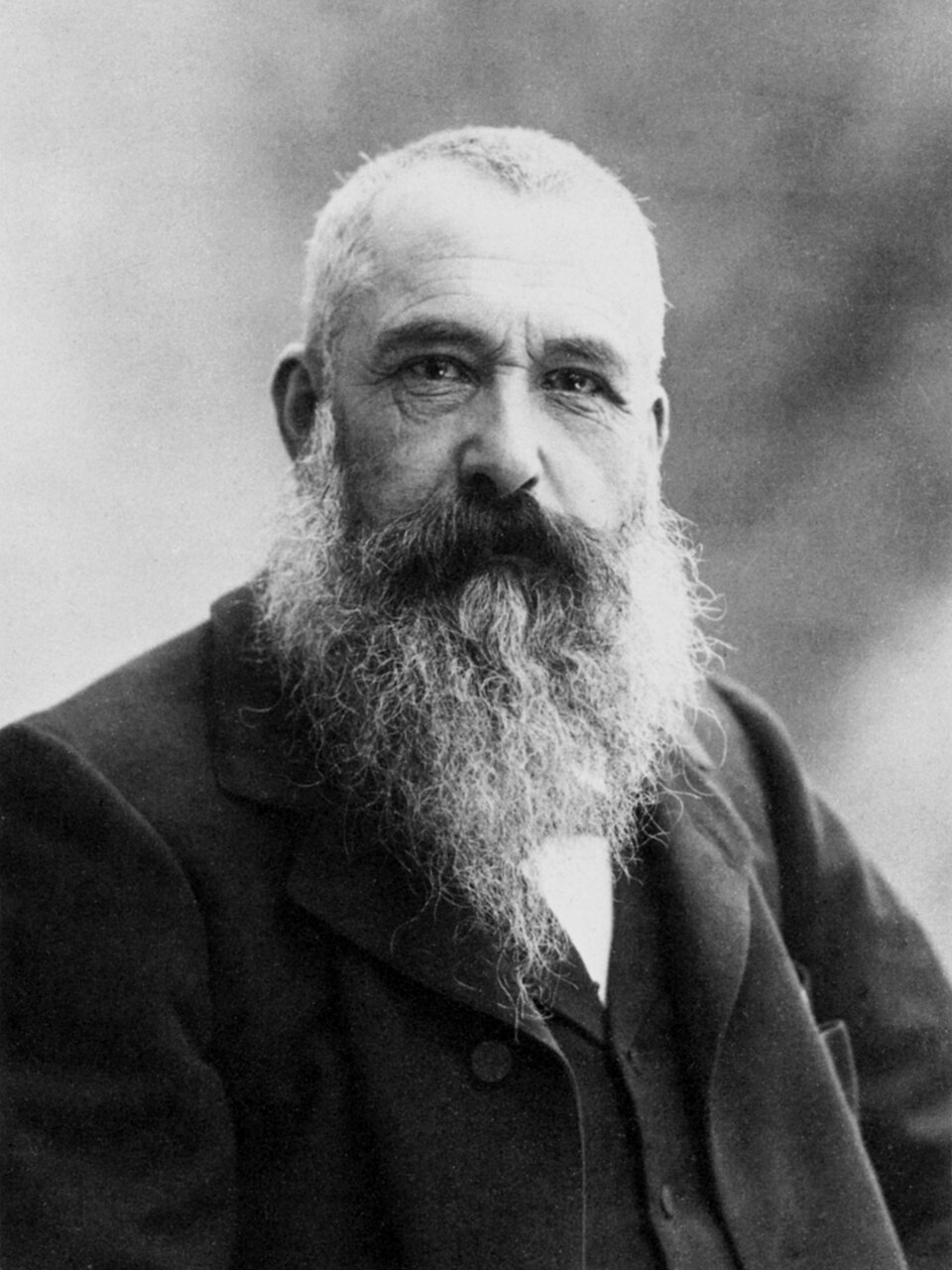
The French painter who named Impressionism by accident and then spent half a century refining its central conviction — that light and atmosphere, not objects, are the proper subject of painting.
Claude Monet was the most consistent practitioner of the Impressionist creed, a painter who returned again and again to the same subject under different light conditions not because he was indecisive but because he understood that what changed between one hour and the next — the quality of the air, the angle of the sun, the saturation of shadow — was precisely what he was painting. The movement that takes its name from one of his early works produced, in his late series paintings, some of the most sustained meditations on perception in the history of art.
Early formation and the Salon years
Oscar-Claude Monet was born in Paris on 14 November 1840 and grew up in Normandy, where the light and coastline that would define much of his mature work were already available to him. He showed early facility for caricature and studied under Eugène Boudin, who introduced him to painting outdoors — en plein air — rather than finishing landscape work in the studio. The discipline of painting from observation in natural light remained foundational.
In Paris he met Renoir, Sisley, and Bazille at the Académie Suisse. The group shared an impatience with academic convention and a commitment to contemporary subject matter and direct observation. Their relationship with the official Salon was fractious; Monet submitted regularly and was rejected regularly.
Impressionism and its name
The term Impressionism derived from one of Monet's paintings submitted to the First Impressionist Exhibition of 1874 — an independent show organised as an alternative to the Salon by Monet, Renoir, Degas, Pissarro, and others. The painting, Impression, Sunrise (1872), depicted the harbour at Le Havre in early morning light with a looseness of brushwork that a hostile critic used to name the movement mockingly. The name stuck.
The 1874 exhibition and its successors gave the group an independent platform and a collective identity. Monet's work of this period — the Gare Saint-Lazare series (1877), the Boulevard des Capucines — showed his characteristic attention to atmospheric effect and the recording of transient conditions in paint.
I want to paint the air in which the bridge, the house, and the boat are to be found — the beauty of the air around them.
The series paintings
From the 1880s onward Monet began working in extended series — returning to the same subject across many sessions and many canvases to capture its different appearances. The Haystacks series (1890–1891), the Rouen Cathedral series (1894), and the London series (Houses of Parliament, Thames fogs) established the method: the subject was a pretext for studying light, and the series was a sequential argument about its variability.
The Water Lilies series, produced at his garden at Giverny from around 1896 until his death in 1926, extended this into something without precedent — more than 250 paintings of the same pond surface, its reflections and plant life, made over three decades. The late works, large-format and nearly abstract, were installed in the Orangerie in Paris as a permanent installation; they are among the most visited paintings in the world.