Constantin Brâncuși
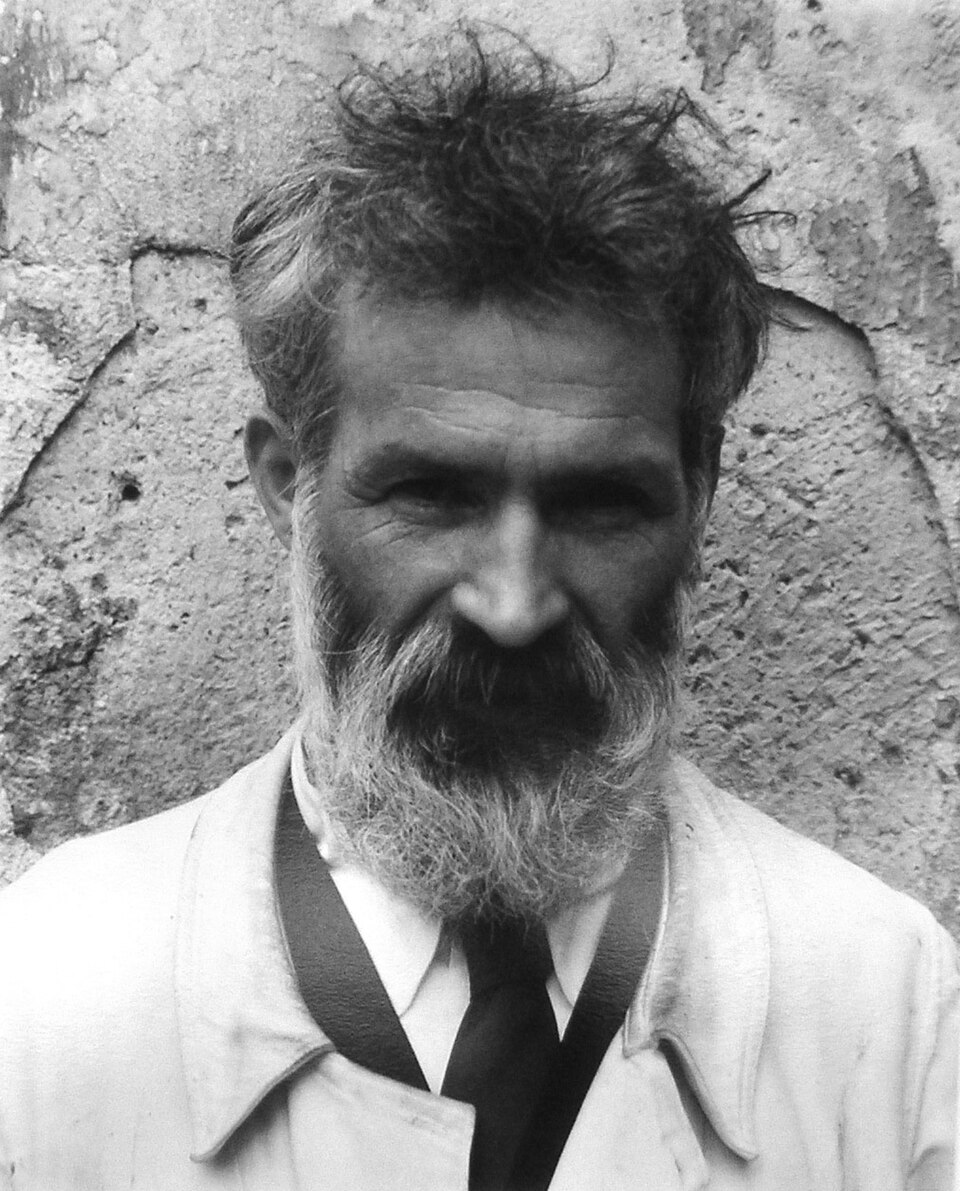
The Romanian sculptor who stripped form to its irreducible essence, producing works so concentrated they feel less carved than discovered.
Constantin Brâncuși arrived in Paris in 1904 having walked much of the way from Romania, and proceeded to dismantle the conventions of Western sculpture. Where Rodin modelled surface and emotion, Brâncuși reduced — cutting until only the essential form remained, and naming what he had found.
Origins in wood and stone
Brâncuși was born into a peasant family in the village of Hobița in the Carpathian foothills. As a boy he displayed a natural aptitude for carving wooden farm implements and household objects. After formal training in Bucharest — first at the School of Arts and Crafts, then at the School of Fine Arts — he made his way to Munich and eventually Paris, enrolling at the École des Beaux-Arts in 1905. He briefly worked in Rodin's studio, then left. "Nothing grows in the shadow of great trees," he reportedly said. He took a studio in Montparnasse and began his lifelong project: finding the inner life of his materials.
The reduction of form
Brâncuși's mature work proceeds through a series of sustained meditations on a small number of subjects — the bird, the head, the column, the kiss. Each subject was returned to across decades, each iteration paring away further. His Bird in Space series, begun in the 1920s, renders the idea of flight as a single tapering vertical form in polished bronze or marble, weightless and still. His Endless Column, installed at Târgu Jiu in Romania in 1938, rises nearly thirty metres as an open-ended repetition of a rhomboidal unit — a column that implies no beginning and no end.
Simplicity is not an end in art, but one arrives at simplicity despite oneself, in approaching the real sense of things.
He worked the surfaces of his bronzes to a mirror finish, making the object both opaque form and luminous reflection. His studio — which he bequeathed to the French state — is reconstructed at the Centre Pompidou in Paris.
Romanian folk art and non-Western sources
Like several of his Parisian contemporaries — Picasso, Derain, Gauguin — Brâncuși drew on non-European visual traditions, seeing in them an alternative to academic naturalism. But his most persistent source was Romanian folk carving: the vernacular column forms of wooden grave-markers from his home region appear directly in the geometry of his later column works. This made his modernism unusual: not an escape from roots but a return to them through abstraction.