David Hockney
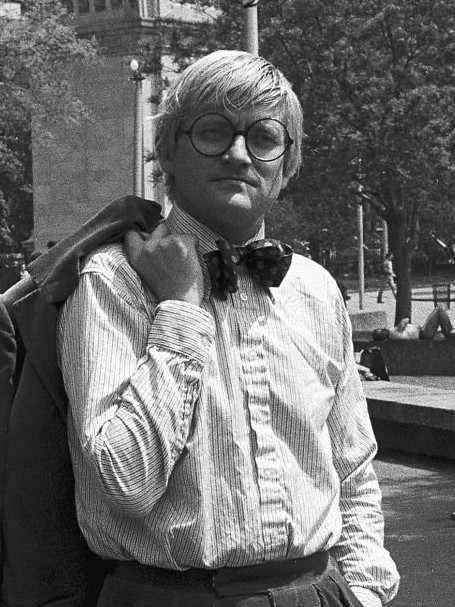
A painter who refused to choose between rigour and pleasure, and produced one of the most recognisable bodies of work in twentieth-century British art.
David Hockney spent six decades resisting the art world's categorical demands — painting figures when abstraction dominated, insisting on joy as a legitimate subject, and embracing new tools from the Polaroid camera to the iPad without apology. His work gave the twentieth century some of its most vivid images of light, water, and human intimacy.
Bradford to the Royal College
Hockney was born in Bradford, Yorkshire, in 1937, and trained at Bradford School of Arts and Crafts before winning a place at the Royal College of Art in London. At the RCA in the late 1950s and early 1960s he was already a generation-defining student — winning the Gold Medal in 1962 and showing work that combined Pop sensibility with a distinctly personal iconography.
His engagement with gay experience — coded at first, then increasingly direct — gave his early paintings a personal urgency unusual for the period. Works from 1960–1963 drew on Walt Whitman, on coded desire, on the language of tabloids and advertisement, feeding them into figurative canvases that sat oddly outside the dominant modes of the day.
California and the pool paintings
Hockney first visited Los Angeles in 1963 and eventually settled there. The city suited him: bright, horizontal, abundant in bare skin and flat surfaces. The pool became his defining motif. A Bigger Splash (1967) reduced the moment of a dive to a frozen white spray against a flat blue rectangle — sun, stillness, and the suggestion of someone invisible. Portrait of an Artist (Pool with Two Figures) (1972) set a swimmer underwater against a clothed figure at the edge, combining psychological tension with the technical problem of depicting two different visual worlds simultaneously.
| Work | Date | Note |
|---|---|---|
| We Two Boys Together Clinging | 1961 | Early coded figure work |
| A Bigger Splash | 1967 | Defining California image |
| Mr and Mrs Clark and Percy | 1970–71 | Double portrait, Tate collection |
| Portrait of an Artist (Pool with Two Figures) | 1972 | Record auction price at the time |
Method, photography, and later digital work
Hockney maintained a sustained interest in optics and representation. His book Secret Knowledge (2001) argued that Old Masters had used optical devices — camera obscura, camera lucida — to achieve their characteristic precision. The thesis was controversial but the underlying inquiry — how does seeing relate to depiction? — was continuous with his own practice.1
In the 1980s he made composite photographic works he called "joiners," which assembled dozens of photographs into fragmented perspectives inspired by Cubism. Later he painted large-scale Yorkshire landscapes, working in series, tracking seasonal change. In his seventies and eighties he adopted the iPad as a painting tool, producing work at speed that he shared directly with friends and then exhibited at the Royal Academy.
Legacy
Hockney received the Order of Merit in 2012. His 2017 retrospective at Tate Britain was the most visited show in the gallery's history. Portrait of an Artist (Pool with Two Figures) sold at auction in 2018 for over $90 million, a record for a living artist at that time. He died in January 2026 at the age of 88, having remained productive into the final years of his life.
All you can do is look and try and notice things. Most people don't really notice things.
Footnotes
- The "Hockney–Falco thesis," as it became known, was co-developed with physicist Charles Falco and generated sustained debate among art historians. ↩