Diego Velázquez
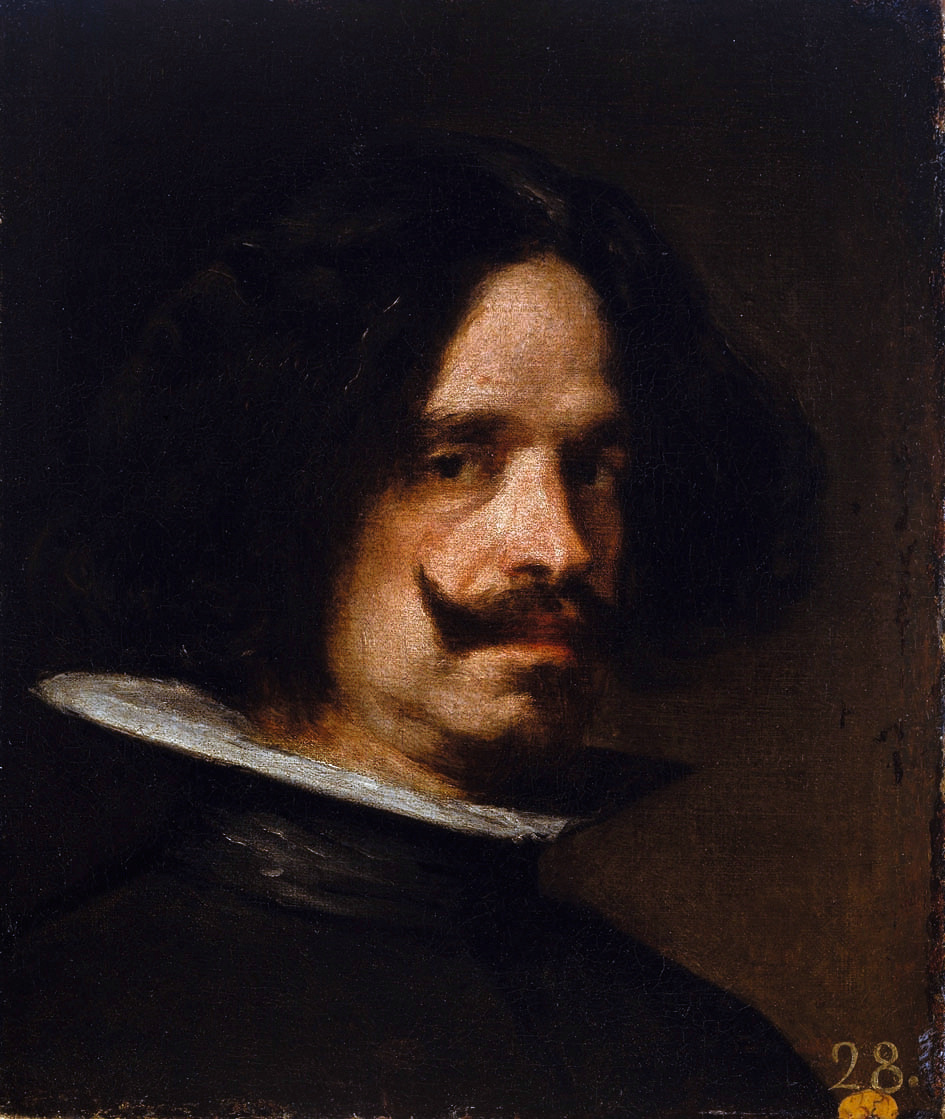
The court painter of Philip IV who turned royal duty into the most searching study of appearance and reality in the history of painting.
Diego Velázquez served the Spanish court for thirty-seven years and used that position of apparent constraint to produce the most philosophically complex paintings in Western art. His technique — paint applied with a directness and economy that later painters would spend careers trying to understand — described the visible world with an accuracy that has never been surpassed.
Seville and the early manner
Diego Rodríguez de Silva y Velázquez was born in Seville on 6 June 1599. He trained under Francisco Pacheco, a learned painter and writer who held meetings of Seville's humanist circle; Velázquez later married Pacheco's daughter. His early work — bodegones, or kitchen and tavern scenes with still-life elements — show a precocious command of observed light and material texture that owed a debt to Caravaggio but exceeded its source in naturalistic precision.
In 1623, at twenty-three, he was summoned to Madrid and made court painter to Philip IV. The appointment was for life. He painted the king more than thirty times.
At the court of Philip IV
The Spanish royal collection — the richest in Europe in Venetian painting, above all in Titian — gave Velázquez an education no studio could have provided. He studied the Titians carefully and his palette lightened, his handling loosened, and his understanding of how colour functions in shadow deepened. Two visits to Italy, in 1629–31 and 1649–51, further extended his range.
His portraits of Philip IV and the royal family are the core of his achievement: figures placed against plain backgrounds, painted with a touch so confident that a few strokes of impasted paint describe the sheen of silver thread, and a few passages of tone describe a face across a room. The question they ask — what does it mean to look at a person? — is inseparable from the fact that the people depicted have no choice but to be looked at.
Las Meninas
Las Meninas (1656) depicts the Infanta Margarita and her attendants in the royal studio, with the king and queen visible in a mirror at the back of the room and the painter himself — Velázquez — standing at a large canvas on the left. The positions of painter, subjects, viewer, and mirror have generated more sustained analysis than any other painting in existence. What seems at first a court group portrait turns out to be an inquiry into the act of painting, the nature of the royal gaze, and the place of the artist in the social order.
What counts is not the subject, but how you see it.
Legacy
Velázquez's reputation was high in his own time but grew to near-mythological status in the nineteenth century, when Manet's repeated trips to the Prado to study the royal collection made the Spanish master's method — above all his handling of black, silver, and grey — the model for a different kind of modern painting. Manet called him "the painter of painters." Francis Bacon's repeated treatments of the Innocent X portrait sustained the line into the twentieth century.