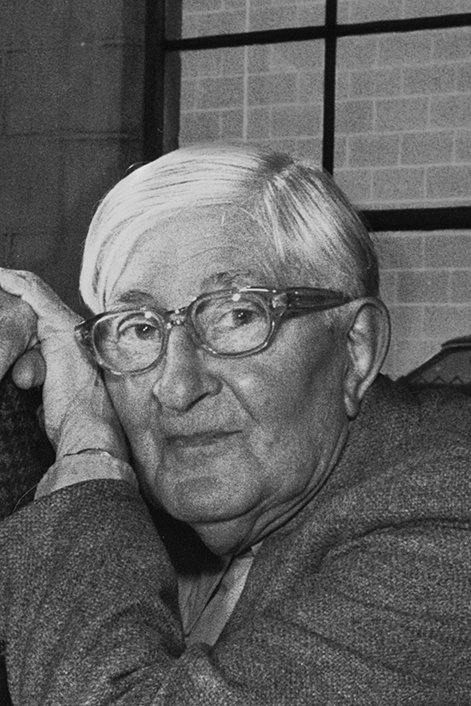
Donald Judd
An artist who insisted that a box made with absolute precision was not a container for meaning but meaning itself.
Donald Judd spent his career asserting that objects made with rigorous attention to material, colour, and space required no interpretation beyond themselves — no symbolism, no composition, no illusion. In doing so he became the central theorist and practitioner of what critics called Minimalism, a term he spent his life rejecting.
Formation as artist and critic
Judd was born in Excelsior Springs, Missouri, in 1928 and served in the Korean War before studying at the College of William and Mary and then Columbia University, where he completed a degree in philosophy. He also studied art history at Columbia under Meyer Schapiro. Through the late 1950s he supported himself as an art critic for Arts Magazine, writing direct, demanding reviews that established him as someone with a clear theory of what art could and should be.
His early work was painting, but by the early 1960s he had moved into three-dimensional objects — reliefs and freestanding forms — convinced that painting's illusion of depth was a limit he could not work within. The wall relief and the floor stack were his innovations: objects that sat neither in the category of painting nor of sculpture as conventionally understood.
Specific Objects
The 1965 essay "Specific Objects", published in Arts Yearbook, gave Judd's practice its theoretical framework. He argued that much of the most interesting new art occupied a territory between painting and sculpture — three-dimensional work that had abandoned the conventions of both. It was not about form representing something else. The object was specific: this material, this colour, this space, these dimensions.
His Stacks — identical rectangular boxes fixed to a wall at equal intervals, cantilevered into a room — enacted the argument directly. Each unit was the same; the progression was the same; what changed was the relationship between unit and space, between repetition and perception.1 His Progressions used mathematical sequences to determine the intervals between forms, refusing compositional hierarchy.
| Series | Approx. dates | Material |
|---|---|---|
| Stacks | 1965 onward | Galvanised iron, Plexiglas, various |
| Progressions | 1966 onward | Aluminium, steel, copper |
| Marfa installations | 1982–1994 | Concrete, aluminium |
Marfa and the permanent installation
In the early 1970s Judd moved from New York to Marfa, a small town in the high desert of West Texas, eventually purchasing and converting a former army base. The Chinati Foundation, established in 1986, houses permanent installations of his work and that of invited artists including Dan Flavin and John Chamberlain. One hundred large-scale aluminium works are installed in two converted artillery sheds — a permanent, site-specific encounter between simple form and Chihuahuan desert light.
Marfa became both a demonstration of his ideas about permanence and context and an alternative institutional model — work displayed where it was made, in conditions it controlled, for as long as the foundation could sustain it.
Influence
Judd's influence runs through architecture as much as visual art: his furniture designs, his insistence on the integrity of space and material, and his rejection of decoration as decorative have shaped a generation of architects and designers. His writing remains primary reading for anyone working with form, material, and space.
The new work obviously resembles sculpture more than it resembles painting, but it is nearer to painting.
Footnotes
- Judd was precise about fabrication, typically commissioning skilled metalworkers and fabricators to execute his specifications — a practice he defended as no different from an architect having buildings built. ↩