Édouard Manet
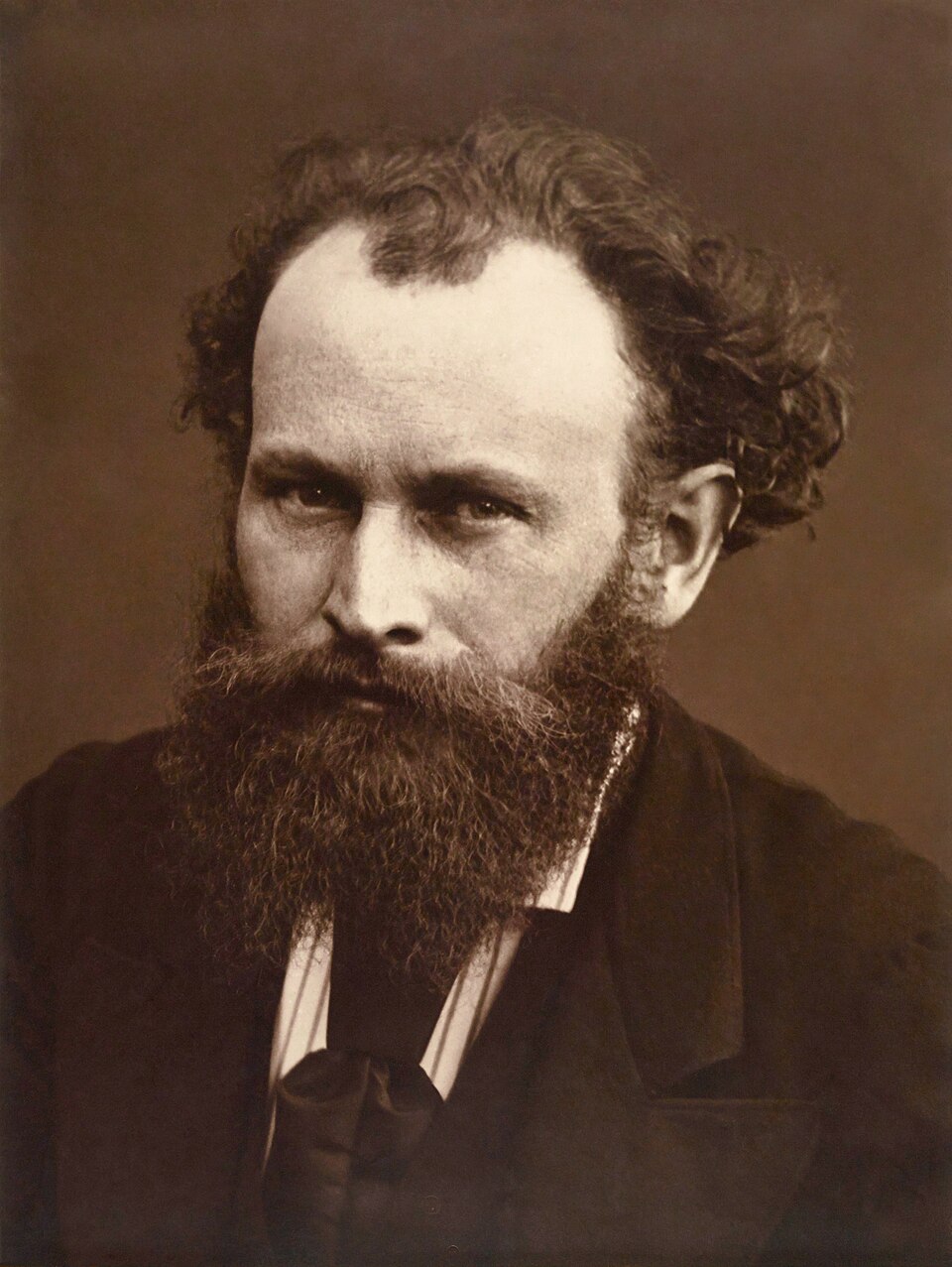
The pivotal painter who broke with academic tradition to depict modern Parisian life with a directness that made him the reluctant godfather of Impressionism.
Édouard Manet was a French painter who stands at the hinge between Realism and Impressionism. He did not found a movement, lead a school, or seek to overthrow convention — he simply painted what he saw in the cafés, streets, and gardens of Paris with an economy and flatness of surface that made academic painting look suddenly antique. The scandals that greeted his early work were not stylistic misunderstandings; they were accurate recognitions that something fundamental had shifted.
Formation and early influences
Manet was born on 23 January 1832 in the former 10th arrondissement of Paris into a haute-bourgeois family — his father a senior official in the Ministry of Justice, his mother the daughter of a diplomat. After failing the entrance examination for the Naval Academy, he studied painting under Thomas Couture from 1850 to 1856, a traditional academic training he simultaneously absorbed and resisted. Extended study trips to Germany, the Netherlands, and Italy exposed him to Titian, Rembrandt, Hals, and Velázquez — the painters whose loose handling and tonal directness he would later recall in his own work.
His early Salon submissions — The Absinthe Drinker (1859, rejected) and Spanish Singer (1861, accepted and awarded honourable mention) — established his range of subject matter and his willingness to transpose Old Master formats into contemporary settings.
The scandals of 1863
Two paintings made in 1863 defined Manet's reputation and the subsequent trajectory of French painting. Le Déjeuner sur l'herbe — a large-scale nude in a park setting with clothed male companions, transposed from Giorgione and Raphael — was rejected by the Salon and shown at the Salon des Refusés. Its affront was not nudity per se but the absence of mythological alibi: the woman is naked in a park with modern men, and she looks directly at the viewer without apology or invitation.
Olympia, shown at the 1865 Salon, restated the challenge. A reclining nude — referencing Titian's Venus of Urbino but identified by her name, her accessories, and her attendant's delivery of flowers as a contemporary courtesan — returned the viewer's gaze with the same implacable directness. The public and critical response was one of the most violent in Salon history. The painting was eventually acquired by the French state in 1890 and entered the Louvre, later transferring to the Musée d'Orsay.
The Impressionist circle and late work
Manet resisted exhibiting with the Impressionists — he preferred the legitimacy of the Salon — but his friendship with Monet, Renoir, Berthe Morisot (who became his sister-in-law), and Degas was close and mutual. In the early 1870s, working alongside Monet at Argenteuil, he adopted a lighter palette and looser brushwork. The contact was reciprocal; the Impressionists' outdoor practice reinforced tendencies already present in his work.
A Bar at the Folies-Bergère (1882), his last major submission to the Salon, distilled decades of thinking about the spectacle of modern life into a single image: a barmaid behind her counter, reflected in a mirror, surrounded and implicated by the entertainment industry she serves. It is one of the most discussed paintings of the nineteenth century. Manet received the Legion of Honour in 1882. He died on 30 April 1883 in Paris, aged 51, from the effects of locomotor ataxia.
There is only one thing that is true — to set down directly what you see. When you've got it, you've got it. When you haven't, you start again.