Egon Schiele
The Austrian painter who made the human body strange and urgent again — drawing it in extremis, all angles and exposed nerves, before dying at twenty-eight in the influenza pandemic of 1918.
Egon Schiele worked for barely a decade, yet the drawings and paintings he produced in that time — bodies contorted, gaunt, urgently present — established Expressionism's most uncompromising visual vocabulary. He died of the Spanish flu in October 1918, three days after his wife, at twenty-eight years old.
Formation under Klimt
Schiele was born in Tulln an der Donau in 1890, the son of a railway stationmaster whose mental deterioration and early death deeply affected his son. He enrolled at the Vienna Academy of Fine Arts in 1906 — the same institution that rejected Adolf Hitler the following year — and almost immediately came into contact with Gustav Klimt, then the dominant figure of Viennese Secession painting.
Klimt recognised Schiele's talent, introduced him to patrons and models, and offered the younger painter a framework: the Secession's interest in sexuality and ornament. Schiele absorbed it and immediately departed from it. Where Klimt decorated bodies in gold-leaf patterns, Schiele stripped them to raw anatomy.
The body as subject
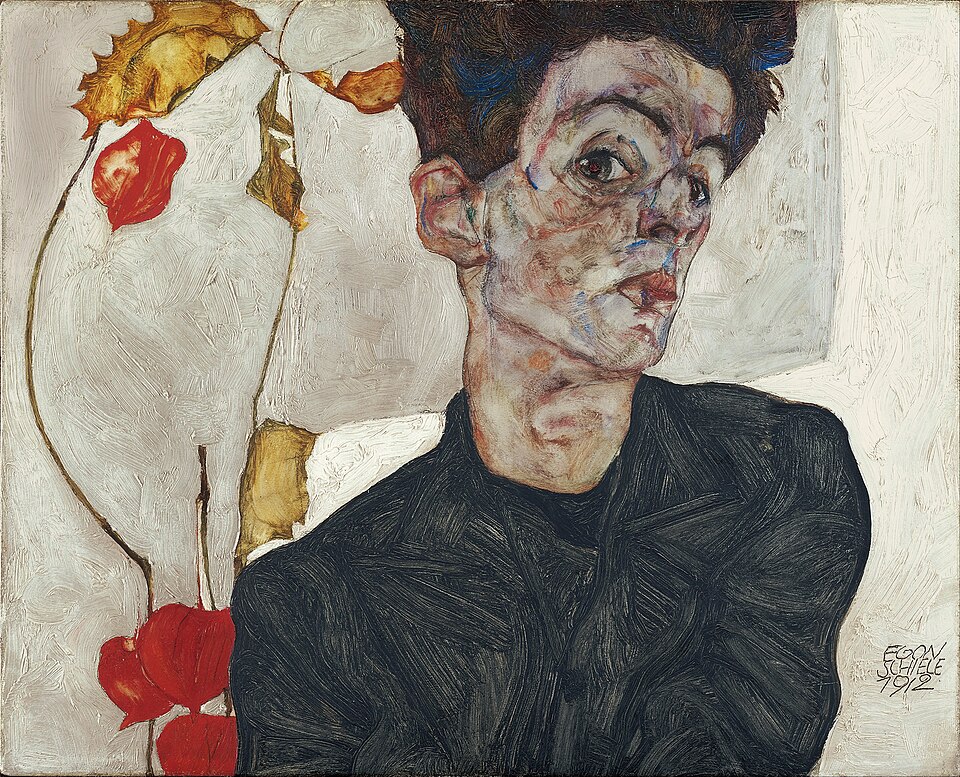
By 1909 Schiele had left the Academy and established his own style. His figures — whether himself in the many self-portraits or his models — are characteristically angular, often underfed-looking, posed in ways that expose rather than flatter. The line is urgent and searching, not smooth. Colour, when used, tends toward raw flesh tones and sickly ochres.
The frank sexuality of some works brought him into legal trouble: in 1912 he was arrested in Neulengbach on charges related to works found in his studio. He served twenty-four days in prison. The experience appears in the series of self-portraits he made in the jail cell.
Art cannot be modern; art is eternally primitive.
Self-portraiture and expressive line
Schiele produced more self-portraits than almost any major artist of the period — studies in which he pushed his face and body into configurations that express psychological states as directly as possible. The works are uncomfortable to look at in ways that Klimt's are not: they remove both the decorative frame and the flattering distance of idealization.
His drawings, often finished works in themselves rather than studies, show a draughtsman working at the edge of what a line can bear. The contour defines not volume but tension.
Legacy
In 1918 Schiele had his first major public success: a retrospective at the Vienna Secession in March that year finally established his reputation with collectors and critics. He died seven months later. His wife Edith had died of influenza three days before him.
The brevity of his career has paradoxically amplified his influence: the whole body of work is compressed, intense, and consistent in its ambition. Expressionism's later manifestations — in Germany, in American abstract expressionism's gestural energy — owe something to the directness he modelled.