El Lissitzky
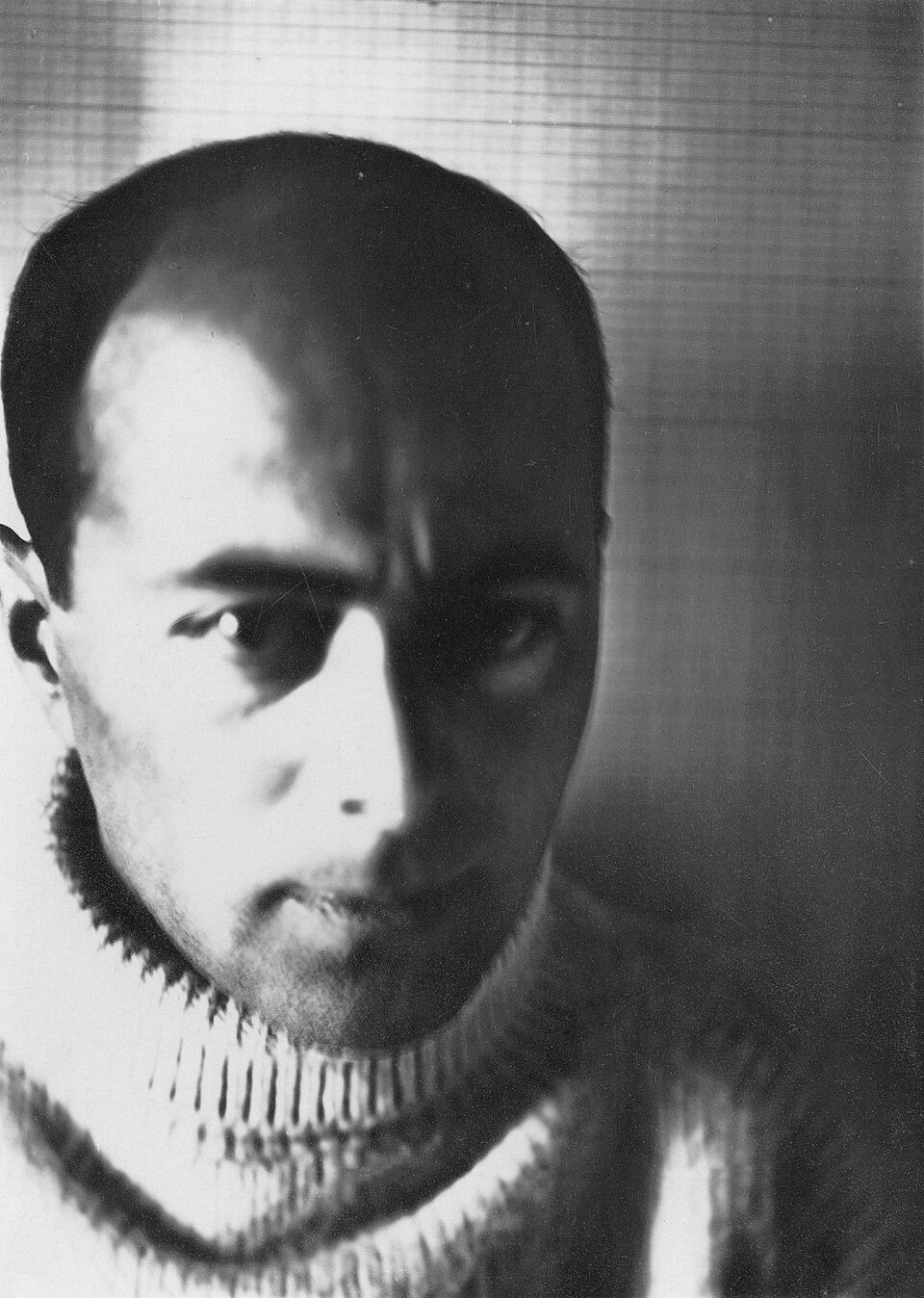
The Soviet avant-gardist who turned the blank page into a field of forces — shaping suprematism, exhibition space, and the grammar of modern graphic design.
El Lissitzky worked at the intersection of painting, architecture, and agitprop, treating each as a variation on a single problem: how to organise space so that it acts on the viewer. In the decade between the Russian Revolution and his withdrawal into tuberculosis, he produced a body of work — posters, exhibition rooms, books, photographs, typographic experiments — that remade the visual language of the twentieth century.
Formation and Vitebsk
Lazar Markovich Lissitzky was born in 1890 in Pochinok, in the Smolensk region of Russia. Unable to enter the Imperial Academy of Arts because of quotas on Jewish students, he enrolled at the Technische Hochschule in Darmstadt, where he trained as an architect. He returned to Russia in 1914 and, after the Revolution, found his way to Vitebsk, where Marc Chagall had established a pioneering art school. When Kazimir Malevich arrived in 1919, Lissitzky came under his direct influence and rapidly converted to suprematism.
The encounter was transformative. Malevich's abstract compositions — squares, crosses, and planes floating in white space — gave Lissitzky a foundation, but he almost immediately pushed past it. Where Malevich made paintings, Lissitzky began to make Prouns: "Projects for the Affirmation of the New," axonometric compositions that treated abstract form as architecture yet to be built. The Proun series, developed from 1919 onward, refused to declare a fixed orientation — they could be read as views from above, below, or the side, dissolving the hierarchy between painting and plan.
Beat the Whites with the Red Wedge
In 1919 Lissitzky produced one of the most recognised works of political graphic design: Beat the Whites with the Red Wedge. A red triangle drives into a white circle against a stark background — an image so compressed in its geometry and so clear in its meaning that it needs no caption. The poster distilled suprematist abstraction into pure visual argument and demonstrated that the new art had practical work to do.
The book is a monument. Its form must speak before its content is read.
Exhibition design and the typographic room
Lissitzky's most enduring influence on design practice came through his exhibition work in Germany during the mid-1920s. Invited to contribute to major shows, he conceived rooms in which the wall itself became a dynamic surface — sliding panels, angled struts, and typographic elements that changed their appearance as visitors moved. The Proun Room (1923) and the Abstract Cabinet in Hanover (1928) treated the exhibition not as a frame for objects but as a total environment.
His typographic experiments — in books like Of Two Squares (1922) — showed how the page could be organised as a spatial field rather than a column of text. These ideas fed directly into Bauhaus typography and, through it, into every subsequent movement in graphic design.
Legacy
Lissitzky spent his final years producing propaganda for the Soviet state, his health increasingly compromised by tuberculosis contracted as early as 1921. He died in Moscow on 30 December 1941. His Proun series, his exhibition rooms, and his typographic radicalism passed into the bloodstream of modern design so completely that their origin is often forgotten.