Eric Gill
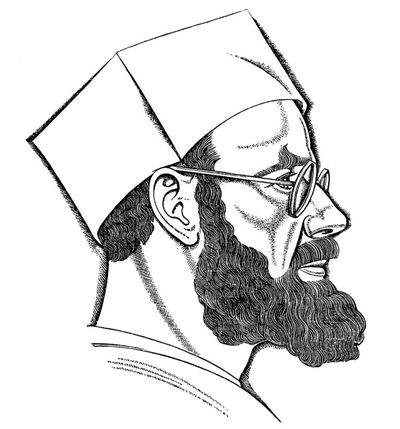
The English letter-cutter whose typefaces remain in daily use worldwide, and whose private life constitutes one of the most disturbing revelations in twentieth-century art biography.
Eric Gill's typefaces — Gill Sans above all — saturated the visual culture of twentieth-century Britain and remain among the most widely deployed letterforms in the world. His sculpture and lettering were equally celebrated in his lifetime. The posthumous disclosure of systematic sexual abuse in his private diaries has made him one of the most contested figures in design history, raising unresolved questions about the separability of work and life.
Formation and early work
Arthur Eric Rowton Gill was born in Brighton in 1882, the son of a Nonconformist minister. He trained under the architect W. D. Caröe before studying lettering under Edward Johnston at the Central School of Arts and Crafts in London — Johnston's influence on his approach to letterform was decisive. Gill set up as an independent letter-cutter in 1903, cutting inscriptions in stone for churches, memorials, and public buildings.
He was a convert to Roman Catholicism (1913) and drew his aesthetic programme from the Arts and Crafts tradition and Catholic social teaching, insisting on the integration of craft, religion, and daily life. In 1913 he co-founded the community of Ditchling, where craftspeople lived and worked together under religious rule.
Typefaces
Gill's contribution to typography rests primarily on three faces. Perpetua (designed from 1925, released 1928–1932) was a roman text face commissioned by Stanley Morison at the Monotype Corporation, derived directly from stone-cut letter forms. Gill Sans (1928) was a humanist sans-serif that modified Johnston's Underground alphabet into a commercially viable face; it was adopted by the LNER railway and became the dominant British sans-serif of the mid-century, used by Penguin Books, the BBC, and British Rail among hundreds of others. Joanna (designed 1930, initially for private use) was a transitional face for book text.
Letters are things, not pictures of things.
Sculpture and controversy
As a sculptor Gill produced significant public commissions, including the Stations of the Cross in Westminster Cathedral (1913–1918) and carvings for the BBC's Broadcasting House and the League of Nations buildings in Geneva. The Oxford Dictionary of National Biography described him as the greatest artist-craftsman of the twentieth century.
The biographer Fiona MacCarthy's 1989 life disclosed, from his own diaries, that Gill had sexually abused his daughters and his sister. The revelations did not destroy his reputation as a craftsman but permanently altered its frame. Institutions using Gill Sans have periodically debated whether to continue doing so; no consensus has emerged. His work stands as a canonical problem in the ethics of art reception.