Eugène Delacroix
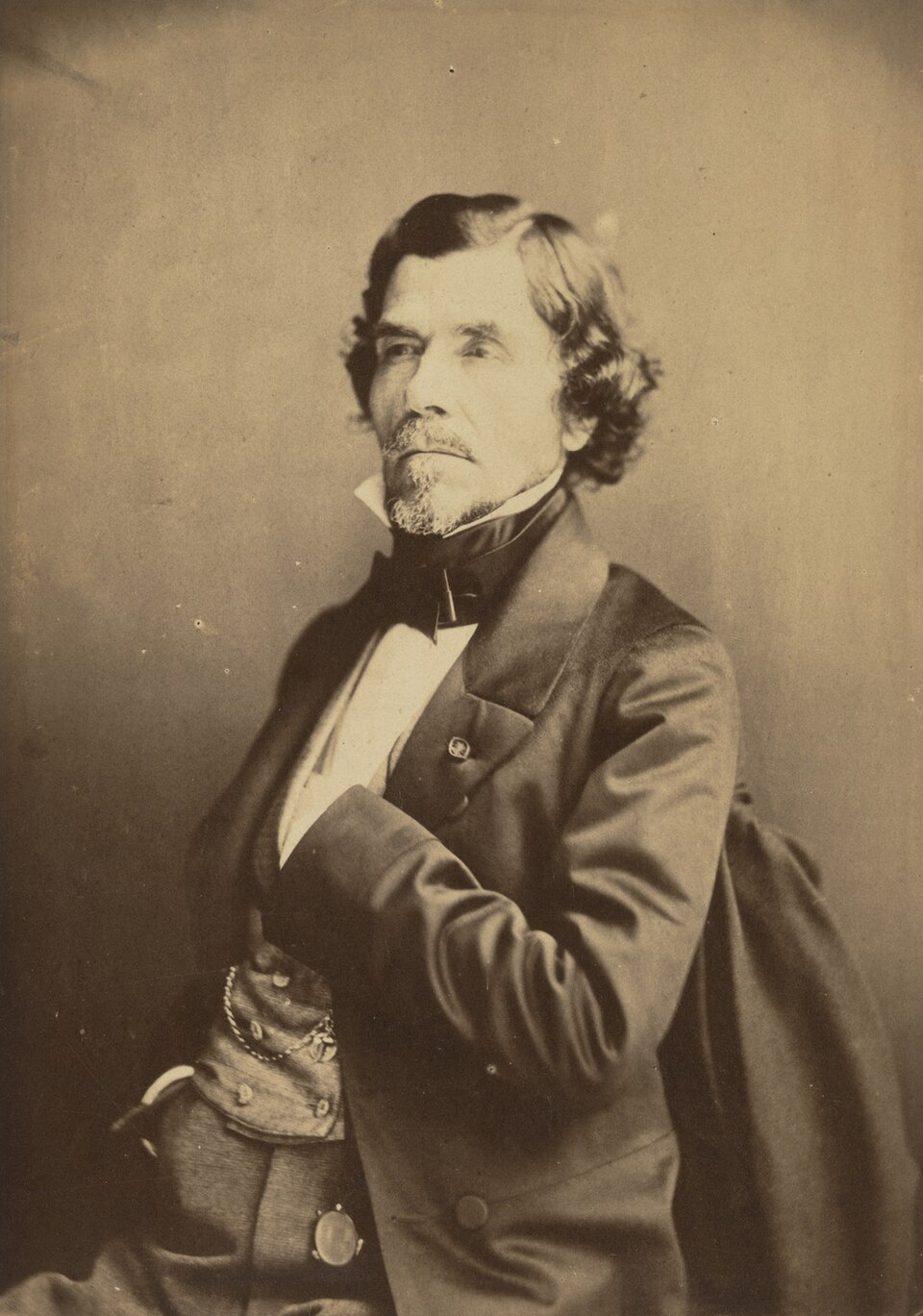
The uncontested leader of French Romanticism, who made colour and movement the primary instruments of historical and emotional truth in painting.
Ferdinand Victor Eugène Delacroix was the pre-eminent painter of French Romanticism and one of the most influential figures in the history of Western painting. Where the Neoclassicists led by Ingres prioritized line and sculptural form, Delacroix answered with colour, dynamic brushwork, and a dramatic range of subject matter drawn from literature, history, contemporary politics, and his own travels in North Africa. His influence ran directly into Impressionism, Post-Impressionism, and beyond.
Early life and the Salon debut
Delacroix was born on 26 April 1798 in Saint-Maurice (now part of Charenton-le-Pont), near Paris. His official father was Charles Delacroix, a diplomat; there has been long speculation, never conclusively settled, that his biological father was the statesman Talleyrand. He entered the studio of Pierre-Narcisse Guérin in 1815 alongside Géricault, whose epic Raft of the Medusa (1819) exercised a decisive influence. Delacroix's own Salon debut came in 1822 with The Barque of Dante, which was bought by the French state and announced a talent equal to any ambition.
The Massacre at Chios (1824) and Death of Sardanapalus (1827) deepened his reputation as a painter of violent, chromatic force — works that disturbed academic taste precisely because they could not be dismissed as incompetent. The Neoclassicist critic Étienne-Jean Delécluze called The Death of Sardanapalus "a massacre of painting"; the public disagreed.
Liberty Leading the People and public recognition
The July Revolution of 1830 produced Delacroix's most celebrated work. Liberty Leading the People — an allegory in which a bare-breasted personification of Liberty strides across barricades over fallen bodies, flanked by a top-hatted bourgeois and a street boy — fused the contemporary and the mythic in a way the French state immediately recognized. It was purchased by the government, briefly exhibited, then removed as politically too incendiary. It entered the Louvre's collection permanently in 1874.
The 1830s brought major mural commissions: the Salon du Roi at the Palais Bourbon (1833–37), the library of the Palais Bourbon (1838–47), the library of the Palais du Luxembourg (1840–46), and the central ceiling of the Louvre's Galerie d'Apollon (1851). These large-scale decorative cycles confirmed Delacroix as the inheritor of Rubens's tradition of heroic painted space.
North Africa and late work
In 1832 Delacroix accompanied a diplomatic mission to Morocco and Algeria. The six months he spent there transformed his palette and his understanding of colour in direct sunlight. Women of Algiers in their Apartment (1834), exhibited at the Salon to general admiration, distilled what he had seen into a work of sustained chromatic complexity and unusual intimacy. He returned repeatedly to North African subjects for the rest of his career.
Delacroix kept a journal from 1822 until a few weeks before his death; the surviving text, published posthumously in 1893, constitutes one of the most searching records of the artistic mind in the nineteenth century. He died in Paris on 13 August 1863. His studio was found to contain some 9,000 works.
What moves those who are not moved by colour alone has already been moved by it without knowing it.